
Artist / Band
Porcelain Forehead
Biography
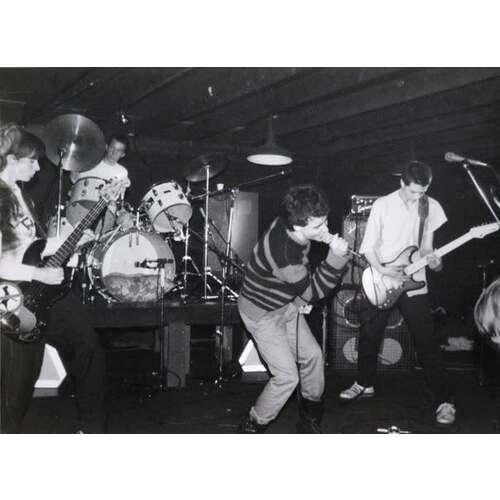
Porcelain Forehead were one of the most distinctive groups to emerge from Ottawa’s early-1980s punk underground, combining the raw economy of first-generation punk with the increasing speed of hardcore, angular rhythms, occasional funk influences, political commentary and a streak of absurdist humour that prevented them from fitting comfortably within any single category. During an original lifespan of barely three years, they released the independent Right Now! – The World Needs A Clear Head EP, appeared on several important Canadian and international compilations, toured through Ontario, Quebec and the northeastern United States, shared stages with bands including M.D.C., the Butthole Surfers, the Minutemen and Dead Kennedys, and recorded a full-length album that would remain unreleased until 1993. Their brief existence nevertheless left an unusually rich documentary trail through records, cassettes, fanzines, photographs and live recordings, much of which survived because Ottawa’s punk community was consciously documenting itself while it was happening.
Porcelain Forehead emerged directly from the overlapping personnel and friendships of Ottawa’s early punk scene, with particularly strong roots in Angry Raisins and Forbidden Fruit. Singer Mike Hillis brought the longest personal connection to punk into the group. Growing up in Windsor, Ontario, he was drawn toward the emerging movement after buying Patti Smith’s Horses in 1975 on the recommendation of schoolmate and future Creem editor Mark Norton. Hillis subsequently fronted the early Windsor band Dry Heaves, playing at Vincent Massey Secondary School on April 28, 1978, before moving to Ottawa and singing with Tainted Meat and then Angry Raisins. Guitarist Chris McLellan had also been a member of Angry Raisins and had earlier played with Red Menace, making Porcelain Forehead in part a direct continuation of relationships established within the earlier band. McLellan and drummer Ian Seabrook, meanwhile, had played together in Forbidden Fruit with singer Brian Bunt, himself the guitarist in Angry Raisins during much of that band's brief existence.
When Bunt left Forbidden Fruit in 1982, he suggested that Hillis try singing with the remaining musicians in suburban Nepean, effectively creating another link between the two earlier groups and what would become Porcelain Forehead. Hillis later remembered approaching the rehearsal with little expectation that anything serious would result; the players were younger than he was, and he was unsure whether their musical instincts would connect. Within a couple of hours, however, they had created several songs and found enough common ground to continue. With Bruce Stevenson on bass, the first Porcelain Forehead lineup was established: Mike Hillis on vocals, Chris McLellan on guitar, Bruce Stevenson on bass and Ian Seabrook on drums.
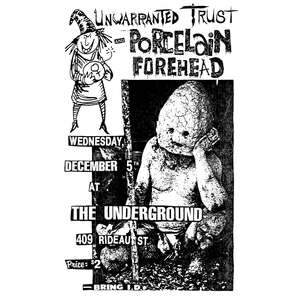
Contemporary issues of Ottawa’s No Cause for Concern? fanzine document the group almost from its formation, placing Porcelain Forehead within a particularly active local network that included bands such as Civil Terror, Unwarranted Trust, Raw Sewage, Honest Injun, Last Prayer and Youth Youth Youth. Organizations such as Youth Culture Promotions booked shows and helped create opportunities for bands that had little or no access to the conventional music industry, while fanzines, college radio and cassette compilations provided the means by which recordings and information travelled beyond the city.
Porcelain Forehead’s earliest performances already demonstrated how difficult the band would be to classify. Their own later description of the music as “original, high-energy punk” is probably more useful than trying to force them retrospectively into a narrowly defined hardcore category. Hillis’s frenetic vocal delivery gave the group considerable aggression, but the instrumentation frequently behaved in less predictable ways. Stevenson’s bass could become an active melodic and rhythmic voice, McLellan’s guitar often favoured jagged figures over conventional rock playing, and Seabrook’s drumming allowed the songs to accelerate, stop, twist and change direction without losing their internal momentum.
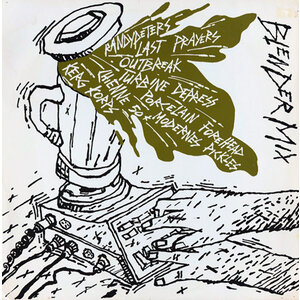
In 1983, Porcelain Forehead made their first appearance on vinyl with ‘The Gameshow Riff’ and ‘Keepsake’ on Blender Mix, a compilation bringing together bands from Ottawa and Quebec City through a collaboration between Youth Culture Promotions and Productions sans nom. The compilation served as an early document of a regional underground that was increasingly connected across provincial boundaries.
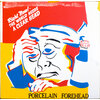
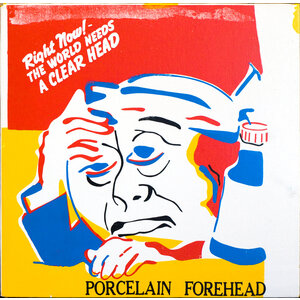
Later that year the band issued its own six-song EP, Right Now! – The World Needs A Clear Head, on Corpus Callosum Records. Recorded at Ambience Recorders and engineered by Phil Bova, the EP contained ‘That Number Again Folks’, ‘Q’, ‘How High?’, ‘Human Torch’, ‘Unfinished Porch’ and ‘Gleaning Ground’. Much of the record was captured with the immediacy of a live band in the studio; Hillis later recalled redoing the vocal for ‘Human Torch’ because the original take did not sound sufficiently raw.
The physical record was as uncompromisingly independent as the music. The original run consisted of approximately 1,000 copies, housed in thick cardboard sleeves with silkscreened artwork and accompanied by a foldout insert crowded with handwritten lyrics, political imagery, cartoons, altered advertisements, photographs and visual jokes. Rather than presenting a polished commercial image, Porcelain Forehead treated the packaging almost as an extension of a punk fanzine, allowing political satire, consumer imagery, religious references and absurdist humour to collide on the printed page.
Contemporary reviews confirm that the band’s stylistic ambiguity was evident immediately. One 1983 review praised the improved studio sound over the earlier Blender Mix recordings and observed that Porcelain Forehead could move from slower, sleazy funk riffs into outright thrash, sometimes within the same composition. Another contemporary review described them as “genuine garage punk from north of the U.S. border,” but likewise noted bursts of thrash in ‘How High?’ and ‘Gleaning Ground’, along with the deliberately disjointed character of ‘Q’. The same review emphasized the critical nature of the lyrics. These different descriptions are revealing: even listeners encountering the band in real time could hear several strands operating at once.
The lyrics were an equally important part of Porcelain Forehead’s identity. Hillis wrote from a position of political frustration without reducing the songs to slogans. Corporate power, American militarism, televangelism, consumer culture, environmental contamination and the broader absurdities of modern North American life all appeared, but humour, paranoia and deliberate exaggeration frequently destabilized whatever message might otherwise have seemed straightforward.
Hillis later summarized the band’s attitude in a 1983 fanzine response reproduced on the Frog Boy Lives insert: “Our band is angry, sometimes my lyrics may seem unfocussed, but that’s a reflection of anger.” He went on to describe the difficulty of balancing political seriousness with humour and his desire to challenge the stereotype of punk as mindless or nihilistic. Porcelain Forehead wanted to remain abrasive without becoming inaccessible for its own sake; the objective was not simply to entertain people who already agreed with them, but to provoke thought in listeners beyond the immediate punk audience.
An important moment came on July 16, 1983, when Porcelain Forehead appeared with M.D.C., Civil Terror and Unwarranted Trust. Contemporary coverage in No Cause for Concern? described the band’s performance as particularly intense and reported that M.D.C. were impressed enough to offer assistance distributing Porcelain Forehead’s forthcoming EP. It was exactly the sort of informal relationship through which the North American punk underground functioned: bands introduced one another to promoters, traded records and contacts, stayed in one another’s homes and helped recordings circulate without the infrastructure of the commercial music business.
The DIY nature of that system is illustrated perfectly by one of Hillis’s later recollections. His Aunt Marjorie in Michigan reportedly paid the postage required to send approximately 200 copies of Right Now! to Rough Trade Records’ California operation. Rough Trade experienced difficulties around the same time, and Porcelain Forehead never discovered what became of the shipment. For a record pressed in only a thousand copies, the possible disappearance of roughly one-fifth of the pressing into the independent distribution network is a remarkable piece of punk-era history.
Porcelain Forehead also took the music on the road. Hillis documented one particularly chaotic excursion in No Cause for Concern? under the title ‘On the Road with Porcelain Forehead’, describing cancelled bookings, border difficulties, borrowed amplifiers, strangers’ floors and the precarious logistics familiar to independent punk bands of the period. The trip moved through southern Ontario and into the United States, including stops around Windsor, London, Kent, Akron and Cleveland. During the journey the band wrote ‘Cold Steak’, rehearsed it quickly and performed it almost immediately, an example of the spontaneity with which its repertoire continued to develop.
The touring experience also placed Porcelain Forehead within a much broader North American punk network. They shared stages during their original existence with M.D.C., the Butthole Surfers, the Minutemen and other touring underground groups, while compilations allowed the music to travel still farther than the band itself.
The first lineup changed in August 1983, when Ian Seabrook played his final show with Porcelain Forehead at the Roxy on Elgin Street. Geordie Allen subsequently became the drummer, joining Hillis, McLellan and Stevenson for the group’s second phase. Seabrook remained active in the punk community and later played with groups including Snuff Maximus and Deep Six.
With Allen behind the kit, Porcelain Forehead became increasingly represented on the international compilation circuit. Their song ‘Will Amerika’ appeared on the landmark 1984 International P.E.A.C.E. Benefit Compilation released by R Radical Records in conjunction with Maximumrocknroll. The double album assembled dozens of punk bands from around the world in support of anti-nuclear and peace activism, placing Porcelain Forehead alongside artists including Dead Kennedys, Crass, Subhumans, D.R.I., Reagan Youth, M.D.C. and the Butthole Surfers.
‘Cold Steak’ appeared on the 1984 Montreal compilation Primitive Air-Raid, while other recordings circulated through cassette culture. ‘Mary Tie Your Mutant Down’ appeared on CKCU 93.1’s Ottawa Cassettera Vol. 1: The Cassingles Collection; ‘The Gameshow Riff’, ‘The Viewing’ and ‘Gnawin’ On... (Neurotic Song)’ appeared on Stephen Perry’s Ontario: Yours To Discover; and ‘In Our Inaction...’ appeared on Ken Rentner’s Does Anyone Here Know How To Tune A Guitar?. The scattered nature of these appearances helps explain why Porcelain Forehead’s recorded legacy remained difficult to assemble for many years.
In February 1985, the Hillis-McLellan-Stevenson-Allen lineup entered the studio to record what was intended to become the band’s full-length album. The sessions took place at Ambience Recorders in Kemptville, Ontario, with Porcelain Forehead and Pig Dog Dave producing and Phil Bova engineering. The tapes were originally mixed at Ambience in Ottawa. Plans apparently existed for the album to be released through Alternative Tentacles, but the record never appeared during the band’s lifetime.
Before the album situation could be resolved, Porcelain Forehead reached the end of their original run. On April 23, 1985, they appeared at the Palladium in Montréal opening for the Dead Kennedys, on a bill that also included D-Ploy and Genetic Control. Hillis later remembered an audience of approximately 1,200 people. The date carried an additional personal significance for him, occurring almost exactly seven years after his first punk performance with the Dry Heaves at his Windsor high school.
The Montréal appearance became Porcelain Forehead’s final original-era concert. Chris McLellan subsequently left for India, and the band ceased performing.
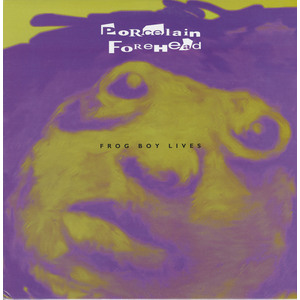
The unreleased 1985 recordings, however, survived. In 1993, Frank Manley, known for his work documenting Canadian punk through Smash the State, issued the material as Frog Boy Lives on No Exit Records. The tapes required considerable post-production work before release, eventually being salvaged by Rob Sanzo at Number Nine Sound in Toronto with assistance from Josh Joudrie. The resulting thirteen-song LP finally documented the music Porcelain Forehead had been creating during its final period, eight years after the band itself had disappeared.
The album’s elaborate packaging continued the visual language established by the earlier EP. Geordie Allen was responsible for the cover artwork, while Mike Hillis assembled the densely packed insert combining lyrics, collage, political imagery, found material and commentary. Included among those materials was Hillis’s 1983 statement explaining the group’s attempt to balance anger with humour and to challenge perceptions of punk as inherently nihilistic.
The delayed appearance of Frog Boy Lives also demonstrated that Porcelain Forehead’s concerns had not aged as rapidly as might have been expected. Although the songs emerged from the political climate of the early Reagan era, their anxiety about corporate power, militarism, environmental danger, media manipulation and social conformity extended beyond the specific circumstances of 1983–85. The band’s tendency to approach those issues through black humour rather than rigid ideology helped preserve their effectiveness.
Evidence also gradually emerged that Porcelain Forehead’s recordings had travelled considerably farther than the band probably realized. Ian MacKaye, whose work with Minor Threat and Fugazi became central to North American independent music, later recognized Porcelain Forehead when asked about them by Nardwuar and remembered their record as part of the larger constellation of music that had reached him during the period.
An even stranger acknowledgement came years later when an archived Chart magazine survey of the Top 100 Canadian Singles of All Time placed Porcelain Forehead’s ‘Right Now’ at No. 87. The precise value of any ranked list is debatable, but the appearance itself is remarkable: an independently produced Ottawa punk record with an original pressing of approximately one thousand copies had remained sufficiently present in Canadian musical memory to appear among nationally recognized recordings decades later.
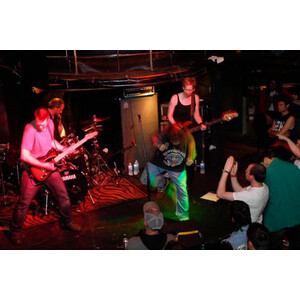
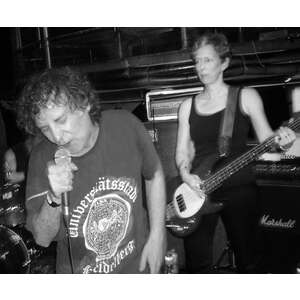
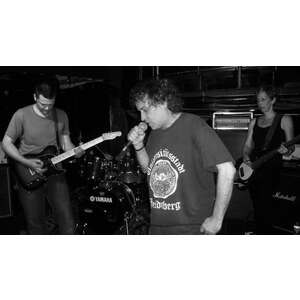
Porcelain Forehead’s story acquired an unexpected second chapter in June 2009, when Hillis, McLellan, Stevenson and original drummer Ian Seabrook rehearsed together for the first time in approximately twenty-seven years. Stevenson ultimately did not continue with the live reunion, and Janine Frenken, formerly of fellow Ottawa punk group Unwarranted Trust, took over on bass.
The reunion lineup of Mike Hillis, Chris McLellan, Ian Seabrook and Janine Frenken returned publicly at Ottawa’s Dominion Tavern on March 20, 2010. The show drew longtime followers as well as listeners who had discovered the group retrospectively through reissues and underground music collecting.
Only weeks later, Porcelain Forehead opened for Jello Biafra and the Guantanamo School of Medicine in Ottawa and Toronto. The connection was particularly fitting: almost twenty-five years earlier, their final original-era performance had been opening for Biafra with the Dead Kennedys in Montréal.
The reunion also returned the original Right Now! – The World Needs A Clear Head material to circulation, while the band continued with selected performances rather than attempting to recreate a full-time touring career. They appeared at Pouzza Fest in Montréal in 2011 and 2012, extending a history that had once seemed permanently closed in 1985.
Porcelain Forehead’s importance within Canadian punk is therefore difficult to measure simply by counting records. Their original catalogue was small, their career brief, and their full-length album did not appear until years after they had ceased to exist. Yet those limitations are themselves characteristic of the period in which they worked.
The band belonged to a Canadian underground in which musicians, promoters, fanzine writers, college-radio programmers, independent labels and audiences collectively created the infrastructure necessary for music to exist outside the conventional industry. Youth Culture Promotions could organize the show, No Cause for Concern? could document it, CKCU could circulate the recordings, another band could provide a place to sleep, an international compilation could carry an Ottawa song overseas, and somebody’s aunt could finance the postage necessary to send records across a continent.
Porcelain Forehead took full advantage of that freedom. They absorbed first-generation punk, emerging hardcore, garage rock, angular rhythm, political theatre and absurdist humour without feeling obligated to choose between them. Contemporary reviewers heard garage punk, thrash, funk and disjointed experimental passages because all of those elements were genuinely present.
What ultimately held the music together was not a genre but an attitude: political anger tempered by humour, nervous energy, curiosity, irreverence and a refusal to accept that punk itself should become another fixed set of rules.
For a group that existed for only three years, Porcelain Forehead left an unusually persistent trail. Their recordings survived on seven-inch vinyl, obscure cassette compilations, an international peace benefit, a belated LP and, decades later, digital archives and reunion performances. What began in suburban Nepean with a rehearsal that Mike Hillis did not expect to lead anywhere became a small but enduring part of Canadian punk history.
Porcelain Forehead did not simply fit themselves into punk. They used its freedom to make something distinctly their own.
-Robert Williston
Tracks
21 tracks
Blender Mix comp (1983)
2 tracks
-
Gameshow Riff
-
Keepsake
-
That Number Again Folks
-
Q
-
How High?
-
Human Torch
-
Unfinished Porch
-
Gleaning Ground
Frog Boy Lives (1993)
Showing 10 of 13 tracks
-
Great Guns!
-
This, Not a Test
-
The Gameshow Riff
-
Candies
-
The Viewing
-
Blanket Statement
-
Mary Tie Your Mutant Down
-
In Our Inaction...
-
Gnawin' On...(Neurotic Song)
-
Gleaning Ground
Discography
Featured Titles
Albums
Singles
Compilation Tracks
Gallery
Images
20 images
View All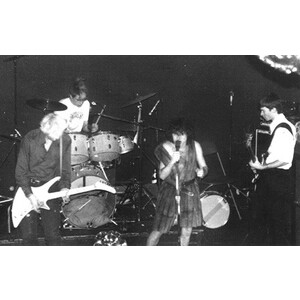
PORCELAIN FOREHEAD 002001
PORCELAIN FOREHEAD 001001
Porcelain Forehead (1)
Porcelain Forehead (2)
Porcelain Forehead (3)
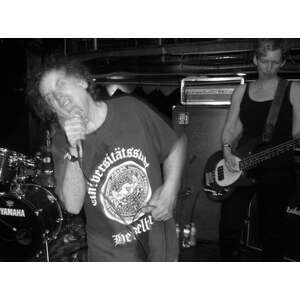
Porcelain Forehead (5)
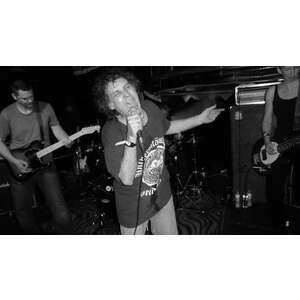
Porcelain Forehead (4)
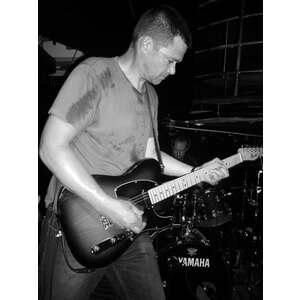
Porcelain Forehead (6)
Media
Videos
0 videos
No videos available for this artist.