Artist / Band
Edward Schweigert

Biography
Edward Gustav “Ed” Schweigert was a prairie old-time fiddler whose life and music moved across the small towns, dance halls, army postings, fiddle contests, and community gatherings of Western Canada. Born on December 22, 1921, on a farm west of Maple Creek, Saskatchewan, he grew up in several southwest Saskatchewan communities, including Murraydale, Princinel, Farewell Creek, and Crossfel. Music came early: by the age of five he was already playing fiddle, and by nine he was performing at dances. His first fiddle reportedly cost seventy-five cents, but it carried him through decades of prairie music-making.
During the Second World War, Schweigert enlisted in the Canadian Army in July 1942 and served at postings including Halifax, Dundurn, Sussex, Fredericton, and Regina before his discharge in 1945. While stationed in Halifax, he had a memorable encounter with Don Messer and His Islanders, meeting members of the group and joining them privately to play “Don Messer’s Breakdown” and other tunes. After the war, he and his wife Florence “May” Schweigert returned west, farming near Crossfel before settling in Maple Creek, where Ed worked for the Canadian Pacific Railway and later as a mechanic.
Schweigert’s musical life remained rooted in the old-time dance tradition. He played with groups such as the Cypress Hills Hillbillies, the Walmar Band, and the Alberta 99 Band, and became a familiar figure at dances throughout Saskatchewan and Alberta. By 1969 he was competing seriously in old-time fiddling contests, winning top honours and eventually earning more than thirty-five first-place standings. He also judged contests, supported old-time fiddle organizations in Penticton, Swift Current, and Medicine Hat, and served as a regional director for the Alberta Society of Fiddlers.
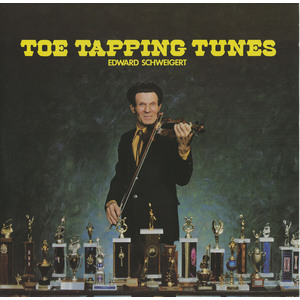
A practical mechanic as well as a musician, Schweigert brought invention into his playing. He built a foot-operated device that strummed a guitar while he played fiddle, taught himself piano, accordion, and guitar, and even built fourteen violins, selling all but one favourite instrument he kept at home. His music was not professionalized in the urban show-business sense; it came from dances, contests, service clubs, family halls, prairie towns, and people asking to hear favourite tunes again. That spirit is exactly what shaped his LP Toe Tapping Tunes, recorded at Soundwest Studios in Calgary and produced by Schweigert himself. The album gathered the kind of waltzes, reels, jigs, and two-steps that had become part of his public repertoire, including “Zenda Waltz,” “Village Carousel Waltz,” “Happy Acres Two Step,” “Maple Sugar,” “Centennial Waltz,” and “Rustic Jig.”
After living for a period in Penticton, British Columbia, Schweigert moved to Medicine Hat, Alberta, in 1976, where he became known locally not only as a fiddler but as a community musician with deep roots in the prairie old-time tradition. He died in Medicine Hat on March 2, 2016, at the age of 94. His obituary remembered him as a well-known local fiddler who enjoyed all aspects of music. For collectors, Toe Tapping Tunes preserves a modest but important document of that world: the sound of a self-taught Saskatchewan-born fiddler carrying old-time music from the farm, the dance floor, and the contest stage into the grooves of a Canadian private-press LP.
-Robert Williston
Tracks
12 tracks
Toe Tapping Tunes (1977)
Showing 10 of 12 tracks
-
Zenda Waltz
-
Village Carousel Waltz
-
Happy Acres Two Step
-
The Television Reel
-
Maple Sugar
-
Debbie's Jig
-
Centennial Waltz
-
You, You, You
-
To Whom it May Concern
-
First Century Reel
Discography
Featured Titles
Albums
Gallery
Images
1 image
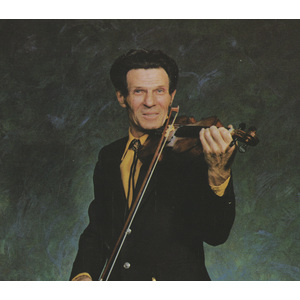
Edward Schweigert
Media
Videos
0 videos
No videos available for this artist.