Artist / Band
Les Bouffons Psychotiques
Biography
Trying to assign an exact beginning to Les Bouffons Psychotiques is almost contrary to the nature of the group itself. The partnership between Max Climax and Christian Psychic stretched back to 1978, when the two first met at school, long before either had thought of turning their shared taste for absurdity into an actual musical project. For years their collaboration consisted largely of evenings spent improvising songs, jokes and increasingly strange performances for their own amusement. According to the duo's own account, an important piece of the eventual puzzle arrived at Christmas 1987 when the still-novice guitarist Max Climax received an inexpensive keyboard from Marc Legrand Musique. Christian Psychic was already accompanying his improvised, cynical monologues on an old guitar, and the following year the pair composed what they regarded as their first properly "bouffon" song, 'Perpendiculaire', inspired by an especially tedious mathematics class.
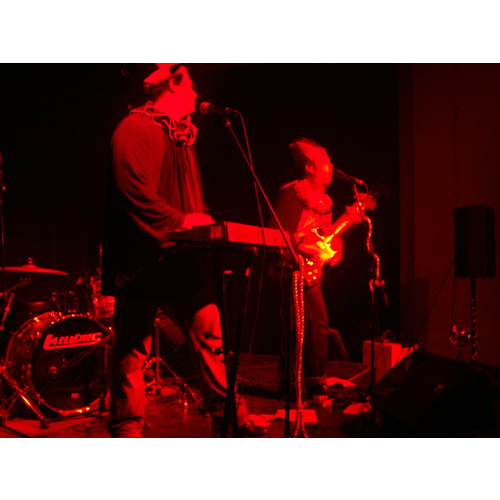
The music continued to develop informally through the following decade. What had begun as two friends entertaining themselves gradually accumulated enough songs, characters and purpose to become something more deliberate. In 1997 they finally attached the name Les Bouffons Psychotiques to the project, while contemporary accounts place the recognizable performing incarnation of the duo around 1998-99. Their adopted identities were an essential part of it. Christian Psychic handled guitar and vocals while Max Climax supplied vocals and keyboards, but the two were as much characters as conventional band members, building a miniature theatrical world around their music. By October 2001, Quebec weekly Voir was describing them as a duo playing biting new wave while dressed as clowns, with songs generally sung in French but occasionally venturing into English and Spanish. Christian explained that the repertoire had grown almost accidentally out of years of parties in which the two had sung simply to fool around until, almost despite themselves, some genuinely good songs began to emerge.
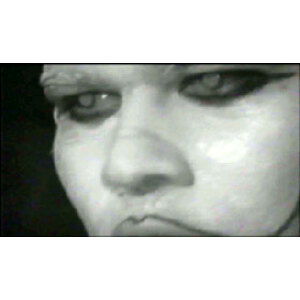
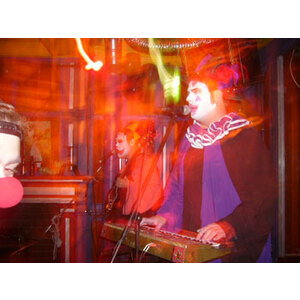
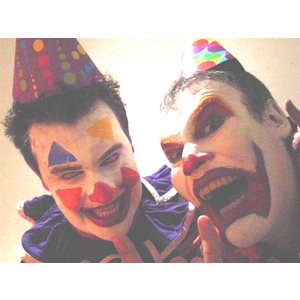
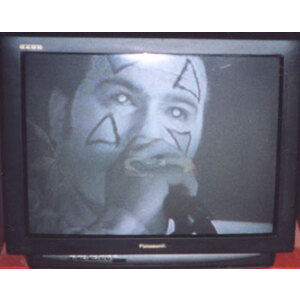
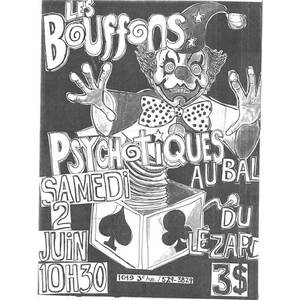
The clown imagery was never merely decoration. Les Bouffons Psychotiques treated performance as an invitation to step outside normal behaviour, using exaggeration, cynicism and absurd humour to poke at social conventions and the musical establishment. In their own telling, the project had become a jovial but pointed response to corruption, narrow-mindedness within the record industry and artistic standards imposed from above. The pair performed around Quebec City in bars and at assorted arts events, cultivating a presentation in which cheap electronics, guitar, theatrical costuming and apparently uncontrolled humour were all parts of the same thing. For an October 27, 2001 Halloween appearance at the Bal du Lézard, they encouraged the audience to arrive in costume and even offered a prize for the most outrageous clown outfit. Christian nevertheless insisted that theirs was not Halloween music; the clown simply provided a useful means of bringing the audience into the peculiar universe the duo had already created.
Musically that universe was considerably broader than the new-wave tag suggested. The synthesizers and deliberately synthetic textures carried an obvious debt to the 1980s, but the songs refused to remain inside any one style. When Voir returned to the group in 2006 it described a mixture embracing reggae, ska, polka, bossa nova, garage punk, new wave and French chanson, with cynicism and mockery functioning almost as musical ingredients in their own right. That stylistic restlessness was particularly suited to songs with titles such as 'Télévision-Guitare-Girafe', 'Psychique-Cosmique', 'Une Vie De Pilules' and 'Le Cimetière À Jamais Non Pas', pieces in which nonsense, satire and everyday observation could collide without any obligation to resolve themselves into something sensible.
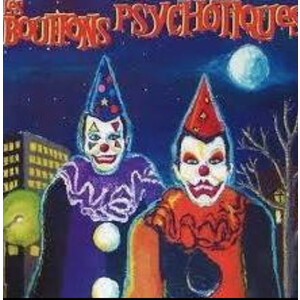
The partnership nearly destroyed itself just as the group was becoming established. At the end of 2001, Max Climax and Christian Psychic suffered what their own wonderfully unreliable press biography characterized as an "aneurysm rupture and abominable chaos." A serious falling-out followed, complete in their account with shouted obscenities, and the two ceased speaking for almost a year. Their self-titled Les Bouffons Psychotiques CDr appeared in 2002, gathering thirteen songs including 'Face À La Mort', 'Bouffon Psychotique', 'Névrosse À L'Affût', 'Télévision-Guitare-Girafe', 'Chez Jean', 'Une Vie De Pilules', 'La Différence D'Un Jour' and 'Et Je M'En Foutais...'. The independently issued album remains the central recorded document of the group's early period and captured the collision of primitive electronics, guitar, melody, spoken and sung vocals and blackly comic lyricism that had grown out of those years of private improvisation.
By 2003 the quarrel had exhausted itself. As the pair later put it, the two "idiots" finally swallowed their pride and telephoned one another, an event their mythology embellished with broken glass, revolver shots and a massacre by jigsaw. Behind the comic exaggeration was a genuine reconciliation, and Les Bouffons Psychotiques returned to performing. They were still active in March 2006, when Max Climax and Christian Psychic appeared at Le Scanner in Quebec City for another characteristically unruly performance. Voir noted that the two had already known one another for roughly two decades and treated their unpredictable stylistic mixture as one of the group's defining qualities rather than a novelty that had worn off.
Nor did the group simply vanish with the end of that first phase. Les Bouffons Psychotiques remained connected to Quebec City's independent scene, including an appearance with Les Goules and Spacemak3r during the Festival OFF in July 2012. Their recordings also began developing a second life outside their original homemade context. 'Chez Jean' was selected for the soundtrack of Edgar Fritz's independent Quebec feature Limoilou, which premiered at the Festival de cinéma de la ville de Québec in 2014 before receiving a theatrical release that November. The film, itself rooted in the creative underground of Quebec City's Limoilou neighbourhood, was an unusually appropriate home for a song from a group whose own history had been built around that same local culture of do-it-yourself music and eccentric artistic independence.
The album continued circulating beyond Quebec as well. In February 2023, American free-form station WFMU included 'Chez Jean' in its programming, with the host directing listeners toward the complete record and a surviving 2001 live performance. More than twenty years after its original CDr appearance, music that had begun with two Quebec school friends improvising for their own amusement was still finding listeners well outside the circle for which it had originally been made.
The strangest turn in the story may be that Les Bouffons Psychotiques eventually became a vinyl band after all. In 2025, more than two decades after their self-titled CDr, the group issued the five-song 12-inch EP Sparx. Its tracks — 'Wake Up', 'El Payasa Malo', 'Robots Violents', 'Qui Suis-Je?' and 'Choc Après Choc' — showed that the Bouffons name had survived well beyond its turn-of-the-century Quebec City origins, while contemporary postings from the group and a Quebec City record-store launch placed the project firmly back in circulation. The release was appropriately classified as both new wave and punk, two useful labels for music that had spent most of its existence cheerfully refusing to respect labels in the first place.
From a boring mathematics class to clown costumes, cheap keyboards, broken friendships, reconciliation and an improbable return on vinyl, Les Bouffons Psychotiques followed a trajectory almost perfectly suited to their name. Beneath the deliberately ridiculous mythology, however, lay an unusually durable collaboration between two friends who spent decades turning private jokes, improvised performances and a shared distrust of convention into songs. Their small recorded catalogue occupies an eccentric corner of Quebec City's independent music history: part new wave, part garage punk, part chanson, part theatre and, in the end, very much its own thing.
-Robert Williston
Tracks
0 tracks
No tracks available for this artist.
Discography
Featured Titles
Albums
Gallery
Images
16 images
View All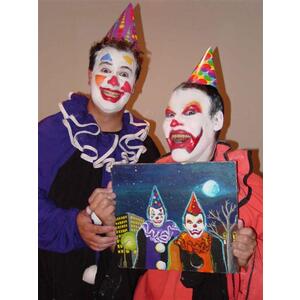
Peinture
bouffon
bouffonsindex
bouffonssouriant
maxbouffons
poster
roujejan2005_1
roujejan2005_3
Media
Videos
2 videos