Artist / Band
Blushing Brides
Biography
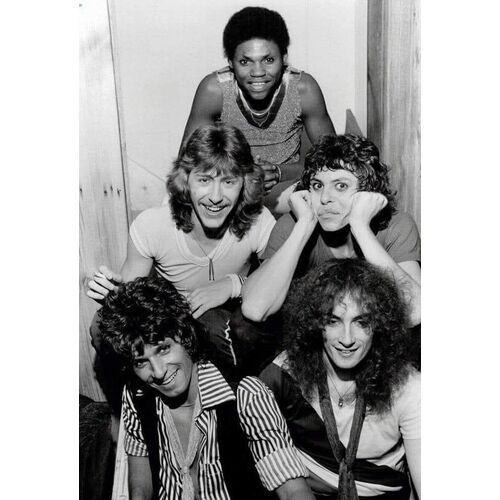
The Blushing Brides emerged at the cusp of the 1980s as one of Canada’s most successful and controversial live rock acts, occupying a unique space between tribute performance, original songwriting, and full-scale major-label ambition. Formed in Ontario in 1979, the band was born not out of irony or nostalgia, but necessity: the long absences between Rolling Stones tours left a devoted audience hungry for the sound, swagger, and visceral experience of classic Stones-era rock ’n’ roll.
The group coalesced around Maurice Raymond, a Montréal-based vocalist with a deep grounding in blues and rock performance, and Paul Martin, a Kingston, Ontario guitarist. Raymond had been fronting a covers band called Jade, performing material by the Stones, Bowie, Dylan, Springsteen, and the J. Geils Band, when Martin approached him in late 1978 with the idea of forming a new group dedicated to capturing the essence of the Rolling Stones’ live power. Joined by guitarist James “DB” Green, bassist Martin Van Dijk, and drummer Richard “Ricco” Berthiaume, the band adopted the name The Blushing Brides and quickly developed a reputation for uncanny authenticity—at a time when tribute bands, as a category, barely existed.
From the outset, the Brides distinguished themselves by combining Stones material with original songs written in the same idiom. As their popularity exploded across Ontario and Quebec, they began drawing crowds in excess of 10,000 at fairs, amusement parks, and large venues. Critics often remarked—half-jokingly, half-seriously—that the Brides sounded closer to the “real” Rolling Stones than the Stones themselves did in that period. Their timing was ideal: the Stones’ absence from the touring circuit, combined with the lack of competing tribute acts, made the Brides a phenomenon rather than a novelty.
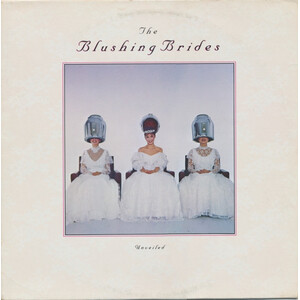
By 1980, the band had become the hottest unsigned rock act in Canada, prompting a major-label bidding war. RCA Records ultimately signed the Brides to a five-year deal, positioning them as a full-fledged recording act rather than a live curiosity. Their debut album, Unveiled, released in 1981, delivered exactly what audiences expected: lean, swaggering rock rooted in blues and R&B, highlighted by the single “What You Talkin’ About,” a track whose Stones-inflected groove brought the band national attention. Additional singles followed, including “Run and Hide” and “Got to Like Yourself,” while the album itself also featured a reworking of Creedence Clearwater Revival’s “Fortunate Son.”
Recognizing the band’s strong following in Quebec, RCA had four tracks re-recorded in French—“Can’t Come Back,” “Lonely Boy,” “Foreign Supplement,” and “Sweet Sister”—and issued them as a four-song EP in 1982. At the same time, the Brides began wrestling with a question that would define their future: whether to lean fully into their Stones-inspired identity or attempt to shed it in favor of an entirely original artistic direction.
That internal tension came to a head during a disastrous tour with Chilliwack. Poor planning, mismatched audiences, and mounting financial strain left the band deeply in debt and fractured over musical direction. By the end of 1982, Raymond and Green were voted out of the group, RCA withdrew support, and plans for a follow-up album were abandoned. Raymond briefly pursued an ill-fated U.S. project (The Lonely Boys), while Green joined Toronto band Perfect Affair, but neither venture gained traction.
The Blushing Brides regrouped in 1983–84, reforming around Raymond, Martin, and Van Dijk, with Richard Diamond stepping into the guitar role, Doug Inglis (ex-Goddo) on drums, and a rotating cast of additional musicians. Over the next several years, the band returned to relentless touring, often playing more than 200 shows a year across eastern Canada and the northeastern United States. Lineups shifted repeatedly—drummers, bassists, and guitarists cycling through as the band struggled to balance sustainability with ambition—but the Brides’ live draw remained strong.
In 1995, Raymond and Martin reunited once again, shortening the name to The Brides and signing with Toronto’s Strawberry Records (distributed by A&M). This lineup—featuring Desmond Leahy (guitar), Glen Olive (bass), Dylan Heming (keyboards), and Sascha Tukatsch (ex–Platinum Blonde) on drums—recorded a self-titled album produced by Mike “Spike” Barlow, with sessions at Phase One and Arnyard Studios in Toronto. The single “Feel Like a Man” followed, and the band returned to the club circuit with a hybrid set blending original material from both eras with their signature Stones repertoire.
Though the Brides once again dissolved shortly thereafter, the legacy endured. In the early 2000s, Raymond revived the original name and concept, billing the band unapologetically as “The World’s Most Dangerous Tribute to the Music of the Rolling Stones.” In this form, the Blushing Brides finally embraced what audiences had always known: that their greatest strength lay not in imitation alone, but in channeling the raw, dangerous spirit of rock ’n’ roll at its most elemental.
Today, the Blushing Brides occupy a singular place in Canadian music history—not merely as a tribute act, but as a band that briefly bridged the gap between bar-band mythology and major-label reality, capturing a moment when swagger, sweat, and volume still mattered more than fashion or irony.
-Robert Williston
Tracks
10 tracks
Unveiled (1982)
10 tracks
-
What You Talkin' Bout
-
Run and Hide
-
Won't be Found
-
Got to Like Yourself
-
Can't Come Back
-
Lonely Boy
-
Foreign Supplement
-
Nasty Boy
-
Sweet Sister
-
Fortunate Son
Discography
Featured Titles
Albums
12"
Gallery
Images
1 image
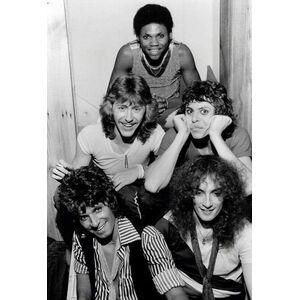
Blushing Brides
Media
Videos
1 video