Artist / Band
Ron Collier Orchestra & Duke Ellington

Biography
Ron Collier was one of the most important architects of modern Canadian jazz. A trombonist, composer, arranger, conductor, and educator, he helped define the country’s postwar jazz language by bridging dance-band professionalism, orchestral discipline, and a distinctly Canadian form of Third Stream experimentation. Born Ronald William Collier on July 3, 1930, in Coleman, Alberta, he received his earliest formal musical training in Vancouver, where he began playing trombone in the Kitsilano Boys’ Band as a teenager before moving east to pursue a broader career in composition and performance. By the early 1950s he was in Toronto, studying composition with Gordon Delamont and quickly establishing himself as one of the city’s most versatile young jazz musicians.
Throughout the 1950s, Collier built a formidable reputation on several fronts at once. He toured with Mart Kenney and His Western Gentlemen, played in Toronto dance bands, and worked extensively as a freelancer with the Toronto Symphony Orchestra, the National Ballet Orchestra, the Canadian Opera Company Orchestra, and numerous CBC radio and television ensembles. That dual life—equally comfortable in jazz clubs and formal orchestral settings—became central to his identity. It also placed him at the centre of the developing conversation around jazz composition in Canada, where musicians such as Collier and Norman Symonds were beginning to imagine a music that could move freely between improvisation and concert hall structures.
By the middle of the decade, Collier had formed his own ensembles, first leading a piano-less quartet from 1954 to 1957, then expanding into a quintet and, in later years, increasingly larger groups. His quintet became one of the defining small groups in Canadian jazz at the time, appearing at the Stratford Festival and serving as a vehicle for his own increasingly sophisticated writing. A key early milestone came in 1957, when the Ron Collier Jazz Quintet joined the CBC Symphony Orchestra under Victor Feldbrill for a broadcast transcription of Norman Symonds’ Concerto Grosso for Jazz Quintet and Symphony Orchestra, with Collier’s own composition ‘Quintet’ occupying the reverse side. That release remains one of the clearest surviving documents of Canada’s early Third Stream movement, and Collier’s role in it was central rather than peripheral. He was not merely a featured soloist—he was one of the composers and ensemble leaders helping invent the form in real time.
The early 1960s saw Collier deepen that reputation. In 1961 and 1962, he became the first jazz composer to receive a Canada Council grant for advanced study, using it to study in New York with George Russell and Hall Overton. Russell’s Lydian Chromatic Concept and Overton’s orchestration methods sharpened Collier’s already distinctive sense of space, colour, and structural balance. Those studies were pivotal. They helped turn an already gifted arranger into a fully mature composer whose work could move confidently from small-group jazz to large ensemble writing, orchestral settings, film, television, and hybrid forms involving narration and spoken word.
At the same time, Collier’s own groups continued to evolve. A 1962 CBC transcription release, Jazz from Canada Programs 7 and 8, documented the Ron Collier Quintet performing original pieces including ‘Weary,’ ‘Blue Boy,’ and ‘Blues on One Theme,’ capturing the group at a moment when Collier’s writing was becoming leaner, cooler, and more compositionally ambitious. Another 1962 CBC Radio Canada issue paired the Ron Collier Septet with the Gordie Fleming Group, further demonstrating his movement toward expanded instrumentation and more elaborate ensemble textures. By 1964, that growth culminated in the superb Ron Collier Tentet on Canadian Talent Library, one of the most revealing albums of his early career. Combining originals such as ‘Walking Out,’ ‘Lee’s Lament,’ ‘Relaxin’,’ and ‘Just About Now’ with highly individual arrangements of standards and film themes, the LP showcased Collier’s gift for unusual voicings, strong brass writing, and a cool, spacious modernism that sat comfortably beside the best contemporary jazz being made anywhere in North America. With Guido Basso, Fred Stone, Ed Bickert, Bernie Piltch, Mort Ross, Bill Britto, and Archie Alleyne among the personnel, the record also doubles as a snapshot of Toronto’s top-tier jazz scene in the mid-1960s.
Collier’s stature as a composer and arranger continued to rise through the 1960s. Alongside his small- and medium-group work, he became a major force in large ensemble writing and broadcast production. He wrote for CBC and CTV, for industrial films, and for the stage, and increasingly embraced ambitious hybrid works that fused jazz with narration, theatre, and orchestral form. Among these were The City (1960), Hear Me Talkin’ To Ya (1964), and Carneval—also encountered as Carnival—a large-scale 1969 work with a libretto by Gwendolyn MacEwen, premiered by Collier’s orchestra with Bruno Gerussi as narrator and Fred Stone as flugelhorn soloist. He also composed for the ballet Aurora Borealis, and his 1965 chamber-orchestral work Waterfront, Night Thoughts was recorded by Robert Aitken. These projects reveal how far Collier’s imagination had moved beyond conventional bandleading: he was building a body of work that belonged as much to Canadian concert music and broadcast culture as it did to jazz.
Expo ’67 marked another important public peak. The official CBC Expo ’67 transcription Au Pavillon Du Canada / At the Canadian Pavilion captured the Ron Collier Jazz Orchestra performing at Montreal’s Canadian Pavilion, documenting him in full big-band command on one of the most visible national stages of the era. By this point, the progression from quartet to quintet to tentet to orchestra was complete. Collier had become one of the country’s premier jazz orchestrators, equally at home writing for tight small-group interplay or expansive brass-and-reed architecture.
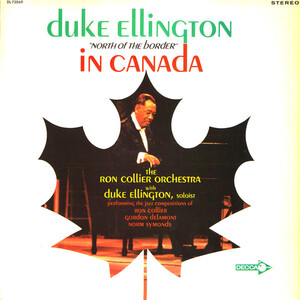
That same period led directly to the most famous collaboration of his career. In 1967, as part of a CAPAC-sponsored project built around works by Canadian composers, Collier conducted a big band and string orchestra with Duke Ellington as featured soloist. The resulting Decca LP, Duke Ellington: ‘North of the Border’ in Canada—also associated with the title Collages—featured Ellington performing music by Collier, Norman Symonds, and Gordon Delamont. Collier’s Aurora Borealis and Silent Night, Lonely Night were central to the project, and the album remains one of the most remarkable cross-border collaborations in Canadian jazz history. More than a prestige guest appearance, it opened the door to a sustained working relationship between Collier and Ellington. In the years that followed, Collier served as an orchestrator for Ellington and was later described as an uncredited co-composer on works including Celebration (1972), commissioned by the Jacksonville Symphony Orchestra. On occasion, he also conducted the Ellington orchestra itself—an extraordinary level of trust from one of the most important figures in 20th-century music.
Parallel to his jazz and concert work, Collier became increasingly active in film and television. He wrote scores for the play The Mechanic, for CBC radio and television productions, and for feature films including Face Off (1971), A Fan’s Notes (1972), and Paperback Hero (1973). The Face Off soundtrack album, released on Agincourt International, credits him as arranger, conductor, and producer of the score, illustrating how completely he could inhabit the role of musical director in a commercial setting. For a film tied so directly to hockey, celebrity, youth culture, and Toronto in the early 1970s, Collier provided music that moved fluidly between dramatic underscoring, pop-inflected cues, and broader cinematic atmosphere—yet another example of his adaptability across forms.
In 1972, Collier entered what would become the most influential long-term chapter of his career when he was appointed composer-in-residence at Humber College in Toronto. Beginning in 1974, he taught composition and arranging there until his retirement in 1994, helping shape generations of Canadian musicians. Under his direction, Humber’s stage band won the Canadian Stage Band Festival in 1975, 1982, and 1986, and he led student ensembles in concerts, broadcasts, and touring appearances. For many younger musicians, Collier was not simply a faculty member but a living bridge to the formative decades of modern Canadian jazz—someone who had worked with Mart Kenney, Norman Symonds, Victor Feldbrill, Duke Ellington, and CBC’s top ensembles, yet who remained fully engaged with new writing and the realities of contemporary performance. His students and colleagues consistently remembered him as a demanding but inspiring mentor whose standards were high because his own experience had been so broad and hard-earned.
Even after retiring from Humber, Collier continued to take on major writing projects. In 1997 he undertook a big-band arrangement of Oscar Peterson’s Canadiana Suite, transforming Peterson’s sketches into a full jazz orchestra work that was later praised for the colour, atmosphere, and structural depth Collier brought to the material. The arrangement was premiered by Fred Stride’s Big Band and later performed by Collier’s own orchestra, confirming that even late in life he remained one of the country’s most authoritative voices in jazz orchestration. He continued to lead his own band in festival appearances into the early 2000s, including a notable opening performance at Toronto’s du Maurier Downtown Jazz Festival.
Ron Collier died in Toronto on October 22, 2003, only months after being named an Officer of the Order of Canada. The honour was fitting. Few Canadian musicians moved as fluently between jazz, symphonic writing, film scoring, education, and national cultural institutions, and fewer still did so while leaving behind such a broad and distinctly Canadian body of work. His recordings with the Ron Collier Quintet, Septet, Tentet, and Orchestra, his pioneering Third Stream collaborations with Norman Symonds, his landmark association with Duke Ellington, and his decades of teaching at Humber all point to the same conclusion: Ron Collier was one of the central builders of modern Canadian jazz
-Robert Williston
Tracks
6 tracks
-
Aurora Borealis
-
Nameless Hour
-
Collage #3
-
Fair Wind
-
Silent Night, Lonely Night
-
Song And Dance
Discography
Featured Titles
Albums
Gallery
Images
0 images
No photos available for this artist.
Media
Videos
0 videos
No videos available for this artist.