
Artist / Band
Ellison

Biography
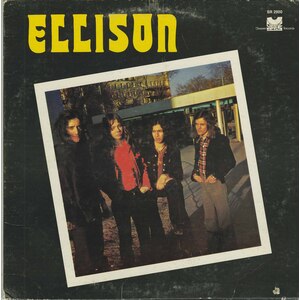
Among the rarest and most valuable Canadian rock albums of the early 1970s, Ellison’s 1972 self-titled LP has become one of the key underground hard rock releases in the country’s collector canon. Issued on Supreme and distributed by Trans-World, the album captures a short-lived Montreal band working at the edge of heavy blues rock, hard rock, and early heavy psych. Original copies are highly sought after, with a near mint pressing estimated at approximately $2,000 USD, but the album’s reputation rests on more than scarcity alone. Ellison remains a powerful document of Quebec’s early underground rock scene, combining raw musicianship, dark atmosphere, and a distinctive sense of drama.
The album announces itself immediately. Before the band even begins, the listener hears a knock at the door, footsteps approaching, and the slow creak of a door opening. It is a simple effect, but an effective one, setting a haunted tone before the first notes arrive. That same door closes at the end of the record, giving the album a circular, almost theatrical quality, as though Ellison has briefly opened a room into a heavier, more shadowed corner of Canadian rock before sealing it again.
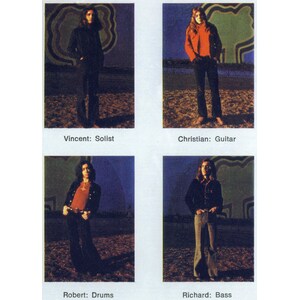
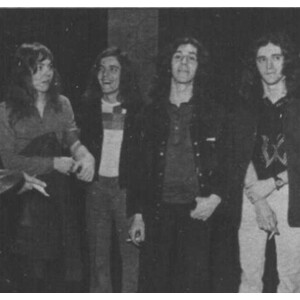
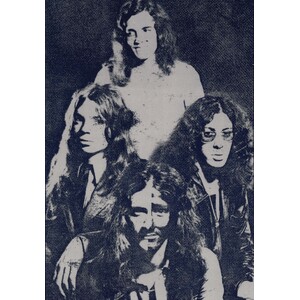
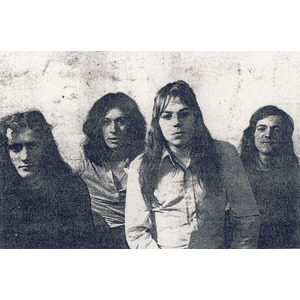
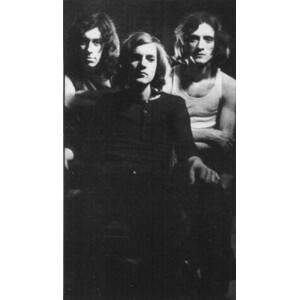
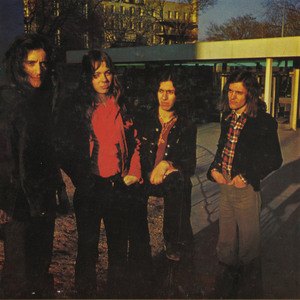
Ellison formed in Montreal in late 1967, when vocalist and guitarist Vincent Marandola and bassist Richard Arcand began playing together in a trio called Jimmy Peace. By 1969, drummer Robert Cager and guitarist Christian Tremblay had joined, and the group adopted the name Ellison. The band became part of L’Association des Orchestres, a collective that supported Quebec underground rock, blues, and hard rock artists, and built its reputation mainly through performances in Quebec and Ontario. By 1971, Ellison was gaining visibility through college campus shows, placing the group within the active but still under-documented network of early 1970s Canadian heavy rock.
In March 1972, Ellison entered Studio 6 to record their only album with engineer Quentin Meek. Produced by Alexandre Dumas and Yves Hamel, the LP was released in October 1972 on Supreme and distributed by Trans-World. Despite the strength of the material, the record received limited distribution, and the band’s history remained brief. Their last known performance took place on March 31, 1973, in Montreal. Richard Arcand later passed away in 1997, while Vincent Marandola eventually relocated to Sainte-Dorothée, Quebec.
Musically, Ellison sits between the raw attack of 1960s Canadian garage rock and the heavier blues-based hard rock that was emerging in the early 1970s. The album’s seven tracks are driven by forceful guitar work, muscular bass, hard-hitting drums, and Vincent Marandola’s direct, impassioned vocals. There are echoes of the energy associated with earlier Canadian groups such as The Ugly Ducklings, The Haunted, and The Sinners, but Ellison moves into a darker and heavier space, closer to proto-metal and underground heavy psych than straight garage rock.
The album’s atmosphere is one of its defining strengths. Rather than sounding like a polished studio production, Ellison feels immediate and physical, with the band pushing through the material in a way that emphasizes weight, tension, and performance. Marie-Claire Séguin and Richard Séguin appear on ‘Freedom,’ adding further Quebec music-history significance to a record already deeply rooted in the province’s underground scene.
As an original LP, Ellison quickly became a collector’s treasure. Its rarity was later recognized by writers and collectors including Vernon Joynson and Hans Pokora, who identified it as an R4 rarity. The album was reissued on CD by Gear Fab Records and also appeared on Void in the United States in 1999. The 2000 Gear Fab edition was remastered from the best available vinyl sources, as the original master tapes were no longer available, and included liner notes from Vincent Marandola, historical background, and band photographs, though no bonus tracks or additional recordings were included.
Ellison was later remastered and reissued in Spain by Guerssen in 2016. In April 2026, Guerssen repressed the LP under license from Gear Fab, this time using new digital vinyl transfers by Robert Williston after the label expressed dissatisfaction with the audio master used for the 2016 edition. The album has also circulated through a small number of unauthorized reissues, including CD editions by Black Rose Records and versions on Supreme / Trans-World with white labels.
Ellison’s self-titled album remains an essential Canadian heavy rock document: rare, atmospheric, forceful, and historically important as a surviving artifact of Montreal’s early 1970s underground. Its combination of blues-based heaviness, theatrical framing, Quebec scene connections, and long collector reputation makes it one of the most compelling Canadian hard rock LPs of its era.
-Robert Williston
Lineup:
Vincent Marandola: vocals, guitar
Christian Tremblay: acoustic guitar, electric guitar
Richard Arcand: bass
Robert Cager: drums
Marie-Claire Séguin: vocals on ‘Freedom’
Richard Séguin: vocals on ‘Freedom’
Tracks
7 tracks
-
Unchanged World (Vincent Marandola, Richard Arcand, Robert Cager, Christian Tremblay)
-
Seal a Beam Bow (Vincent Marandola)
-
Satanic (Vincent Marandola, Richard Arcand)
-
Winter Slutch (Vincent Marandola)
-
Strawberry Rain (Vincent Marandola, Richard Arcand)
-
Untruth Story (Vincent Marandola)
-
Freedom (Vincent Marandola)
Discography
Featured Titles
Albums
Gallery
Images
8 images
Ellison 003
eLLISON (5)
Ellison 001

eLLISON (4)
Ellison 002
eLLISON (3)

eLLISON (1)
Ellison
Media
Videos
0 videos
No videos available for this artist.