Artist / Band
Équipe 79
Biography
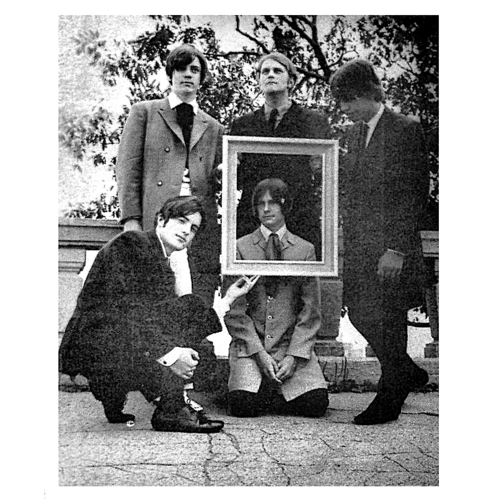
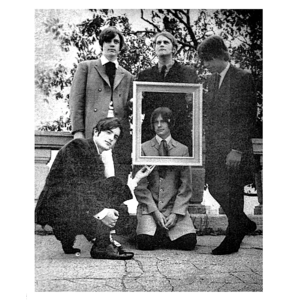
Équipe 79 were a late-1960s Laval, Québec rock group whose brief recording career documents the moment when French-Canadian student bands began moving beyond local dance circuits and into Canada’s national recording system. Comprised of five young students from Laval, the band emerged during the height of Québec’s garage and early psychedelic rock wave, a period when youth groups were increasingly writing original material, recording professionally, and navigating bilingual markets.
The group’s core lineup consisted of Claude Sirois, Gaétan Chartrand, Paul Lanciaux, Réal Desrosiers, and Robert Morissette, with songwriting credits consistently attributed to Sirois and Chartrand. Early on, Équipe 79 operated within the same school-based and community-hall ecosystem that produced dozens of similar bands across the Montréal North Shore, playing dances, youth clubs, and regional showcases while developing a repertoire that mixed French-language originals with English-leaning garage rock influences.
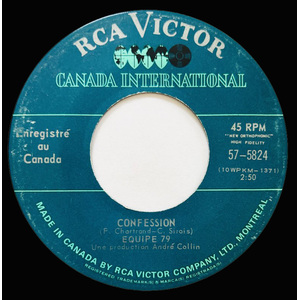
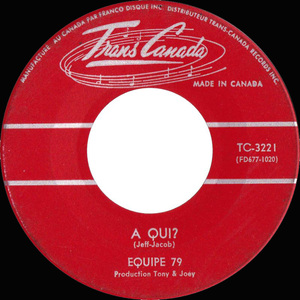
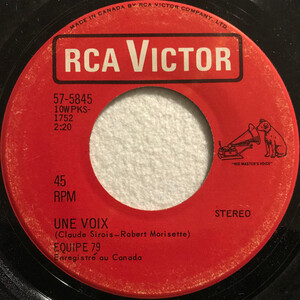
Their first known single appeared in 1967 on the Trans-Canada label, marking their transition from a purely local act to one operating within Montréal’s small but active independent recording network. That release led directly to their signing with RCA Victor Canada, where the band issued a series of singles in 1968 as part of the label’s Canada International series—a program specifically designed to introduce emerging Canadian artists without the commitment of full LP releases.
Across their RCA Victor recordings, Équipe 79 demonstrated an unusual duality. Songs like ‘Confession’ and ‘Hantise’ reflect the raw, tightly wound energy of Québec garage rock, while ‘The Girl From P.E.I.’ stands out as a deliberate English-language A-side aimed at a broader national audience. All of their RCA material was produced by André Collin, situating the band firmly within the professional Montréal studio system of the era rather than the private-press underground.
Despite multiple singles and national distribution, Équipe 79 never progressed to an album release. Like many student-era bands of the period, their lifespan appears to have been short, shaped by the realities of education, career paths, and the rapidly shifting musical landscape at the end of the 1960s. By 1969, members of the group reportedly explored a more psychedelic direction under a new name before dissolving entirely.
Several members went on to notable careers beyond Équipe 79. Most significantly, drummer Réal Desrosiers later became a prominent figure in Québec music, achieving national recognition through his work with Beau Dommage, one of the province’s most influential bands of the 1970s. Guitarist Claude Sirois pursued formal musical studies and later recorded instrumental material, reflecting the broader pattern of technically skilled youth musicians transitioning into professional or academic music careers.
Though their discography is small, Équipe 79’s recordings capture a precise historical moment: young Francophone musicians balancing garage-rock immediacy with professional studio ambition, navigating bilingual markets, and briefly intersecting with Canada’s major-label infrastructure before returning to the margins. Their singles remain a concise and revealing snapshot of Laval’s contribution to Québec’s late-1960s rock underground.
-Robert Williston
Musicians
Robert Morissette: lead vocals
Paul Lanciaux: guitar
Claude Sirois: guitar
Gaétan Chartrand: bass
Réal Desrosiers: drums
Tracks
6 tracks
-
J'aime ta voix
Confession b/w Hantise (1968)
2 tracks
-
Confession
-
Hantise
-
The Girl from P.E.I.
-
Confession
-
Une voix
Discography
Featured Titles

Singles
Gallery
Images
1 image
Équipe 79
Media
Videos
0 videos
No videos available for this artist.