Artist / Band
Merrick & Kathy Jarrett
Biography
Merrick Jarrett was a Canadian folk singer, broadcaster and educator whose career connected wartime radio, the postwar folk revival, the first Mariposa Folk Festival and several decades of music education. A singer, guitarist, piper and accomplished yodeller, he devoted much of his life to preserving traditional songs and introducing them to audiences through recordings, radio, festivals, classrooms, schools and public libraries.
Jarrett’s interest in folk music began in childhood under the influence of his mother, Sassa. One of the first traditional ballads he learned was ‘The Frog’s Courting,’ which she taught him when he was about five years old. His musical outlook later broadened through the work of singers and folklorists including Edith Fowke, Alan Mills, Oscar Brand, Burl Ives, Pete Seeger and Richard Dyer-Bennett.
His public performing career began during his service in the Canadian Armed Forces. Stationed in Newfoundland as a wireless officer, Jarrett entertained fellow servicemen with cowboy songs associated with Wilf Carter and began performing on radio station VORG. After the war, he continued working in radio through programmes on CKEY, CHUM and CFRB in Toronto, as well as several CBC radio series.
Jarrett became part of Toronto’s early country and folk broadcasting community. He was associated with the CHUM Valley Folks, a country-and-western ensemble that performed on radio and at live engagements, and with the Danforth Radio Folks, a group devoted to traditional and contemporary folk material. These activities placed him within the developing Canadian folk movement well before the commercial folk boom of the 1960s.
An important part of Jarrett’s career was his collaboration with Canadian folklorist Edith Fowke. He sang and narrated traditional material for CBC radio programmes she prepared, helping bring Canadian ballads, cowboy songs and other folk traditions to a national audience. Rather than treating folk music solely as entertainment, Jarrett approached the repertoire as a living form of history that could be taught, shared and carried forward.
In May 1956, Jarrett recorded The Old Chisholm Trail: Traditional Songs of the Old West at Hallmark Studios in Toronto. Released that September by Riverside Records in the United States, the album presented traditional cowboy songs, trail songs, work songs and narrative ballads. Folklorist Kenneth S. Goldstein edited the project for Riverside’s Folklore Series.
The record established Jarrett as a direct and knowledgeable interpreter of western folk material rather than a polished Nashville-style country performer. The same recordings were later reissued by Washington Records under the shortened title Songs of the Old West.
Jarrett was also active on the Canadian festival and coffee-house circuit. He performed at clubs in Canada and the United States and participated in festivals including Algoma, Madoc and Mariposa. In 1961, he appeared at the inaugural Mariposa Folk Festival in Orillia, joining the artists who helped establish one of Canada’s most important folk-music institutions.
His work increasingly turned toward children and music education. While employed as a travelling representative for the Macmillan Company of Canada, Jarrett visited libraries across the country. These visits developed into participatory children’s concerts built around traditional songs, storytelling, clapping, singing and simple folk instruments.
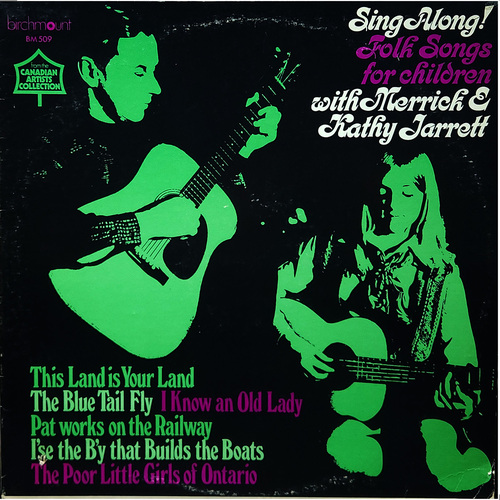
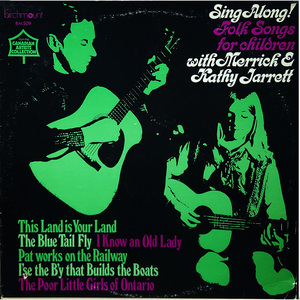
One of these performances was recorded at the Peterborough Public Library in January 1969 and released by Birchmount as Singalong: Folk Songs for Children. Jarrett was joined by his 14-year-old daughter, Kathy Jarrett, later known as Kate Jarrett, who sang, played guitar and piano, operated a traditional limberjack dancing doll and helped lead the children in audience participation.
The album drew from Canadian, American and British folk traditions, combining material by Woody Guthrie and Alan Mills with railway songs, children’s songs and regional Canadian repertoire. The performance captured Jarrett’s belief that folk music should not be presented passively to children. The young audience was encouraged to sing, clap and become part of the recording.
Kate had grown up surrounded by folk music and also played clarinet in her school orchestra. The album notes identified her as a descendant of Thomas Myrick, whose death became the subject of the early American ballad ‘Springfield Mountain.’ The Birchmount album appears to have been a special father-and-daughter project rather than the beginning of a continuing commercial duo.
Jarrett’s library concerts introduced thousands of children across Canada to folk music. He later worked with the Kitchener Public Library and continued performing in schools and community settings throughout Waterloo Region. His ability to combine scholarship, humour, storytelling and participation made traditional music accessible without reducing it to a museum piece.
In 1974, Conrad Grebel College at the University of Waterloo invited Jarrett to develop a course on traditional folk music in the Anglo-Saxon tradition. He taught there for 17 years, reaching approximately 3,000 students. His later courses included a programme devoted specifically to Canadian folk music, and he adapted his teaching for Conrad Grebel’s Elderhostel sessions.
Jarrett’s importance as an educator came from practical experience rather than conventional academic credentials. He had learned songs through family tradition, radio, collectors, fellow performers and decades of live presentation. In the classroom, he connected the historical background of a song with the experience of actually singing it.
He remained active in the folk and storytelling communities of Waterloo Region, including the Old Chestnuts Song Circle. Even after his principal recording years, he continued performing, lecturing and encouraging communal singing. His work helped preserve repertoire that might otherwise have survived only in archives or specialist collections.
In January 1997, Jarrett self-published the illustrated autobiography My Life in Folk Music, documenting his experiences from early broadcasting through the Canadian folk revival, festival movement and his later educational work.
His contributions were formally recognized in 2002 when he received the Kitchener-Waterloo Arts Award for Music.
Merrick Jarrett died peacefully in Peterborough, Ontario, on December 6, 2005, at the age of 81, one year after the death of his wife, Mary. He was survived by his sister Sheila; his children Linda, Stephen and Kate; and eight grandchildren. His obituary remembered him as a singer of folk songs, a piper and a “yodeller extraordinaire,” while emphasizing the thousands of children and students introduced to folk music through his concerts and teaching.
Merrick Jarrett’s legacy extends well beyond his surviving commercial recordings. He belonged to a generation that carried traditional music from family singing and early radio into the folk festivals, libraries and classrooms of modern Canada. His career joined performance with preservation and scholarship with participation.
Through his cowboy recordings, CBC work with Edith Fowke, appearances at Mariposa, children’s concerts and long teaching career at Conrad Grebel College, Merrick Jarrett became an important link between Canada’s older oral traditions and the audiences that encountered folk music during the second half of the twentieth century.
-Robert Williston
Tracks
15 tracks
Singalong: Folk Songs For Children (1969)
Showing 10 of 15 tracks
-
This Land is Your Land
-
Uncle Reuben
-
The Blue Tail Fly
-
I Know an Old Lady
-
Pat Works on the Railway
-
Lumberjack Dancing Doll
-
Les Raftsmen
-
Tungo
-
I'se the B'y That Builds the Boats
-
I Had a Bird and the Bird Pleased Me
Discography
Featured Titles

Albums
Gallery
Images
1 image
Jarrett & Kathy Merrick
Media
Videos
0 videos
No videos available for this artist.