Artist / Band
James Leroy
Biography
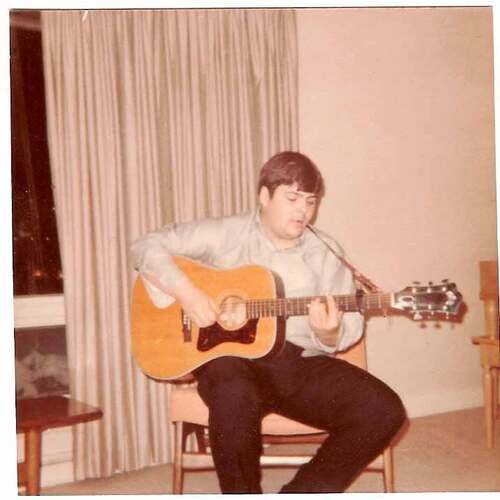
James Leroy was born in Ottawa, Ontario, on April 3, 1947, and spent much of his childhood and adolescence around Martintown in eastern Ontario. The rural community remained important to him throughout his life. He later used the Martintown name for his publishing company, tying his professional songwriting back to the place where his family had roots.
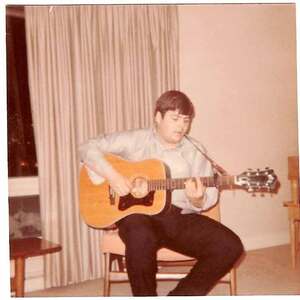
Music initially came through folk. As a teenager Leroy taught himself guitar and piano and became interested in Bob Dylan, Pete Seeger, the Kingston Trio and other folk performers. He later attended university in the United States but returned to Canada during the Vietnam War period as friends around him were being drafted. Back in Ottawa, he worked at his father’s Canadian Tire operation while writing songs and trying to establish himself as a performer. He also took vocal instruction from Bruce Cockburn during his early development as a folk singer.
Leroy began appearing in Ottawa-area coffeehouses and small clubs and offered songs to local groups. Canada Goose, September Dawn and Renaissance were among the bands that tried his material, although none of those early songs appears to have been commercially recorded. His growing connections placed him inside an unusually productive Ottawa music network that included musicians from the Esquires, the Townsmen, Canada Goose, 3’s a Crowd and the Modern Rock Quartet.
By 1970, former Esquires guitarist Gary Comeau was helping Leroy assemble a band around his songs. One early version included Ritchie Grand, formerly of the Mynah Birds. The lineup came together more fully during 1971 with guitarist David Oslund, drummer Gibby LaCasse and bassist Chuck Bergeron, all with connections to Jumbo, alongside Comeau and singer Valerie Tuck, who had worked with Canada Goose.
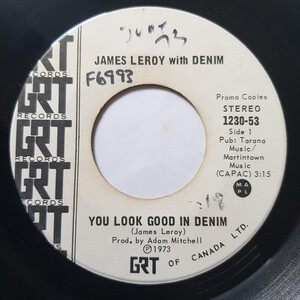
The group was initially known simply as the James Leroy Band. The name Denim came from Leroy’s song ‘You Look Good In Denim’, a title that suited the unpretentious image he wanted for the group.
The key professional relationship was with Ottawa promoter and manager Harvey Glatt. Glatt had already played a major role in the Ottawa folk and rock scene through his work with Le Hibou, the Esquires, 3’s a Crowd and other artists. After repeated approaches from Leroy, Glatt agreed to manage him and helped secure a deal with GRT Records. By the end of 1973, Billboard was citing Glatt’s management of James Leroy and Denim as one of the Canadian artist-manager relationships attracting attention within the rapidly expanding domestic music industry.
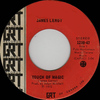
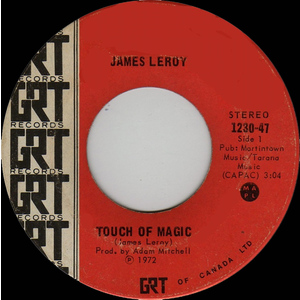
Leroy’s breakthrough came with ‘Touch of Magic’. Recorded at Manta Sound in Toronto, the song was written by Leroy and produced by Adam Mitchell. GRT issued it as 1230-47, backed with ‘Comin’ On Home’. RPM was listing the single on its national chart by February 1973, when it stood at number 50, and it climbed steadily over the following weeks. On April 14 it reached number 6, up from 14 the week before, and that proved to be its peak. It slipped to 18 the following week, but by then it had become one of the major Canadian records of the spring.
The band’s success was visible on stage as well. In late February 1973 RPM reported that the James Leroy group was setting itself up for what looked like a successful week downstairs at Toronto’s El Mocambo, having played the Jarvis House only a couple of weeks earlier, with GRT’s marketing director Larry Green backing the promotional push. Older followers were mixing with a growing new audience as ‘Touch of Magic’ moved into hit territory.
GRT also pushed the recording well beyond Canada, and the international releases materialized. In the United States the single appeared on Janus as J-219 and entered the Cash Box Top 100, reaching number 98 in August. In Britain it was issued by MAM as MAM R 98, with promotional copies circulated to radio. An Australasian pressing followed on Interfusion in New Zealand in 1974. RPM’s 1974 industry directory later summarized the record as having reached number 6 in Canada while also charting in Cash Box and Record World.
The success led to the group’s only LP, James Leroy With Denim, issued by GRT in 1973 as 9230-1034 in a gatefold sleeve. Janus released it in the United States as JLS 3057, and GRT also pressed it in South Africa. Recorded at Manta Sound, the album featured Leroy on vocals, piano, organ and acoustic guitar, David Oslund on lead guitar, Gary Comeau on pedal steel guitar, Chuck Bergeron on bass and backing vocals, Gibby LaCasse on drums and Valerie Tuck on harmony vocals. Adam Mitchell and Chris Dedrick arranged the strings and horns, and Bart Schoales handled the design and photography.
The ten-song album was built almost entirely around Leroy’s writing and included ‘You Look Good In Denim’, ‘Anniversary Waltz’, ‘Someday Soon’, ‘Comin’ To A Party’, ‘Make It All Worthwhile’, ‘Touch of Magic’, ‘Comin’ On Home’, ‘Lady Of The Night’, ‘Take A Look At Life’ and ‘Friends And Brothers’. It reached the RPM albums chart during the summer of 1973.
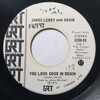
‘You Look Good In Denim’ followed ‘Touch of Magic’ onto Canadian radio during the summer of 1973. It received major-market airplay across the country and became the group’s second charting single. ‘Make It All Worthwhile’ followed later in the year and became a strong regional record in several Canadian markets.
The group’s road schedule was substantial. RPM’s 1974 Canadian music-industry directory credited James Leroy and Denim with a 41-concert tour with the Stampeders and appearances on six CBC and CTV network television programs. Leroy also appeared on Keith Hampshire’s Music Machine.
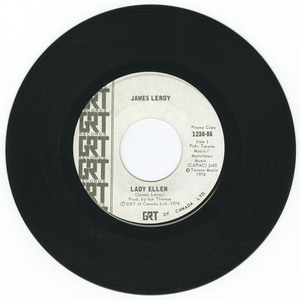
By 1974 Leroy was moving away from Denim as a fixed group. Marvin Dolgay replaced Oslund on guitar, while Wayne Leslie, another musician with Canada Goose and Townsmen connections, came in on bass. Leroy returned to Manta Sound with producer Ian Thomas for two solo GRT singles, ‘Some Kind Of Fool’ / ‘Fast Eddie’ and ‘Lady Ellen’ / ‘Lady Comes’.
‘Some Kind Of Fool’ received particularly good response in western Canada during 1974. Early in 1975 GRT followed it with ‘Lady Ellen’. RPM reported immediate airplay from CFGO in Ottawa and CHUM AM and FM in Toronto. Both sides of the single were written by Leroy, and Ian Thomas produced the session.
A projected solo album never appeared. Leroy continued touring, frequently sharing dates with the Stampeders, and spent periods writing in northern Ontario. For a time he stepped away from the usual touring cycle and became entertainment manager at the Water Tower Inn in Sault Ste. Marie. That move led directly to the next phase of his career.
At the Water Tower Inn he encountered Major Hoople’s Boarding House, the Cambridge, Ontario band that had already scored Canadian radio success with ‘I’m Running After You’. Leroy joined the group in 1976 and encouraged the musicians to shorten the name to Boarding House.
The new version of the band centred increasingly on Leroy’s material. At a Canadian music-industry showcase in November 1976, RPM reported that Boarding House, now featuring Leroy’s songs, received one of the strongest responses of the weekend and was called back for an encore. The magazine noted that it was the first time many people in attendance had seen the band with Leroy.
The group also took Leroy into the Maritimes. A September 1976 Dalhousie University advertisement billed “Boarding House band featuring James Leroy” during orientation week in Halifax, confirming that the renamed band was already working outside Ontario.
Leroy’s Boarding House lineup included Richard “Rocky” Howell on guitar and vocals, Peter “Moss” Beacock on keyboards, Keith “Chopper” Stahlbaum on bass and Ed Miller on drums, with Leroy singing and playing keyboards. His time with the group was relatively brief, and he eventually moved on without making a full album with them.
He next became involved with the Terry Crawford Band, a Winnipeg-rooted group then working from Toronto. The musicians worked with Leroy in the studio and on stage, adapting some songs he had written during the Boarding House period. Nothing from that association was released at the time, although two live Terry Crawford Band performances connected to Leroy, ‘The Family’ and ‘I’m A Sailor’, eventually surfaced decades later. The Terry Crawford Band continued to develop after Leroy’s involvement and eventually secured its own RCA recording contract.
In 1978 Leroy returned to the Denim name. With manager Martin Onrot, he assembled another touring band that included Gibby LaCasse on drums, Marvin Dolgay on guitar and steel guitar, Paul Faubert on bass and John Stimson on keyboards and vocals. GRT also reissued ‘You Look Good In Denim’ backed with ‘Touch of Magic’, giving his best-known material another run at Canadian radio.
The comeback was still developing when Leroy died in Ottawa on May 10, 1979, at the age of 32.
RPM Weekly devoted an obituary to him two weeks later. Written by Mel Shaw, it remembered the sight of Leroy behind a small electric piano on long Canadian tours and the audience recognition that came when he began ‘Touch of Magic’. Shaw wrote that it had been a long time since the hit filled the airwaves and seemed to promise so much, and that the album had by then been deleted. The piece also described the less visible side of the years that followed: the continual calls looking for engagements and for record companies still interested in signing him, and the twice-yearly performing-rights cheques that Leroy valued as proof that somewhere at some time someone had heard his songs. Shaw closed by writing that everyone had lost a little touch of magic.
His recordings did not disappear with him. In 2002, ‘Touch of Magic’ received a SOCAN Classic Award for surpassing 100,000 domestic radio performances. The award credited James Leroy as composer and Martintown Music and Snowberry Music as publishers.
The song has continued to surface in Canadian music since then. Helix recorded a new version for its 2010 acoustic album Smash Hits...Unplugged!, bringing Leroy’s best-known composition to another generation of Canadian rock listeners.
The wider catalogue returned in 2021, when Pacemaker Entertainment issued Touch of Magic: The Complete Collection. The twenty-two-track compilation gathered the 1973 album with the 1974 and 1975 GRT singles and added a booklet along with material that had never been released. Among the previously unissued recordings were five Leroy demos, ‘Lampton County Woman’, ‘When the War Is Over’, ‘Martintown Diary’, ‘Now That the Children Have Gone’ and an alternate take of ‘It’s All Worthwhile’, together with the two live Terry Crawford Band performances. A demo called ‘Martintown Diary’ is a reminder of how directly Leroy kept returning to the place his family came from.
-Robert Williston
James Leroy & Denim, 1973 lineup
James Leroy: vocals, piano, organ, acoustic guitar
David Oslund: lead guitar
Gary Comeau: pedal steel guitar
Chuck Bergeron: bass, backing vocals
Gibby LaCasse: drums
Valerie Tuck: harmony vocals
James Leroy, 1974 touring and recording lineup
James Leroy: vocals, keyboards, guitar
Marvin Dolgay: guitar
Gary Comeau: steel guitar
Wayne Leslie: bass
Gibby LaCasse: drums
Valerie Tuck: background vocals
Boarding House, 1976
James Leroy: vocals, keyboards
Richard “Rocky” Howell: guitar, vocals
Peter “Moss” Beacock: keyboards, synthesizer
Keith “Chopper” Stahlbaum: bass, vocals
Ed Miller: drums
Denim, 1978 revival
James Leroy: vocals, keyboards
Marvin Dolgay: guitar, steel guitar
Paul Faubert: bass
Gibby LaCasse: drums
John Stimson: keyboards, vocals
Tracks
6 tracks
-
Touch of Magic
-
Comin' On Home
-
You Look Good in Denim
-
Lady of the Night
-
Lady Ellen
-
Lady Comes
Discography
Featured Titles
Singles


Compilation Tracks

Gallery
Images
1 image
James Leroy
Media
Videos
1 video