Artist / Band
Niven Miller
Biography
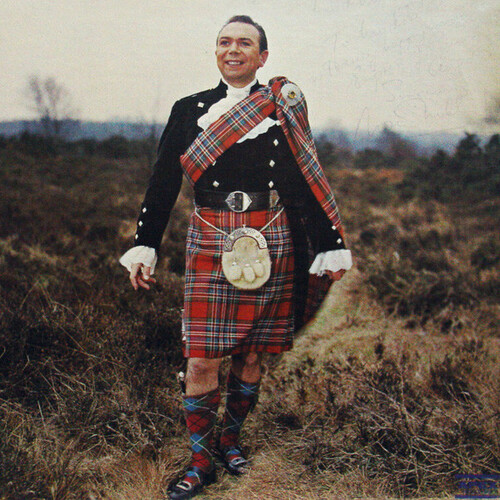
Niven Miller, born James Thomson Niven Miller in St Monans, Fife, Scotland, was a singer whose repertoire ranged from Scottish traditional music and opera to sacred music, poetry and popular song. Although he came from a family of shipbuilders whose history extended back more than two centuries, Miller displayed musical ability from an early age and became known locally as a boy soprano in Fife.
While studying engineering in Glasgow, Miller attracted the attention of conductor Hans Oppenheim, who encouraged his vocal development and helped lay the foundation for his professional career. After completing his engineering degree, Miller won the Darrington Opera Scholarship, which provided two years of study at the Opera School in London. He later received the Sir James Caird Travelling Scholarship, allowing him to continue his training with teachers connected with La Scala in Milan, the Vienna State Opera and the Geneva Conservatory.
After returning to Britain, Miller sang principal roles with Sir Thomas Beecham and the Royal Philharmonic Orchestra, Glyndebourne Festival Opera, Dublin Grand Opera Festival and the Edinburgh International Festival. He also appeared extensively on radio and television and in concert throughout Britain and Europe. His repertoire extended from opera and oratorio to Scottish folk song, and his Scottish recitals became an annual event at London’s Royal Festival Hall.
The 1957 album Presenting Niven Miller brought together Scottish favourites including ‘The Road to the Isles,’ ‘Annie Laurie,’ ‘Loch Lomond,’ ‘Scots Wha Hae’ and ‘Auld Lang Syne.’ Released in Canada by London Records, the album introduced Canadian listeners to Miller before he began touring the country.
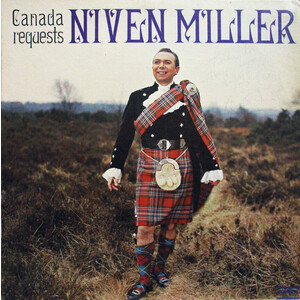
Miller subsequently performed in New Zealand, South Africa, the United States and Canada. His Canadian connection became especially strong through tours of the Maritime Provinces. Liner notes for Canada Requests describe standing ovations and enthusiastic reviews during his first Maritime tour. His first Fredericton concert was presented under the patronage of New Brunswick Lieutenant Governor Wallace S. Bird, while his first Halifax appearance was held under the patronage of Nova Scotia Lieutenant Governor Victor de B. Oland.
Produced by Ron Dykhof and issued by Apex, Canada Requests was released in response to requests for a permanent souvenir of Miller’s Canadian appearances. The album paired songs associated with Robert Burns with selections from Rossini, Schubert and Verdi, sacred music and traditional Irish material. Miller was accompanied by Kenneth Bowen, who remained closely associated with his Canadian recordings.
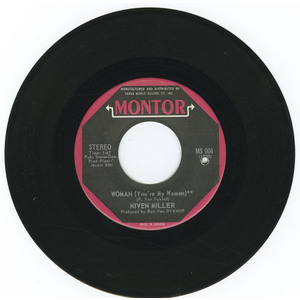
In 1971, Montor Records issued the single ‘Woman (You’re My Woman)’ / ‘Anna Maria (I Love You).’ Both songs were written and produced by Dykhof, and the lacquer was cut at RCA Victor Studios in Montréal, Québec. The single placed Miller in a contemporary vocal-pop setting that differed from the Scottish, operatic and religious repertoire for which he was better known.
Miller’s Canadian career increasingly centred on inspirational broadcasting. His television series Niven Miller Sings was carried by Canadian stations during the 1970s, while his radio program Thoughts for To-day was sponsored by the Senator Emerson Foundation of Saint John, New Brunswick. The Foundation was established by Frances Emerson, widow of Senator Clarence V. Emerson, and supported Miller’s broadcasts across Canada, the United States and overseas.
Liner notes for The Holy City and Other Favorites Featuring Niven Miller state that Miller’s programs had been heard across Canada for four years and on numerous American stations. The Senator Emerson Foundation’s international distribution brought the broadcasts to listeners in Asia and other parts of the world. In 1972, Frances Emerson received a peace award connected with bringing Miller’s Thoughts for To-day program to Asia.
Several albums preserved material associated with these television and radio broadcasts, including Popular Requests from Color TV Series and International Radio Programmes with Niven Miller and Popular Requests from the Color TV and International Radio Programmes of the Senator Emerson Foundation with Album 2. The selections moved between hymns, psalm settings, spirituals, popular standards and inspirational songs such as ‘I Believe,’ ‘Born Free,’ ‘Climb Every Mountain,’ ‘What a Wonderful World’ and ‘The Holy City.’
Much of Miller’s Canadian recording activity appeared through Millem Records and Millem of Canada, operating from Saint John, New Brunswick. Albums included Niven Sings Gospel, The Holy City and Other Favorites, One World and other religious and inspirational recordings. The Holy City and Other Favorites was recorded at RCA Victor Studios in Montréal, Québec, with Kenneth Bowen on piano and organ.
That album combined hymns, psalm settings and selections from Handel’s Messiah with Miller’s spoken poems ‘Prayer’ and ‘The Warmth of God.’ Niven Sings Gospel continued the mixture of song and poetry, including Miller’s compositions ‘The Peace That Passeth All Understanding’ and ‘The Law of God.’ The two-part One World, consisting of ‘The Springtime of Life’ and ‘The Autumn of Life,’ reflected the extended spoken and musical presentations that became an important part of his Canadian work.
Miller also recorded Christmas Selections & Other Favorite Requests, accompanied by Kenneth Bowen and recorded at RCA in Montréal, Québec. The album combined traditional carols, sacred songs, Handel selections and quartet performances, continuing the religious and seasonal programming associated with Miller’s broadcasts.
Despite the growing emphasis on sacred and inspirational music, Miller continued performing Scottish material. The Canadian album My Ain Folk included ‘Skye Boat Song,’ ‘Ae Fond Kiss,’ ‘An Eriskay Love Lilt’ and other traditional songs, showing that his Scottish identity remained central throughout his time in Canada.
Miller later returned to Britain and worked as a singing teacher. His Canadian career extended well beyond a single tour or recording session and included concert appearances, national television, international radio broadcasts and a substantial body of recordings produced in New Brunswick and Montréal, Québec.
-Robert Williston
Tracks
0 tracks
No tracks available for this artist.
Discography
Albums

Singles
Gallery
Images
1 image
Niven Miller
Media
Videos
0 videos
No videos available for this artist.