Insight
1755 took its name from the year the Acadians began to lose their homeland. In the summer of 1755 the governor and council of Nova Scotia ordered the removal of the Acadian population, and by autumn British troops were putting families onto ships at Grand-Pré, Pisiquid, Chignecto and Annapolis Royal. Houses, barns and churches were burned so there would be nothing to come back to. Over the next eight years thousands were carried off to the Anglo-American colonies, to England and eventually to France, while others escaped into the woods and north to the Miramichi, the Saint John River and Québec. Acadians call it the Grand Dérangement. The families who came through it rebuilt along the coasts of New Brunswick, Nova Scotia and Prince Edward Island, and some made their way to Louisiana, where their descendants became Cajuns. More than two centuries later, a group of young musicians in Moncton put the date on their band.
Pierre Robichaud and Roland Gauvin had been playing music together since 1973. Robichaud remembered the sparks flying the first time they jammed, at what he called a bathroom party. Accounts place the formation of 1755 anywhere between 1975 and 1977, and the band was working Moncton bars by 1977. The lineup that made the records had Robichaud on guitar, bass, mandolin and vocals, Gauvin on guitar, banjo, bass and vocals, Kenneth Saulnier on guitar, banjo, mandolin, violin and vocals, Donald Boudreau on bass, clarinet, guitar and vocals, and Ronald Dupuis on drums, percussion and harmonica.
They put Acadian fiddle tunes and old songs together with folk, country and rock, with banjo, mandolin and violin sitting beside electric guitar and drums. They sang in the French of southeastern New Brunswick, Chiac included, and wrote about unemployment, Saturday nights, drinking, love and the streets and places their audiences knew. Very few acts had put that language on a record. Robichaud later said the point in the 1970s was showing that Acadian artists could make something that mattered in their own language.
Much of the repertoire came from a partnership with the poet Gérald Leblanc, from Bouctouche. Robichaud and Gauvin asked Leblanc if they could set his poems to music. Robichaud was sitting in his living room reading one called ‘Le Monde A Bien Changé’ when the melody arrived all at once, shaped by early 1960s hits like Wayne Cochran’s ‘Last Kiss’. Leblanc, Robichaud and Gauvin went on to write close to half of everything 1755 performed.
An appearance on Radio-Canada’s Les Beaux Dimanches, in a program called Ode À L’Acadie, brought a recording deal with the Québec label Presqu’île. The debut album 1755 was released on October 11, 1978, produced by Lucien Gagnon and recorded at Studio Marko. Traditional pieces sat next to the new songs: ‘Hallo Joe’, ‘La Toune À Louis Arsenault’, ‘Geddap Sam’ from Chéticamp, and ‘Maudite Guerre’, which came to the band by way of Louisiana’s Zachary Richard. Leblanc and Gauvin wrote ‘Rue Dufferin’, ‘Boire Ma Bouteille’ and ‘Le Monde Qu’on Connait’. ‘U.I.C. (Unemployed Insurance Commission)’, with words by Ralph Williams and music by Robichaud, made a joke of the unemployment line. ‘Le Monde A Bien Changé’ became the song most closely tied to the group.
Robichaud recalled how quickly the band went from taverns to filling the biggest arenas in the province. Vivre À La Baie followed in 1979, and nearly all of it came from inside the group. Saulnier wrote the title song, Boudreau wrote ‘Mon Coin De L’Acadie’, and Robichaud and Gauvin wrote ‘Je T’aime’ and ‘Le Pire S’en Vient’. Leblanc and Robichaud wrote ‘Kouchibouguac’, named for the Kent County national park whose creation in 1969 had forced more than two hundred families, most of them Acadian, off their land. The album opened with ‘La Gang Arrive’ by G. J. Cormier and A. Lefort and closed with Gauvin’s ‘Disco Banjo’. That year 1755 won the Palme d’or for best song performance at the Festival international de la francophonie in Nice, France. The group was nominated for Group of the Year at the 1979 ADISQ gala, and Vivre À La Baie was nominated for Microsillon de l’année / Folklore et Traditionnel in 1980.
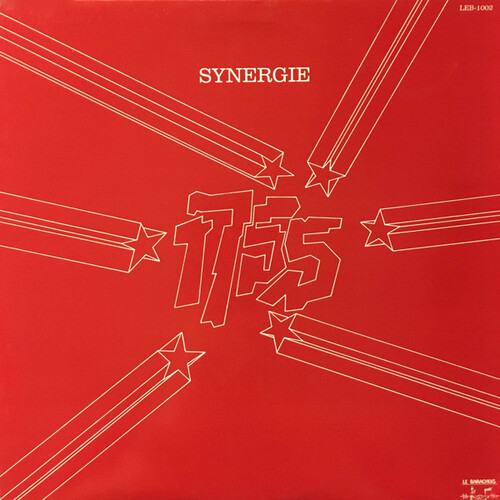
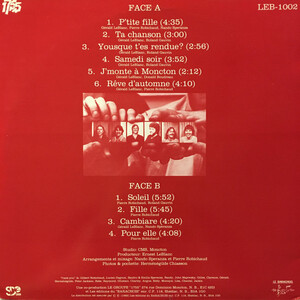
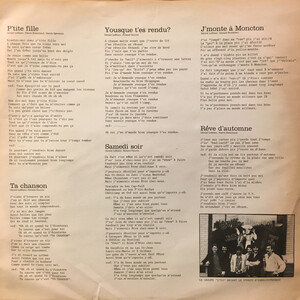
Synergie came out in 1982 on Le Barachois, recorded at CMS Studios in Moncton with Ernest LeBlanc producing. Nando Speranza arranged and mixed the album with Robichaud and shared in the writing, while the poet, filmmaker and painter Herménégilde Chiasson shot the sleeve photographs. Leblanc’s words ran through the record, including ‘P’Tite Fille’, ‘Samedi Soir’ and ‘J’Monte À Moncton’. The personnel around the band had shifted by then, and exactly who plays what on Synergie has yet to be pinned down.
In 1984 the band joined 100 Pour 200, a production marking New Brunswick’s bicentennial and the hundredth anniversary of the Acadian flag. Eleven performers took it through 25 shows across the Maritimes, Québec and Ontario. Troubles with Presqu’île had worn on the group, and 1755 stopped after the project. By then they had played across Acadia, the rest of Canada, Louisiana and France.
On August 21, 1994, during the first Congrès mondial acadien, 1755 came back together at the Moncton Coliseum for Les Retrouvailles De La Famille. More than 10,000 people filled the building. The concert was filmed and issued as a live album, and the first two albums reappeared on CD, reportedly selling more than 30,000 copies within a month.
In 2005, the 250th anniversary of the Deportation, 1755 played the Festival acadien. The East Coast Music Awards gave the group the Dr. Helen Creighton Lifetime Achievement Award in 2008, and in 2012 all three original albums were gathered on Anthologie. The band marked forty years at Acadie Rock in 2017, the same year Les Éditions de la Francophonie published the songbook Les Chansons Du Groupe 1755. Gauvin noticed the crowds changing: early fans now came with their children and grandchildren, and the youngest knew the words as well as anyone. In 2022 ‘Le Monde A Bien Changé’ was inducted into the Canadian Songwriters Hall of Fame, honouring Leblanc, who had died in 2005, and Robichaud. The following year 1755 received the Société de l’Acadie du Nouveau-Brunswick’s Prix Albert-M.-Sormany.
In July 2025 Robichaud, Gauvin and Dupuis announced that 1755 would retire. Robichaud said they had decided it was better to choose when the adventure ended than to let fate choose for them. The farewell summer took them to Shippagan, the Îles-de-la-Madeleine and Edmundston, and on August 15 more than 15,000 people came to Dieppe for the band’s last National Acadian Day show after 48 years. The October farewell concerts at Moncton’s Théâtre Capitol sold out so fast that more dates were added, running through October 11. Gauvin closed with the line he had been leaving audiences with for years: be proud of who you are.
L’Acadie Nouvelle named 1755 its cultural personality of 2025. In May 2026, at the Éloizes in Campbellton, Robichaud, Dupuis and Gauvin accepted the Prix Hommage for the group’s body of work and its impact on Acadian culture.
-Robert Williston
Gallery
Images
6 images
Synergie Back cover
Synergie Record sleeve (back)
Synergie Face A
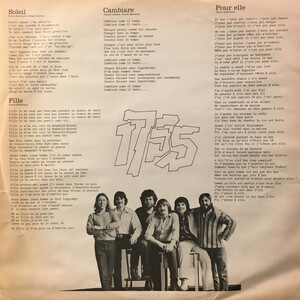
Synergie Record sleeve (front)
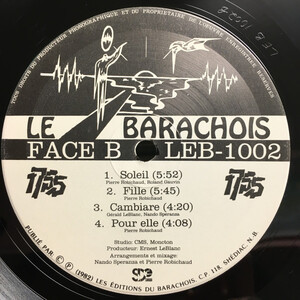
Synergie Face B
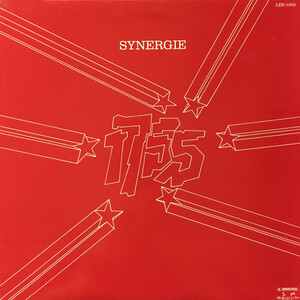
Synergie
Media
Videos
0 videos
No videos available for this title.
Credits
Songwriting
‘Ptite fille’ written by Gérald LeBlanc, Pierre Robichaud and Nando Speranza
‘Ta chanson’ written by Gérald LeBlanc and Roland Gauvin
‘Yousque tes rendue?’ written by Gérald LeBlanc and Roland Gauvin
‘Samedi soir’ written by Gérald LeBlanc and Roland Gauvin
‘Jmonte à Moncton’ written by Gérald LeBlanc and Donald Boudreau
‘Rêve dautomne’ written by Gérald LeBlanc and Pierre Robichaud
‘Soleil’ written by Pierre Robichaud and Roland Gauvin
‘Fille’ written by Pierre Robichaud
‘Cambiare’ written by Gérald LeBlanc and Nando Speranza
‘Pour elle’ written by Pierre Robichaud
Production
Produced by Ernest LeBlanc
Arranged by Nando Speranza and Pierre Robichaud
Mixed by Nando Speranza and Pierre Robichaud
Recorded at CMS Studios, Moncton, New Brunswick
Artwork
Photography and sleeve by Herménégilde Chiasson
Publishing
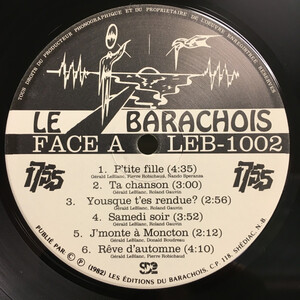
Published by Les Editions du Barachois
Release
Released in Canada in 1982 by Le Barachois, LEB-1002
No Comments