Insight
The 222's started up in the spring of 1978 on the east end of Montreal island. Pierre 'Al Clean' Major played guitar, Louie 'Louie' Rondeau played drums and Christian 'Chris O'Bell' Belleau played bass, with a singer who called himself Jean Frisson out front. In The Saga of the 222s, his history of the band, Chris Barry describes them as a kid-brother band to Danger, an East End rock and roll group whose single 'L'Amour Dans L'Metro' was getting regular play on French radio. Danger sometimes brought them along to high school gigs, and those audiences hated them. The 222's were too loud and too outrageous for a city whose radio ran on Genesis, Styx and Supertramp, and their heroes were the New York Dolls, who had drawn barely a hundred people in Montreal four years earlier.
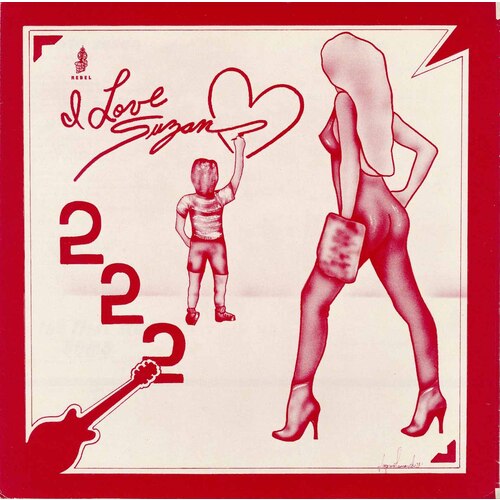
Frisson left for New York that summer. With the band between singers, Rondeau took the lead vocal on their first record, 'I Love Susan' backed with 'The First Studio Bomb', recorded in September 1978 at Le Petit Studio du Nord and issued on Rebel Records (RB-7901). The label credits Rondeau with vocals, keyboards and drums, and names François Doyon, who paid for the session, as producer. It is regarded as the first punk record released in Quebec. It pairs a bright, melodic pop song with a harder punk track on the flip.
Chris Barry joined just as the single came out, in the fall of 1978. He had recently been expelled from Montreal West High School after an Iggy Pop-inspired set at the school talent show, which his band won and several parents did not forgive. The band's own promotional write-up, which Rondeau sent to MoCM in 2022, remembers him as a charismatic sixteen-year-old front man. Tracey Howe of the Normals, who shared a rehearsal room with the 222's on La Gauchetière Street, introduced him to the band. Barry knew Howe from 2000 Plus, the one record shop in town that put the Stooges' Fun House in its front window and stocked import punk singles, and whose bulletin board served as a meeting point for the few hundred people in the city who cared.
By then Montreal had a small scene. The Normals, Lorne Ranger, the Chromosomes and later Electric Vomit played loft parties and a short-lived venue at 364 Saint-Paul Street, and a fanzine, Surfin' Bird, covered them. The 222's fit awkwardly even there. Major, Rondeau and Belleau could really play, their roots ran back through glam to the Dolls, the Stooges and Alice Cooper, and their first manager, boutique owner Pyer Desrochers, dressed them in Chairman Mao T-shirts, day-glo orange leather and zebra-skin pants. They drew girls and a growing crowd, which did nothing for their standing with the rest of the scene.
In early 1979 the 222's headlined a punk festival at McGill University with the Chromosomes, Electric Vomit and the Unknowns, billed at the top because they were the only local band with a single out. Barry recalled close to 800 people, half of them frat boys there to jeer. When the 222's went on, their amps would not work, bottles and garbage started flying, Barry taunted the crowd, and someone cut the power and turned up the house lights. By his account the riot that followed got punk shows banned from nearly every venue in the city.
By spring 1979 Desrochers had lost interest and Doyon took over management. Doyon had come home after U.S. immigration chased him out of Los Angeles, and he had more energy than industry knowledge; Barry remembered him turning up at record company offices in fishing waders and denim hot pants. He still got the band support slots with the Stranglers, Simple Minds and the Professionals and dates at Max's Kansas City in New York. His partner Marc Fontaine ran the local cable show Musivideo, and the 222's appeared on it so often that they could count on several hundred people at their Montreal shows. Toronto crowds were bigger still.
Belleau quit in the fall of 1979 and Joe Cerratto, a friend from Barry's high school days who had spent the summer of 1977 at CBGB's, took over on bass. Barry, Major and Cerratto moved into a rehearsal space Major had found in Little Burgundy, a five-room former office with no hot water, where they bathed in a steel washtub and lived largely on food fans brought over. Rondeau, a little older, kept his own apartment and a part-time job at a liquor store. The band was eventually evicted when they could not come up with $120 in rent.
In 1980 they played wherever they could, including brasseries that normally hired cover bands, running through a twenty-song set up to four times a night for about $75 each on a good weekend. Teenage Head's manager Jack Morrow took an interest and put the 222's on the Head's university tours through most of that year. The band's 2022 write-up puts it the same way, saying they had been unofficially adopted by Teenage Head's management and spent much of the year supporting the Head in Quebec and Ontario between trips to Max's. College crowds kept throwing bottles, but by the end of 1980 the band had a solid reputation across central Canada. They also played month-long residencies at Station 10 on Sainte-Catherine Street and gigs at the Hotel Nelson. Three years in, they still had only one single.
The second came from an attempt to break into French-language radio. The 222's had been playing Michel Polnareff's 1966 hit 'La Poupée Qui Fait Non' live for more than a year, and in 1981 they recorded a bilingual version, subtitled 'She's a Doll'. The Gamma label credits the new lyrics to Rondeau and Barry, and Rondeau confirmed in his email that the two of them wrote them together. They cut it, along with 'Come to Me Cold', in a basement in Laval.
Barry and Rondeau remember those sessions very differently. In his 2006 liner notes, Barry said the people funding the record were gangsters who took over the production, that a handgun was laid on a kitchen table to end days of arguing, and that his voice in the choruses was replaced. Rondeau wrote to MoCM on February 17, 2022 to dispute that story point by point. Nobody recorded at gunpoint, he said, and if anyone had tried, the band and their manager would have called the police. The producer was a former musician with Harmonium, a perfectionist who wore the band out as the sessions went on, and Rondeau says he personally got along with him.
Both men agree the record worked on radio. Gamma released it in 1981 with an instrumental version on the flip. Rondeau told MoCM that Gamma signed the band as soon as it heard the recording, that CKOI-FM added it to its regular playlist, that stations across Quebec picked it up, and that booking offers came in from around the province. No other Montreal punk band, he pointed out, had reached French radio. Barry called it a minor regional hit and disliked it enough that he left the released version off the band's later anthology in favour of the demo.
The original 222's stopped working together in November 1981. Barry wrote of a year of arguments over whether to move toward a more mainstream sound, and of an offer from Stiff Little Fingers to tour the UK that the band could not afford to accept. Rondeau rejected the idea that the band broke up out of embarrassment. In his email he said the band never really broke up at all: he left to make French-language dance music, which reached the Palmarès charts, and the others carried on in what became Barry's band 39 Steps. In 1982 Rondeau and Marc Fontaine formed the synthpop group Nudimension, which reached the Quebec francophone charts with 'Amour Programmé' in 1983. Barry spent time in London, and in 1984 he, Major and Cerratto regrouped as 39 Steps with guitarist Richard Paul and drummer André Gagné.
Most of what the 222's recorded sat on cassettes for decades. In 2005 Barry ran into Montreal radio DJ Mike Biscott, who still had copies of nearly everything the band had taped. That became Montreal Punk '78-'81, released by Sonik's Chicken Shrimp in 2006 with fourteen audio tracks, four video performances and a sixteen-page booklet of Barry's notes. The band also appeared in Érik Cimon and Alain Cliche's 2011 documentary MTL Punk: La première vague, alongside the Normals, the Chromosomes and Electric Vomit.
Rondeau told MoCM that the 222's began rehearsing their old songs again in 2009 and went back to playing music festivals, which they kept doing until live events shut down in 2020. As of his 2022 email the band still existed, and he said they would gladly play again.
Notes: Jean Frisson was the original singer's stage name; other sources give his surname as Brisson. Pierre Major is credited as Al Cleann on the Rebel label and as Al Clean on the 2006 CD. The Rebel label prints the first single's title as 'I Love Susan'; the band's own later texts spell it 'I Love Suzan'.
-Robert Williston
Gallery
Images
4 images
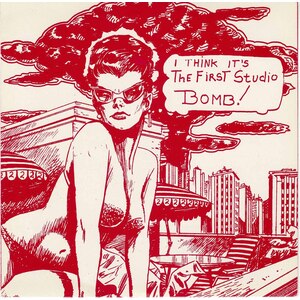
222's - I Love Susan b/w The First Studio Bomb (picture sleeve)

222's - I Love Susan b/w The First Studio Bomb (picture sleeve)
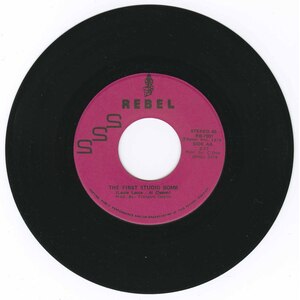
222's - I Love Susan b/w The First Studio Bomb (picture sleeve)
I Love Susan b/w The First Studio Bomb (picture sleeve)
Media
Videos
3 videos
Credits
Musicians
Louie Louie: vocals, keyboards, drums
Al Cleann: guitar
Chris O'Bell: bass, backing vocals
Songwriting
'I Love Susan' written by Louie Louie
'The First Studio Bomb' written by Louie Louie and Al Cleann
Production
Produced by François Doyon
Technical
Engineered by Bobby Labrosse
Recorded and mixed at Le Petit Studio du Nord
Publishing
Published by Duo Publishing
Release
Rebel RB-7901
7-inch, 45 RPM stereo single
Released 1978
℗ Rebel Records 1978
Rights society: PRO
Matrix numbers
RB. 7901A-1S CI RB. 7901 OC.: side A
RB. 7901B-2S CI RB. 7901 OC.: side AA
Track listing
A. 'I Love Susan' 2:02
AA. 'The First Studio Bomb' 2:17
No Comments