Insight
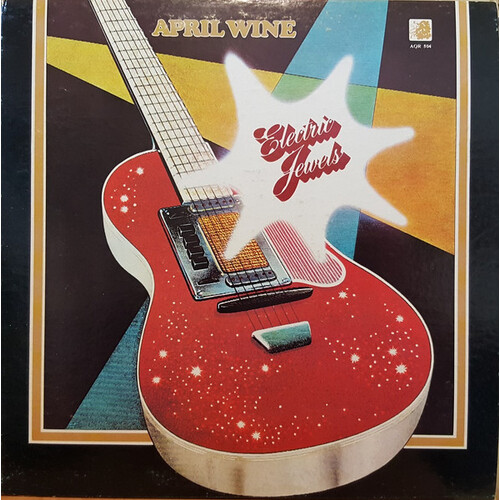
Electric Jewels marks the moment April Wine rebuilt itself from the inside out. What began as a period of strain and uncertainty—heavy touring, creative disagreements, and the eventual departure of David and Ritchie Henman—became the catalyst for a new identity, one defined by focus, power, and a growing sense of ambition. By the time the album was completed in 1973, April Wine had emerged as an entirely different band from the one that made the first two records, yet the transition is captured so naturally on these tracks that the transformation feels inevitable.
The early sessions still included the Henman brothers, whose imprint lingers in the album’s more atmospheric corners, but as the pressures of the previous year mounted, both stepped away before the work was finished. Rather than falter, the band found renewed strength in new arrivals. Guitarist Gary Moffet brought precision, melodic discipline and a keener sense of arrangement, while drummer Jerry Mercer—already widely respected for his explosive work with Mashmakhan—added the power and control that would soon become a defining feature of April Wine’s live shows. With these two players in place, the group took on a sharper edge, a confidence and tightness that had only been hinted at before.
The shift is immediate in “Weeping Widow,” a fierce, heavily driven track written by Robert Wright and delivered with a weight and urgency unlike anything in their earlier catalogue. Mercer’s drumming charges through the song with authority, while Moffet’s guitar work slices through the arrangement, giving Jim Clench’s lead vocal a forceful foundation. Contemporary listeners and later critics have often pointed to this opening cut as the moment April Wine truly stepped into a harder, more assertive sound, a blend sometimes described as Badfinger’s tunefulness fused with a dose of Zeppelin-like attack.
From there, the album unfolds with the confidence of a group discovering its new centre. The writing partnership between Myles Goodwyn and Jim Clench—formed partly out of necessity during the band’s transition—proves surprisingly natural. Songs like “Just Like That,” “Come On Along,” and “You Opened Up My Eyes” balance grit and melody with growing sophistication. Clench’s voice, darker and rougher than Goodwyn’s, adds depth and contrast, while Goodwyn’s emerging command as an arranger gives the songs a structural clarity that had not been present on the first two records.
The title track stands as the album’s emotional anchor, a slow-building piece whose mellotron textures, dynamic shifts and layered harmonies point to a band willing to reach beyond conventional rock forms. The lyric—“electric jewels in the hands of fools”—was later suggested by some listeners to reflect frustration with the industry machinery surrounding the group, though its broader mood of tension and fascination remains open to interpretation. What is certain is that “Electric Jewels” was the most expansive composition the band had recorded up to that point, a sign that April Wine’s ambitions were growing in scale as well as in volume.
The supporting players add colour without ever obscuring the band’s identity. Pierre Senecal’s organ lines, Richard Newell’s harmonica, and Bhen Lazaroni’s string arrangements all contribute to a richer sound palette, while still allowing the guitars and vocals to remain central. It is a fuller, more orchestrated approach, yet the band never loses the sense of rawness that keeps the music grounded.
The closing track, “The Band Has Just Begun,” is unusually candid in its sentiment, arriving at a moment when April Wine had just weathered one of the biggest changes in its young history. In hindsight, the message feels prophetic. The lineup that took shape during the making of Electric Jewels would carry the group through its most important years, and the sound forged here would become the foundation of April Wine’s rise across Canada and, later, beyond.
Although the album did not initially enjoy the chart success of the band’s later work, its reputation has grown steadily, and many longtime listeners consider it the group’s first fully realized statement. When CBC’s Bob Mersereau compiled his list of the Top 100 Canadian Albums in 2007, Electric Jewels appeared among the titles singled out for their lasting impact and influence. The recognition felt fitting: this is the record where April Wine stopped sounding like a promising young Maritime band and began sounding like the April Wine that would define Canadian rock stages for years to come.
-Robert Williston
Musicians
Myles Goodwyn: lead vocals, guitar, mandolin, piano, mellotron
Jim Clench: lead vocals, bass
Gary Moffet: guitar, vocals
David Henman: guitar
Richie Henman: drums
Jerry Mercer: percussion, vocals
Pierre Senecal: organ
Richard Newell: harmonica
Al Nicholls: backing vocals
Pam Marsh: backing vocals
Songwriting
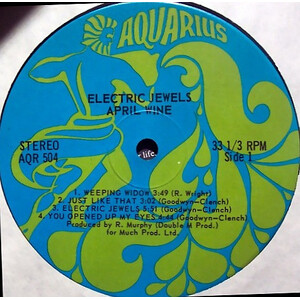
‘Weeping Widow’ written by R. Wright
‘Just Like That’ written by Goodwyn, Clench
‘Electric Jewels’ written by Goodwyn, Clench
‘You Opened Up My Eyes’ written by Goodwyn, Clench
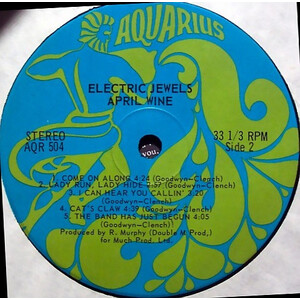
‘Come On Along’ written by Goodwyn, Clench
‘Lady Run, Lady Hide’ written by Goodwyn, Clench
‘I Can Hear You Callin’ written by Goodwyn, Clench
‘Cat’s Claw’ written by Goodwyn, Clench
‘The Band Has Just Begun’ written by Goodwyn, Clench
Strings arranged by Bhen Lazaroni
Published by Summerlea Music Ltd.; and Belwin Mills Music Ltd.
Production
Produced by R. Murphy (Much Productions Ltd.)
Recorded at Toronto Sound Studios
Recorded by Dave Halbert
Mixed at Co-Ordinated Sound Studios
Mixed by Terry Brown
Artwork
Design and graphics by Bob Lemm
Photography by Jacques Des Haies
Notes
Released with a lyrics insert
Bio
April Wine emerged at the end of the 1960s out of the fertile east-coast music community that stretched between Halifax and St. John’s. Brothers David and Ritchie Henman had played together since their teens in Newfoundland, eventually regrouping in Nova Scotia with their cousin Jim Henman in various lineups. Around the same time, Myles Goodwyn — born in Woodstock, New Brunswick and raised in a tough working-class household — was working through his own bands in the Halifax scene, including Woody’s Termites, Squirrel, and East Gate Sanctuary. When those projects dissolved in late 1969, the four musicians brought their strengths together under a new name that simply sounded right: April Wine.
Real opportunity lay outside the Maritimes. The group made a demo and sent it to Montréal’s fast-rising Aquarius Records; a polite rejection was misread as an invitation. On April 1, 1970, with little money and plenty of nerve, April Wine arrived unannounced in Montréal. Aquarius partners Donald K. Tarlton and Terry Flood heard something promising and signed them, putting the young band up in a rural chalet to write and rehearse while touring the region opening for Mashmakhan.
Their debut album April Wine (1971) introduced Goodwyn’s songwriting voice, and its standout track “Fast Train” became a Canadian Top 40 hit. With momentum building, April Wine returned to the studio with a new bassist — Montréal musician Jim Clench, who had replaced the departing Jim Henman — and English-born producer Ralph Murphy to craft On Record (1972). It became their first breakthrough: a muscular reworking of Hot Chocolate’s “You Could Have Been a Lady” shot to No. 2 in Canada and cracked the U.S. charts, while their cover of Elton John’s “Bad Side of the Moon” became a fixture at rock radio. The band quickly graduated from bars to theatres and arenas, opening for The Guess Who, Jethro Tull, Badfinger, Stevie Wonder, and Ike & Tina Turner, gaining the road experience that would define their next decade.
During the making of their third album Electric Jewels (1973), the Henman brothers exited the group; Goodwyn and Clench rebuilt the lineup with two crucial arrivals: drummer Jerry Mercer, already nationally known from Mashmakhan, and guitarist Gary Moffet. The chemistry was immediate. Electric Jewels became a formative record, showcasing songwriting depth in tracks such as “Weeping Widow,” “Just Like That,” and “Lady Run, Lady Hide,” and solidifying the band’s dramatic stage show, complete with lights and pyrotechnics, on their ambitious Electric Adventure tour.
Through the mid-1970s, April Wine became one of Canada’s most reliable and inventive rock bands. Stand Back (1975) pushed them into double-platinum territory with “Tonight Is a Wonderful Time to Fall in Love” and “I Wouldn’t Want to Lose Your Love,” while harder-edged tracks like “Oowatanite” turned into signature concert moments. When bassist Steve Lang replaced Jim Clench in 1976, the band entered its most commercially dominant phase. The Whole World’s Goin’ Crazy arrived with unprecedented platinum advance orders, followed in 1977 by the ballad-driven Forever for Now, whose single “You Won’t Dance with Me” became their best-selling Canadian record of the era.
In March 1977, April Wine unwittingly stepped into one of the most famous episodes in Canadian rock. Booked as headliners for a pair of Toronto charity concerts at the El Mocambo, they discovered that their “opening act,” listed as The Cockroaches, was in fact The Rolling Stones, secretly recording material for Love You Live. April Wine’s own set was captured and released as Live at the El Mocambo, a raw snapshot of a band hitting its stride just as guitarist-vocalist Brian Greenway joined the lineup. With Goodwyn, Moffet, and Greenway, April Wine became a formidable three-guitar outfit; Goodwyn could now move between guitar, keys, and vocals without leaving gaps in the band’s sound.
Their U.S. breakthrough came with First Glance (1978), recorded at Montréal’s Studio Tempo and Québec’s famed Le Studio in Morin-Heights. “Roller” unexpectedly surged on FM rock stations in Michigan, spreading across the U.S. and giving April Wine their first gold album outside Canada. The band was soon touring American arenas with Rush, Journey, Styx, and other major acts, no longer an opening act from the north but a rising international name.
They entered the 1980s at full strength. April Wine performed at the inaugural Monsters of Rock festival at Castle Donington in August 1980 before tens of thousands of fans, signalling their arrival onto the global hard-rock stage. Their next studio album, The Nature of the Beast (1981), recorded partly again at Le Studio, became the pinnacle of their international success. The soaring ballad “Just Between You and Me” broke the U.S. Top 20, while their explosive reimagining of Lorence Hud’s “Sign of the Gypsy Queen” became a defining FM rock staple. The album went multi-platinum in Canada, platinum abroad, and spent months on the Billboard 200, cementing April Wine’s presence across North America and Europe.
The follow-up, Power Play (1982), produced additional airplay with “Enough Is Enough” and “If You See Kay,” but the workload of back-to-back touring and recording cycles took its toll. Animal Grace (1984) and the more fragmented Walking Through Fire (1985) revealed a band under strain, and by the mid-1980s April Wine quietly dissolved. Goodwyn released a solo album on Aquarius and Atlantic; Greenway issued Serious Business; Mercer moved into session work and new collaborations.
By the end of the decade, however, classic-rock radio had revived interest. Goodwyn returned to Montréal in 1988 and began discussing a reunion with Greenway, Mercer, and Jim Clench. A renewed April Wine debuted live in 1992, playing to sold-out crowds across Canada and the United States. Their 1993 studio return, Attitude, went gold in Canada with the single “If You Believe in Me,” followed by Frigate (1994). The band spent much of the 1990s and early 2000s touring widely, sharing stages with Def Leppard, Foreigner, Meat Loaf, Nazareth, Blue Öyster Cult, and other cornerstone classic-rock acts.
Goodwyn brought the group back to its roots for Back to the Mansion (2001) and later the analog-leaning Roughly Speaking (2006). Lineups shifted as the years passed: Clench left and later passed away in 2010; beloved long-time bassist Steve Lang died in 2017; drummer Jerry Mercer retired after more than three decades. Their successors — notably bassist Richard Lanthier and drummer Roy “Nip” Nichol — kept the group’s live power intact alongside Greenway’s enduring presence.
Goodwyn’s 2016 memoir Just Between You and Me shed new light on his early life and the band’s long arc, and in 2018 he was inducted into the Canadian Songwriters Hall of Fame. April Wine themselves received the Canadian Music Industry Hall of Fame’s Lifetime Achievement Award in 2009 and entered the Canadian Music Hall of Fame at the 2010 Juno Awards.
In late 2022, facing ongoing health issues, Goodwyn announced his retirement from touring, but remained involved in writing and guiding the band. He performed one final live concert with April Wine in March 2023, joined by original bassist Jim Henman for a poignant reunion. Myles Goodwyn died in Halifax on December 3, 2023, at the age of 75.
April Wine continues to tour into the present with Brian Greenway, Richard Lanthier, Roy Nichol, and Marc Parent, carrying a legacy built on powerhouse guitars, durable songwriting, and more than fifty years of Canadian rock history — a catalogue that never left the airwaves, and a name that remains synonymous with the rise of Canadian rock on the international stage.
-Robert Williston
Gallery
Images
4 images
April Wine - Electric Jewels
April Wine - Electric Jewels
April Wine - Electric Jewels
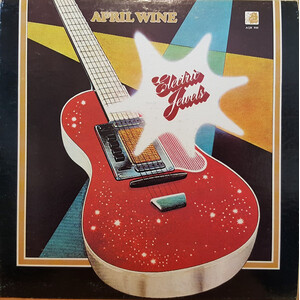
Electric Jewels
Media
Videos
0 videos
No videos available for this title.
Credits
In Transit
No Comments