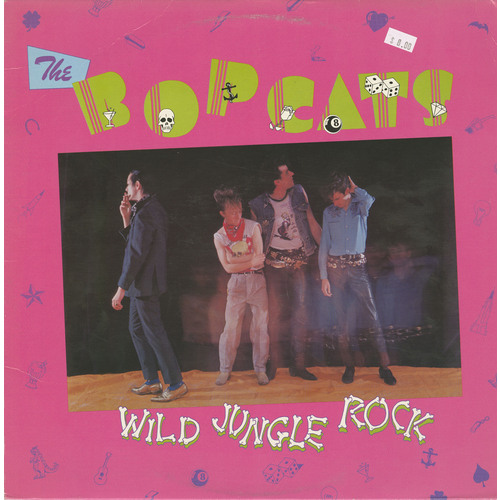
Insight
The Bopcats were among the first Canadian bands to take up the rockabilly revival, working Toronto clubs from 1979 to 1983 with the suits, the pompadours and the slap-back drive of 1950s Memphis, played at the volume of the punk and new wave rooms they shared. They cut their first record before the Stray Cats had released one.
Singer Sonny Baker, guitarist Jim McTaggart (performing as Duane Wayne), bassist Pat Flynn and drummer Teddy Fury made up the first lineup. On October 22 and 23, 1979, they recorded four songs at Comfort Sound in Toronto, co-producing with Dave Booth. Issued on the Showtime label as Extended Play around the turn of 1980, the EP set Wayne’s ‘Lose My Cool’ and the group-written ‘Rockabilly Baby’ beside ‘Rocket’ and the Webb Pierce and Mel Tillis song ‘Bop-A-Lena’.
A second Showtime record followed in 1980: Wayne’s ‘Caroline’ backed with ‘I Can’t Help It’, produced by Terry Wilkins and engineered by Chad Irschick. By August, Cam Marshman had replaced Flynn on bass. The Toronto Star photographed the four of them that month ahead of a night at the Horseshoe Tavern, noting that they were about to head out west for the first time, and Peter Goddard wrote that they were doing a lot of things right.
That lineup was still together in January 1981, when the band was taped live at Larry’s Hideaway, with John Catto of the Diodes sitting in on guitar for ‘Train Kept A Rollin’’. Two of those live tracks became the flip side of Kiss Goodbye, a three-song seven-inch that Attic Records issued that fall in a short run of picture-sleeve EPs. Attic’s Ralph Alfonso told RPM the label had picked the Bopcats because their early success had come with EPs, and that it planned to sell the series through new wave shops and to the bands themselves for sale at gigs.
By then Jack de Keyzer had joined. Born in London, England, in 1955, he had toured with King Biscuit Boy while still a teenager and then gone to New York to play guitar for rockabilly singer Robert Gordon, a job he took without ever having played the style. De Keyzer remembered the Bopcats asking him to join before that trip and signing on once he was back in Toronto in 1979, though his name first appears on their records in 1981. Zeke Rivers came in on bass.
The first Attic album, The Bop Cats, was released in 1981, produced by John Gibb and engineered by Kim Holmgren. It catches the band mid-change. De Keyzer plays throughout, Duane Wayne adds guitar on six tracks and Marshman is still on bass. Wayne wrote or co-wrote most of the originals with Baker, among them ‘Rockin’ A Dream’, ‘Kiss Goodbye’, ‘Crash Landing’ and ‘Dial Red’, and the covers reach back to Charlie Feathers’ ‘One Hand Loose’ and Buddy Holly’s ‘Down The Line’, with Conrad Keyes on piano. Dean Motter, the Toronto designer and comics artist, handled the art direction.
Wild Jungle Rock, recorded at Eastern Sound in Toronto, followed in 1982 with a settled four-piece of Baker, de Keyzer, Rivers and Fury, and by now the band was de Keyzer’s as much as anyone’s. He wrote or co-wrote ten of its fourteen songs and took the lead vocal on ‘Dressed To Kill’ and ‘Rock House’. Producer Bill Bryans, a Toronto drummer who had played with the Government and was about to co-found the Parachute Club, brought in Chicago blues pianist Sunnyland Slim for ‘What Did I Do Last Night?’. The covers ranged from Roy Orbison’s ‘Rock House’ and Jerry Lordan’s ‘Apache’ to the Four Tops’ ‘Yesterday’s Dreams’ and ‘Lights Out’, the 1958 Jerry Byrne rocker co-written by a young Mac Rebennack. ‘Stop Breakin’ Up My Heart’ was pulled as a single, and the album was also issued in France.
Trouser Press heard the strengths and limits of the whole revival in the Bopcats: real spirit on numbers like ‘One Hand Loose’ and ‘Rock House’, originals that strayed only as far as a little hard rock or R&B. It called the two Attic albums pleasing and close to interchangeable, giving Wild Jungle Rock the edge for its smouldering ‘Apache’.
The band was still filling the dance floor at the El Mocambo on October 1, 1983, with de Keyzer and Rivers in the lineup and a new EP in the works with help from Graham Shaw. By the end of the year de Keyzer had moved into the harder-rocking Rock Angels, which issued a 12-inch EP including ‘Calling All Girls’ before folding. De Keyzer later called the Bopcats a good live band whose records never sounded the way he wanted.
He went on to a solo career in the blues, beginning with Hard Working Man on Warner in 1991, winning the 2003 Juno for blues album of the year with 6 String Lover and collecting a long run of Maple Blues Awards. Teddy Fury stayed in Toronto rockabilly, tending bar at the Horseshoe and drumming with the Royal Crowns. In 1993 Attic put both Bopcats albums on a single CD in its Double Header series, swapping ‘Earthquake’ for the Rock Angels’ ‘Calling All Girls’.
-Robert Williston
Gallery
Images
5 images
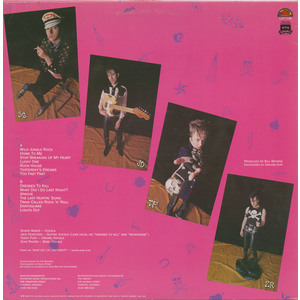
Bopcats - Wild Jungle Rock BACK
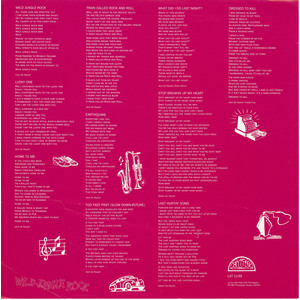
Bopcats - Wild Jungle Rock INSERT SINGLE-SIDED
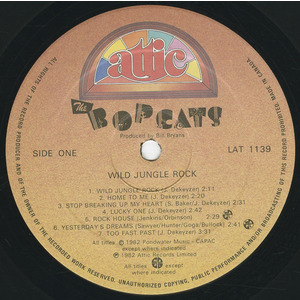
Bopcats - Wild Jungle Rock LABEL 01
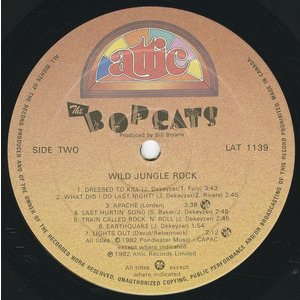
Bopcats - Wild Jungle Rock LABEL 02
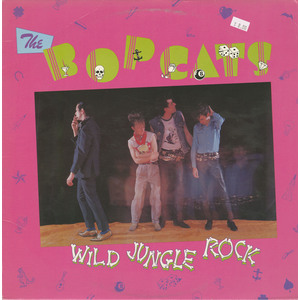
Wild Jungle Rock
Media
Videos
0 videos
No videos available for this title.
Credits
Musicians
Sonny Baker: lead vocals
Jack de Keyzer: guitar, vocals, lead vocals on ‘Dressed To Kill’ and ‘Rock House’
Teddy Fury: drums, vocals
Zeke Rivers: bass, vocals
Sunnyland Slim: piano on ‘What Did I Do Last Night?’
Songwriting
‘Wild Jungle Rock’ written by Jack de Keyzer
‘Home To Me’ written by Jack de Keyzer
‘Stop Breakin’ Up My Heart’ written by Sonny Baker and Jack de Keyzer
‘Lucky One’ written by Jack de Keyzer
‘Rock House’ written by Harold Jenkins and Roy Orbison
‘Yesterday’s Dreams’ written by Pam Sawyer, Ivy Jo Hunter, Jack Goga and Vernon Bullock
‘Too Fast Past (Slow Down-Future)’ written by Jack de Keyzer
‘Dressed To Kill’ written by Jack de Keyzer and Teddy Fury
‘What Did I Do Last Night?’ written by Jack de Keyzer and Zeke Rivers
‘Apache’ written by Jerry Lordan
‘The Last Hurtin’ Song’ written by Sonny Baker and Jack de Keyzer
‘Train Called Rock ’N’ Roll’ written by Jack de Keyzer
‘Earthquake’ written by Jack de Keyzer
‘Lights Out’ written by Seth David and Mac Rebennack
Publishing
Original songs published by Pondwater Music, CAPAC
Lyrics © 1982 Pondwater Music, CAPAC, except where indicated
Production
Produced by Bill Bryans
Technical
Engineered by Graham Duff
Artwork
Cover concept by The Bopcats
Photography by David Street
Art direction and design by Dean Motter for Diagram
Management
Managed by Showtime Music Productions Inc.
238 Crawford Street, Toronto, Ontario
Booking
Represented exclusively in Canada by The Agency
376 George Street, Toronto, Ontario
Release
Vinyl LP, stereo
Manufactured by Attic Records Limited
℗ 1982 Attic Records Limited
© 1982 Pondwater Music
Made in Canada
Issued with lyric sheet
Matrix numbers
Side A: LAT 1139 A
No Comments