Information/Write-up
David Bradstreet has long been one of Canada’s most quietly influential singer-songwriters — a musician whose voice, guitar work, and production sensibilities helped shape multiple corners of Canadian folk, acoustic, instrumental, and independent music from the 1970s onward. Best known for his much-loved song “Renaissance” and for winning the 1977 JUNO Award for Best New Male Vocalist, Bradstreet built a career defined not by commercial flash but by craft, commitment, and a startling breadth of creative reach.
Born in London, England, Bradstreet arrived in Canada as a child and gravitated toward music after studying architecture in college. By the early 1970s he was traveling the U.S. college circuit as a solo performer, honing the warm vocal presence and intricate fingerstyle guitar work that would become his signature. Back home, he rose quickly through the Canadian folk-club scene, recording early sessions in the basement of Bob and Danny Lanois’ mother’s home in Hamilton — a now-legendary incubator of Canadian talent.
Two pivotal years in New York City followed, where he worked under the wing of Peter Yarrow and Phil Ramone, performed as a duo with Mimi Fariña, and briefly joined Lazarus in Woodstock under Albert Grossman, touring alongside Todd Rundgren. During this period he wrote “Renaissance,” a song that became a Canadian folk standard and remains the cornerstone of his repertoire. Its success led to his JUNO win and opened the next phase of his career.
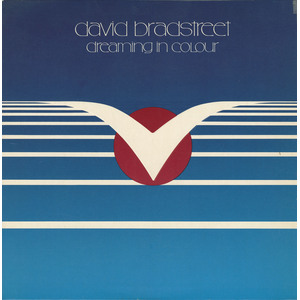
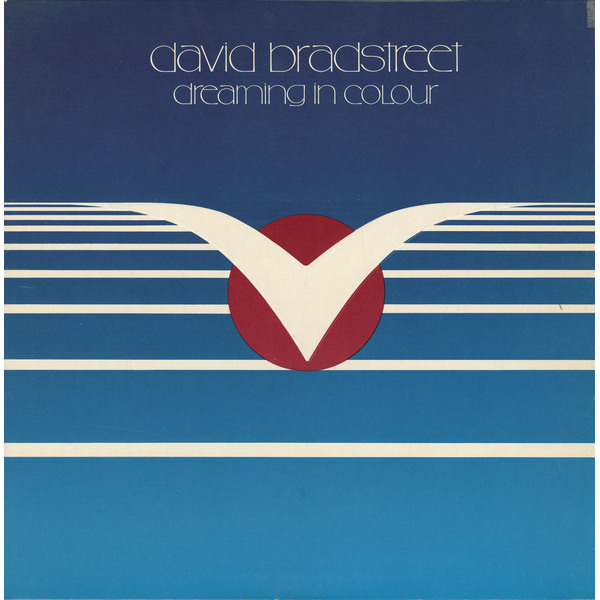
Signed to A&M Records, Bradstreet released the albums David Bradstreet (1976) and Dreaming in Colour (1977), produced by Don Oriolo and engineered by Ed Stasium, setting in motion a cycle of national tours, concert hall appearances, and CBC broadcasts. Rather than remain inside the major-label system, he pivoted to independence, releasing Black & White (1981) on his own Street Records imprint — the same label on which he produced the debut album of a then-unknown Jane Siberry, marking one of his earliest major discoveries as a producer.
His abilities behind the console became a parallel career. Bradstreet went on to produce or engineer projects for Billie Hughes, Carl Keesee, Nancy Simmonds, Colleen Peterson, Jason Fowler, Robert Priest, and many others, while co-creating highly successful instrumental and nature-themed recordings for Dan Gibson’s Solitudes series — several of which earned JUNO nominations and Gold and Platinum certifications. His work in film and television expanded steadily through the 1980s and 1990s, from TSN’s For the Love of the Game to commercials, documentaries, corporate scores, and theatre productions, reflecting both his versatility and the trusted reputation he carried in Canadian studio circles.
Bradstreet’s return to solo recording in the 1990s produced Renaissance (1998), followed by Lifelines (2006) with Jason Fowler and David Woodhead. He co-produced Tears of a Thousand Years, a benefit collection inspired by 9/11, and helped bring forward posthumous and tribute works including Colleen Peterson’s Postcards from California. In 2006 he launched TheraMusic, a series of music-therapy recordings (TheraSleep, TheraCalm) that found international audiences and broadened his catalogue into a new and unexpected field.
Later projects reaffirmed his enduring connection to songcraft. 08.20.10 (2010), recorded live-off-the-floor with Carl Keesee, showcased the intimacy of his voice, guitar, and writing. During 2011 he served as artist-in-residence in Antarctica, documenting the landscape in sound and image. He continued producing emerging artists such as Mira Meikle, while also returning to his own material with Best Foot Forward (2020) and Hindsight (2023), both recorded at his Toronto studio, The Cave. In 2025 he released Bradstreet & Keesee – Live in London, a document of two lifelong collaborators at ease in their shared musical language.
Across six decades Bradstreet has accumulated an unusually broad body of work: acclaimed solo albums, influential production credits, award-winning instrumental recordings, television and film scores, commercial work heard nationwide, and a reputation as a subtle, generous collaborator. Yet at the centre of his story remains the combination identified early in his career — a distinctive voice, a vintage Martin D-35, and a songwriting style marked by clarity, warmth, and emotional precision. That combination has made “Renaissance” endure, but it also explains the lasting impact of his larger catalogue, one that continues to grow as new generations discover his music.
-Robert Williston
Musicians
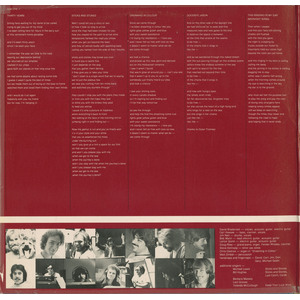
David Bradstreet: vocals, background vocals, acoustic guitar, electric guitar
Carl Keesee: electric bass, clarinet, background vocals
Jim Neil: drums, background vocals
Bob Mann: electric guitar, acoustic guitar
Lance Quinn: electric guitar, acoustic guitar
Doug Riley: piano, organ, Fender Rhodes, clavinet
Steve Kennedy: tenor saxophone
Chris Dedrick: organ (‘Dreaming in Colour’)
Matt Zimbel: percussion
Bill Hughes: background vocals
Michael Lewis: background vocals
Barbara Massey: background vocals
Lani Groves: background vocals
Yolanda McCullough: background vocals
Songwriting
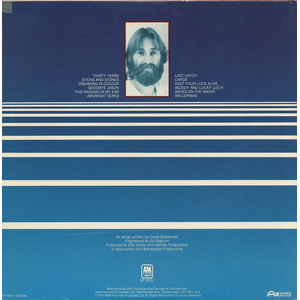
All songs written by David Bradstreet
© 1978 Irving Music of Canada Ltd. (Pro-Can)
Production
Arranged by Brad Baker; Terry Minogue; and Chris Dedrick
Produced by Don Oriolo of Freeflow Productions in association with Blackwood Productions
Engineered by Ed Stasium, assisted by Gary Gray
Executive producer: Michael Godin
Project management: Walter Grasser
Recording
Recorded and mixed at Manta Sound Company, Toronto, Ontario
Strings and horns recorded at the Hit Factory, New York City by Wayne Tanenbaum, assisted by Larry Gates
Mastered by Greg Calbi at Sterling Sound, New York City
This album was mixed using the Aphex Aural Exciter System
Contractors
String contractor: Irving Spice, New York City
Horn contractor: Lew DelGatto, New York City
Artwork
Cover design by Brenda Bradstreet
Art direction by Heather Moore
Cover colour by Alan Magee
Photography by David Bradstreet, Brenda Bradstreet, and Gary Gray
Notes
Bill Hughes appears courtesy of C.B.S. Canada Ltd.
Acknowledgements
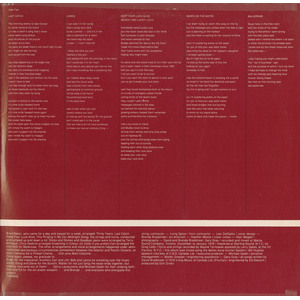
Brad Baker, who came for a day and stayed for a week, arranged ‘Thirty Years,’ ‘Last Catch,’ ‘Keep Your Luck Alive,’ and ‘This Ringing in My Ear (Midnight Song),’ as well as the strings and horns, conducted, and jumped up and down a lot. ‘Sticks and Stones’ and ‘Goodbye Jason’ were arranged by Terry Minogue; ‘Dreaming in Colour’ (or ‘Color’ if you prefer) was arranged by Chris Dedrick; ‘Ballerinas’ was arranged by Carl. The other arrangements and vocal arrangements happened under semi-controlled spontaneous circumstances somewhere between the Atlantic and Pacific Oceans, on land. I believe Ed is Pinball Champ. J. Don wins Best Costume.
Once again, my gratitude to Brad for the inspiration; brothers Carl and Jim; Bob and Lance for knocking over the music stand; Doug and Steve for the Scotch; Walter for not just tying the loose ends together, but making macramé out of them; Gerry Lacoursiere and Michael Godin for their undying faith; Don and Ed for the wit and/or wisdom; and Brenda — and everyone who energized this project.
No Comments