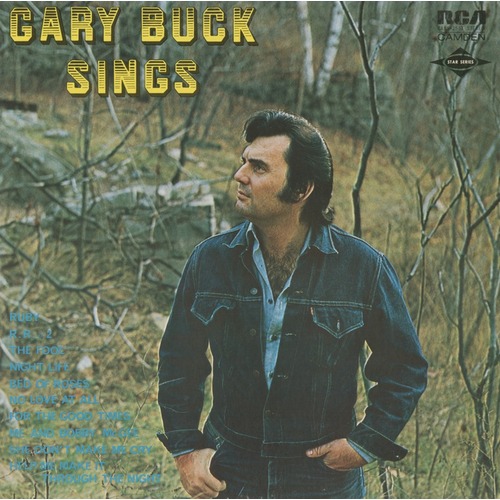
Album / Title
Gary Buck Sings
By: Gary Buck
Origin: Thessalon → Ste. Marie, Kitchener, Ontario → Didsbury, Alberta, 🇨🇦
Insight
Gary Ralph Buck was born on 21 March 1940 in Thessalon, Ontario, and grew up in nearby Sault Ste. Marie, where he became one of the most important and multi-faceted figures in the history of Canadian country music. Singer, songwriter, producer, publisher, label founder, executive, broadcaster, and institution-builder, Buck excelled in virtually every corner of the business over a career that stretched more than four decades. Few Canadian artists left a legacy as broad or as deeply embedded in the infrastructure of the genre itself.
His musical grounding came early. As a teenager in Sault Ste. Marie, Buck played guitar and bass and formed a local group called the Rock-A-Billies. He also became a regular on CKCY radio, singing with Ray Koivisto’s Country Caravan, one of the key northern Ontario country programs of the era. Like many Canadian country performers of the 1950s, he learned in real time — live on the air, in dance halls, and in front of audiences that demanded polish, confidence, and versatility. For a brief period he also pursued semi-professional baseball and even earned a tryout with the Washington Senators, but music ultimately proved the stronger calling. By the end of the decade he was recording in Toronto for the Canatal label, beginning a recording career that would soon take him well beyond Canada.
Buck’s breakthrough came in 1963 with “Happy To Be Unhappy,” released in the United States on the Petal label. The single became an international country hit, reaching No. 1 on the Cashbox country chart and breaking into Billboard’s country listings — a remarkable feat at the time for a Canadian artist. In doing so, Buck joined a very small group of Canadians, including Hank Snow and Myrna Lorrie, to make a significant impact on the U.S. country charts in that era. Cashbox named him one of the year’s top newcomers, and his follow-up singles confirmed that the success was no fluke. “The Wheel Song” became a second U.S. hit in 1964, while in Canada he quickly established himself as one of the country’s leading country vocalists through a steady run of charting releases and increasingly prominent radio and television exposure.
Throughout the 1960s Buck became one of the most visible Canadian country stars of his generation. Records such as “Break The News To Lisa,” “The Weather Man,” “Sorry About That Chief,” “Mr. Brown,” and “Wayward Woman Of The World” kept him on the RPM country charts, while his albums for Capitol positioned him as a polished, modern country singer equally comfortable with honky-tonk, ballads, Nashville material, and crossover repertoire. His profile rose further after he moved from Sault Ste. Marie to Kitchener, Ontario, where he starred on CKCO-TV’s The Gary Buck Show from 1967 to 1969. He also appeared widely on Canadian and American country television and made several appearances at the Grand Ole Opry in Nashville in the late 1960s and early 1970s, rare visibility for a Canadian artist of the period. By the early 1970s, releases such as Gary Buck Sings, Cold Wind On The Mountain, and Wayward Woman Of The World showed him broadening his repertoire while remaining rooted in contemporary country sounds.
As a recording artist, Buck’s catalogue was both substantial and stylistically wide-ranging. He recorded more than fifty singles and issued albums on Canatal, Petal, Capitol, Tower, RCA Camden, Broadland, and his own later labels. His hits stretched from early chart-makers like “Happy To Be Unhappy” and “The Wheel Song” to later favourites such as “It Takes Time,” “Saunders’ Ferry Lane,” “What’ll I Do,” and “You Can’t Change Horses.” He also wrote and recorded numerous commercial jingles, an often-overlooked but highly skilled part of his professional life that reflected his adaptability and his command of studio craft.
Yet Buck’s significance extended far beyond his own discography. He became one of the most prolific and respected producers in Canadian country music, working with an extraordinary roster that included George Hamilton IV, Dallas Harms, Dick Damron, the Family Brown, Tommy Hunter, the Mercey Brothers, Al Cherny, Wayne Rostad, Billie Jo Spears, Johnny Duncan, Gene Watson, and many others. His productions were valued for their clarity, professionalism, and commercial instinct, and his reputation as both a song man and a studio craftsman made him a central figure in Canadian country recording from the late 1960s onward. His own songs were recorded by artists ranging from Bobby Curtola and Donna Darlene to Orval Prophet, Tommy Hunter, and the Mercey Brothers, further underscoring his versatility as a writer.
In 1970 Buck moved more decisively into the executive and publishing side of the industry when he became general manager of Capitol Records’ publishing affiliate, Beechwood Music. In that role he helped shepherd and promote important material during a formative period for Canadian country-pop and singer-songwriter crossover success. He was associated with the early momentum behind Anne Murray’s “Snowbird,” Dick Damron’s “Countryfied,” and Dallas Harms’ “Paper Rosie,” all songs that would become deeply woven into the fabric of Canadian country and crossover music. Buck’s time at Beechwood also demonstrated how instinctively he understood the business of songs — not just performance, but publishing, placement, and long-term catalogue value.
That instinct led directly to his most enduring entrepreneurial achievements. In the early 1970s he founded Broadland Music, along with publishing companies including Doubleplay Music and Grandslam Music, helping create a Canadian-owned structure for recording, publishing, and artist development at a time when the domestic country industry still lacked stable infrastructure. Broadland quickly became a major force, issuing and administering recordings and songs by artists such as Don Cochrane, Alex Fraser, Dallas Harms, Patti MacDonnell, Artie McLaren, Orval Prophet, Ian Tyson, and many others. In 1976, Quality Records acquired a controlling interest in Broadland and the associated publishing companies, a sign of how significant Buck’s independent operation had already become. He later launched the GB label in 1977 and, after the collapse of Quality in the mid-1980s, revived the Broadland concept as Broadland International in Nashville in 1990, operating with a roster that leaned more heavily American while still maintaining strong Canadian ties.
Buck was equally important as an organizer and advocate. He served five non-consecutive two-year terms as international director of the Country Music Association in Nashville, beginning in 1970 and ending with a final term starting in 1990 — an extraordinary level of trust and recognition from the U.S. industry. In 1976 he co-founded the Academy of Country Music Entertainment, the organization that evolved into today’s Canadian Country Music Association, helping establish a national framework for the genre at a time when Canadian country artists had little coordinated institutional support. He also founded the Canadian Country Music Hall of Fame, which began inducting members in 1984, opened in Kitchener in 1989, and later moved to Calgary in 1999. Buck served as the Hall’s president and, in 2001, was inducted himself in both the artist and builder categories — an entirely fitting recognition for someone who had not only made the records, but helped create the systems that allowed Canadian country music to flourish.
Even while taking on executive and administrative roles, Buck never stopped performing or producing. Based at various times in Kitchener, Nashville, and Alberta, he continued to record, produce, and mentor artists well into the 1990s and early 2000s. Later albums such as Western Swing & Country (1998) and the gospel release Don’t Be Standin’ On The Outside (2002) showed that he remained creatively engaged and stylistically flexible. He continued working from Broadland’s Nashville and Calgary operations, producing Canadian and American artists alike and serving as a bridge between the domestic and international country industries.
Gary Buck died of cancer in Didsbury, Alberta, on 14 October 2003. He was posthumously inducted into the Northern Ontario Country Music Association Hall of Fame in 2004, but his larger legacy had already been secured long before then. As a performer, he was among the first modern Canadian country singers to achieve major recognition in the United States; as a producer and publisher, he helped shape the careers of countless artists; and as a founder, executive, and advocate, he built much of the institutional framework that Canadian country music still rests on.
-Robert Williston
Songwriting
'Me And Bobby McGee' written by Kris Kristofferson
'She Don't Make Me Cry' written by Jorrells Pickard
'Help Me Make It Through The Night' written by Jim Malloy, Kris Kristofferson
'The Fool' written by Ford
'For The Good Times' written by Kris Kristofferson
'R.R. #2' written by Barry Brown
'No Love At All' written by C. Carson, Johnny Christopher
'Bed Of Roses' written by Jerry Kennedy
'Ruby' written by Mel Tillis
'Night Life' written by W. Nelson
Production
Produced by George Semkiw, Gary Buck and Mark Smith
Arranged by John Arpin
Recorded in RCA's Toronto Studios
Artwork
Liner notes by Walter Grealis
Notes
Made in Canada by RCA Limited from master recordings owned or controlled by RCA Records
Lacquer cut at RCA Studios, Toronto
Pressed by RCA Records Pressing Plant, Smiths Falls, Ontario
Printed by Ever Reddy
Full public performance under license only
Printed in Canada
Liner notes:
Gary Buck isn’t new on the country scene. In fact, he has probably received more international recognition than any resident Canadian country artist. A few years ago, when production of Canadian country records was in its infancy, Gary Buck was scoring top marks on the international scene with strong listings on the U.S. trade charts. Unfortunately he was fighting an attitude of unfair indifference in his own country and was receiving only token air play here.
Over the years, Buck has moved into the field of producing other artists, utilizing many of the studios across Canada. Several of these artists became stars in their own right — and this certainly hasn’t been restricted to the country area. Rick Neufeld, Russell Thornberry and Green & Stagg, top-rated folksters, were all produced by Buck. Country artists, given the production hand of Gary Buck, included The Mercey Brothers, Lynn Jones, Tommy Hunter, Donna Ramsay, Orval Prophet, Lee Roy and many others.
It was because of his excellent knowledge of the Canadian recording industry that Gary Buck was appointed to head up Beechwood/Capitol Music of Canada. He was responsible for more than 450 individual copyrights being brought to the firm. All executive play was unfortunately making Buck a dull performer. After all, he was a country performer and sitting behind the console and company desk wasn’t really his ideal of doing his own thing. So, he resigned his position with Beechwood, the latter part of 1971 and hit out on his own — and a new label. His latest RCA single release, “Saunders Ferry Lane”, drew the following comment in the New MAPL Releases of RPM (Nov 21/71): “Buck’s into a new style that sets him out far and above his previous releases. He’s developed a leisurely don’t give-a-damn attitude that displays talent — not the overused country energy so often offered as talent. Buck isn’t too far out of range for the middle of the roaders with this one. Listen carefully to the background.”
Gary Buck has certainly developed a new style, and appealing to the easy listener is a move in the right direction for any country artist. This album is pleasurable proof that Buck has made an important move. He’s gone to a little more commercially with some of the big country hits of the past year: “Me And Bobby McGee”, “Help Me Make It Through The Night”, “Bed of Roses” and “Ruby”.
Singing other performer’s hits has never exactly turned the trick for recording artists but it’s interesting to witness, first hand, just what Buck can do with top-rated material. Just enough steel, a subtle vocal backing, country funk piano and a persuasive country-folk performance by Gary Buck that could be tagged a “discovery”.
Gary Buck will continue to produce for other artists, but has once again found his recording niche and this time around his chances for international success and, in his own country, couldn’t be better.
Fortunately for Gary Buck he doesn’t need the legislation crutch — but it helps.
-Walter Grealis
Gallery
Images
2 images
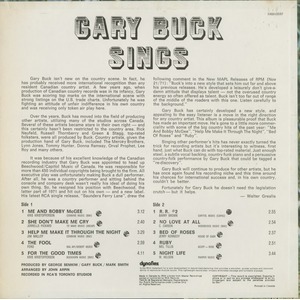
Gary Buck - Sings BACK
Gary Buck Sings
Media
Videos
0 videos
No videos available for this title.
Credits
In Transit
No Comments