Insight
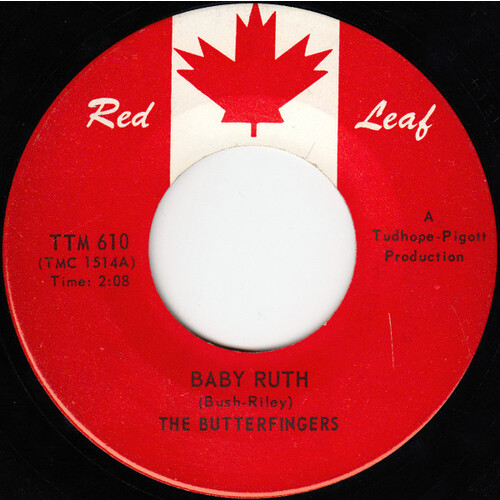
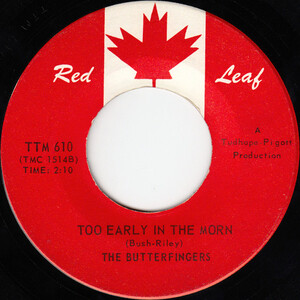
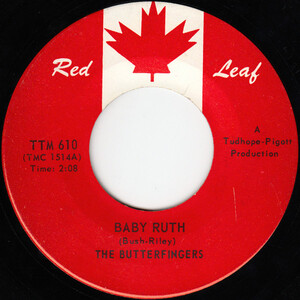
The Butterfingers were not a conventional band at all, but one of the most unusual and successful studio-created pop phenomena of mid-1960s Canadian music. Emerging in Toronto in early 1965, the name was attached to a one-off group of local musicians assembled for an advertising campaign, yet their debut single, ‘Baby Ruth’ b/w ‘Too Early in the Morn’ on Red Leaf Records, escaped its commercial origins and became a bona fide Canadian hit.
The project began at Toronto’s MacLaren Advertising Agency, where young producer Tony (Teddy) Tudhope was tasked with creating a youth-oriented campaign for Curtiss Candy, then promoting its newly acquired Butterfinger and Baby Ruth chocolate bars in Canada. Rather than rely on a typical ad-jingle approach, Tudhope sought out real teenage and young adult musicians from Toronto’s thriving club and studio scene, aiming for something with the feel of an authentic contemporary instrumental single rather than a disposable commercial. According to RPM, the musicians were originally nameless and had simply been hired as a pickup studio group to record a rock-based commercial for radio and television.
What happened next gave the project its legend. Before any formal commercial release, the track circulated as a white-label promotional disc tied to the ad campaign. Toronto broadcaster Glenn “Big G” Walters of CKEY discovered the record and began spinning ‘Baby Ruth’ regularly on his popular Wing Ding program. Teen listeners responded immediately, asking record stores for a song that at first effectively “had no name.” Once demand became obvious, Stan Klees of the newly formed Red Leaf Records tracked the source of the recording through Hallmark Recording Studios, contacted Tudhope, and rushed the single into commercial release on Red Leaf TTM 610. RPM later described it plainly: the Butterfingers “don’t exist,” but the record absolutely did — and it was released because the public demanded it.
Musically, ‘Baby Ruth’ and its flip ‘Too Early in the Morn’ were both written by Terry Bush and Doug Riley, two rising Toronto musicians already active in the city’s professional rock and R&B circles. RPM identified Bush at the time as guitarist with Robbie Lane and the Disciples and Riley as organist with the Silhouettes, placing the Butterfingers squarely within the same network of seasoned Yonge Street players and studio regulars who powered much of Toronto’s mid-1960s sound. Later collector sources have suggested that the session may in fact have drawn directly from members of Robbie Lane’s Disciples, which would make the Butterfingers less a real band than a temporary alias for an already established backing unit. While that exact lineup remains difficult to verify conclusively, the broader picture is clear: this was a professional Toronto studio ensemble built from top local talent rather than a self-contained touring act.
Released in February 1965, ‘Baby Ruth’ quickly became one of the earliest notable successes in the Red Leaf catalogue. The record charted nationally, appearing in RPM by mid-March and continuing to show momentum into the spring. RPM later described it as having made “sales history for a Canadian instrumental,” an impressive achievement in a market where instrumentals were notoriously difficult to break. Its success extended beyond the original campaign itself: despite the fact that the candy bars and radio spots were not equally present in every Canadian market, the record still found airplay and sales well outside the regions directly targeted by the advertising.
The single’s impact was significant enough that The Arrows soon recorded ‘Baby Ruth’ for the U.S. market on Tower Records, and RPM reported that efforts were underway to place the Butterfingers’ original internationally as well. In that sense, the record stands as an early example of a Canadian-made promotional concept unexpectedly crossing into the mainstream pop marketplace. It was a commercial tie-in, yes — but it was also a genuinely effective groove-driven instrumental that connected with teenagers on its own merits.
Though the Butterfingers never developed into a visible public act in the traditional sense, their story remains one of the most charmingly improbable in Canadian pop history: a fictional group, built for a candy-bar campaign, whose first release became a real charting hit. For Red Leaf Records, it was an early proof-of-concept that Canadian product could break nationally. For collectors, ‘Baby Ruth’ remains a quintessential mid-1960s Toronto oddity — a sleek, organ-driven instrumental born from the intersection of advertising, youth culture, studio craft, and the explosive energy of Canada’s early rock era.
Terry Bush: guitar
Gene Trach: bass
Doug Copeland: drums
William Cudmore: harmonica, sax
Paul Denyef: keyboards
Paul Mifsud: tenor sax
Doug Riley: organ
Gallery
Images
2 images
Butterfingers Baby Ruth bw Too Early in the Morn (2)
Baby Ruth b/w Too Early in the Morn
Media
Videos
0 videos
No videos available for this title.
Credits
In Transit
No Comments