Album / Title
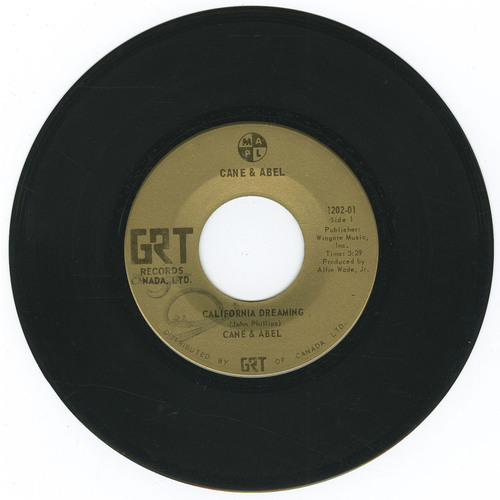
California Dreaming b/w Girl You Move Me
By: Cane & Abel
Origin: Montréal, Québec, 🇨🇦 → Paris, France
Insight
Cane & Able were a Montréal funk and soul group whose brief Canadian recording career led to a much more adventurous second life in Europe. Originally known as Cane & Abel, the band emerged from Montréal’s Black music community around 1970, combining soul, funk and rhythm and blues with a large horn-driven lineup. Within two years they had moved from a Canadian GRT single to two albums recorded in France, leaving behind a catalogue that later became sought after by funk and psychedelic-soul collectors.
The group first attracted wider attention in Montréal in the autumn of 1970. On November 16 GRT of Canada staged a showcase for its Canadian talent division at which more than two hundred of the city’s press, radio and television people turned out. The evening was organized by GRT’s Quebec branch manager Jim Corbett and featured Everyday People, Ronnie Hawkins with his new Edmonton backing band, and Cane & Abel, who according to RPM Weekly “rounded out the evening with a rowdy, ramrod set of standard R & B material.”
RPM described the group that month as an eight-man Montréal soul band that had “exploded onto the Montreal disc scene,” singling out their ability to take a familiar song and rearrange it into something of their own. Their first record paired a version of the Mamas and the Papas’ ‘California Dreamin’’ with the original ‘Girl You Move Me’, and RPM reported that it was already picking up strong play in Montréal.
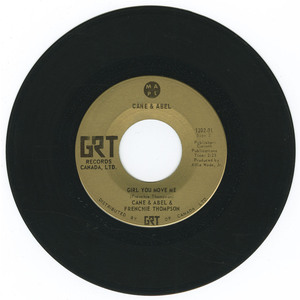
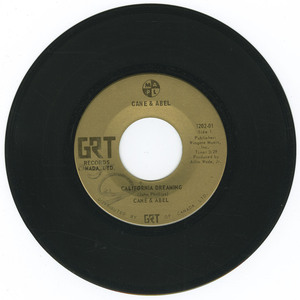
The single was released in Canada through GRT as 1202-01 in November 1970, with the A-side titled ‘California Dreaming’ on the label. It was produced by Alfie Wade, Jr. and published by Wingate Music, while ‘Girl You Move Me’ was written by vocalist Frenchie Thompson and published by Corinth Publications. The label identified Cane & Abel as the performers on the A-side, while the B-side was credited to Cane & Abel & Frenchie Thompson.
The record also documented the group’s Canadian identity through the MAPL system. ‘California Dreaming’ carried Canadian artist and performance designations, while ‘Girl You Move Me’ qualified in all four categories: music, artist, lyrics and performance.
Cane & Abel were already working beyond Montréal during this period. Accounts of the band’s early history place them on engagements in Mexico around the time of the GRT release, while Montréal radio gave the single local exposure. They were among the Canadian artists GRT was actively promoting as the company expanded its domestic recording operations at the beginning of the 1970s.
The band’s early membership drew together musicians from several parts of the Black North American music circuit. Frenchie Thompson handled lead vocals, Worthington “Doc” Brown played bass, Garland “Eddie” Edwards guitar, George “Pee Wee” Carter drums, Arthur “Blinky” Bostic percussion, Billy “Chillie Willie” Ellis saxophone, George “Apache Slim” Alford trumpet, and Norris Ridguard brass and vocals. Keyboardist Frank Abel was also part of the Canadian group.
The exact personnel at the time of the GRT single are difficult to reconstruct with complete certainty. Contemporary publicity described Cane & Abel as an eight-man band, while later discographies associate nine musicians with the Montréal period. The difference likely reflects personnel movement during the group’s transition out of Canada rather than a single fixed lineup.
Norris Ridguard brought a particularly deep musical background to the group. Born in Jamaica, he had played with Byron Lee and the Dragonaires before establishing himself in Canada, where he worked with the Toronto group the Cougars. His path through Jamaican music and the Canadian R&B circuit placed Cane & Abel within a broader movement of Caribbean musicians who helped reshape soul, funk and popular music in Canadian cities during the 1960s and early 1970s.
A major change followed in 1971. Frank Abel left the group and moved to France, and the band subsequently appeared under the spelling Cane & Able. Abel himself became involved with the Bobby Boyd Congress, an American group that had relocated to France in 1971 and that went on to record as Ice before becoming the Lafayette Afro Rock Band. Abel was the keyboardist through that lineage.
The remaining musicians also left Canada. Cane & Able spent time in Milwaukee and secured a relationship with Epic before moving to France, where their music took a markedly different direction. The compact soul arrangements of the Montréal period expanded into heavier funk, psychedelic rock and long-form ensemble playing.
In France the group worked with producer Claude Delcloo, an important figure in the country’s experimental jazz and progressive music community. Delcloo had been closely associated with the BYG/Actuel scene and was involved with recordings that crossed freely between jazz, rock, funk and experimental music. Cane & Able’s arrival placed a Canadian-formed soul band inside that unusually open European recording environment.
Their first album, Cane And Able, appeared on Epic in France in 1972 as EPC 64797, with pressings issued more or less simultaneously in the Netherlands and Spain and a Brazilian edition on Som Livre. The record retained the band’s Montréal core: Frenchie Thompson on lead vocals and arrangements, Worthington Brown on bass, Garland Edwards on guitar, George Carter on drums, Blinky Bostic on congas and timbales, Billy Ellis on saxophones, Norris Ridguard on trumpet, trombone and vocals, and George Alford on trumpet and vocals. Trombonist Tony Lytle and trumpeter Hasan Tayratira expanded an already large horn section.
Claude Delcloo produced the album, with Roland Guillotel engineering and Jean-Luc Pourquier assisting. The material included ‘Starchild’, ‘Who’s Gonna Take The Weight’, ‘Don’t Knock My Love’, ‘Green Grass’, ‘Toe Hold’ and ‘Found A Child’.
Most revealing was the return of ‘Girl You Move Me’, which now opened the record. What had been a 2:25 B-side on the Canadian GRT single was rebuilt as an eight-and-a-half-minute performance. The transformation shows how far Cane & Able had travelled musically in a short period. The Montréal recording was concise soul; the French version opened the song into a heavier, looser funk arrangement built around rhythm, horns and extended instrumental development.
The album mixed funk and soul with psychedelic guitar, forceful brass and Caribbean rhythmic elements. Rather than sounding like a Canadian group attempting to imitate American soul records, Cane & Able had developed into a large ensemble capable of moving between tightly arranged songs and much freer passages.
They were also a working live band in France, not simply a studio project. The English keyboard player Gary Moberley, who joined the group in 1972, later recalled touring for six months without a break through the south of France, from Menton and Cassis to the Voom Voom Club in St Tropez, then Marseille and back to Paris, sleeping on top of the Hammond organ in the band’s van. He described the group as eight Black musicians and himself at the keys, and remembered Cane & Able playing the Montreux Jazz Festival.
A second album, Relating A Message To You, followed on Epic in France in 1972 as EPC 65265. It was recorded in Paris in June and October of that year, with the core group joined by keyboardist Alan Reeves on piano and organ, pianist Patrick Gauthier, flautist Chris Hayward, strings conducted by Daniel Carlet, and backing singers Cher Kimbrow, Dotty Shipman, Maria Popkiewicz and Mauricia Platon. Claude Delcloo again produced, with the arrangements credited to the band.
The nine songs were ‘Be Free (Une Belle Histoire)’, ‘Sweet Burn’, ‘Maria’, ‘No Time’, ‘Mass Of Confusion’, ‘Keep On Moving’, ‘Relating A Message To You’, ‘Stoned Groove’ and ‘Gemma Morett’. The album continued the funk foundation of its predecessor while placing greater emphasis on soul vocals and ensemble arrangements, and the opening track’s subtitle points to how far the band had settled into its adopted country.
The two French albums were the group’s principal legacy. Cane & Able did not develop into a long-running recording act, and the musicians eventually moved into other projects. Their short existence nevertheless connected several otherwise separate strands of music history: Montréal soul and funk, Caribbean musicians in Canada, GRT’s early investment in domestic artists, the American soul circuit, and the experimental recording culture developing in France in the early 1970s.
Several members went on to notable careers. Frank Abel’s work in France placed him in the musical lineage that developed through the Bobby Boyd Congress and Ice into the Lafayette Afro Rock Band, whose recordings later became highly regarded in funk, Afro-rock and hip-hop sampling circles.
Saxophonist Billy Ellis eventually settled into the American funk and R&B scene and became a founding member of the S.O.S. Band, formed in Atlanta in 1977. Beginning with ‘Take Your Time (Do It Right)’ in 1980, that group became one of the most successful funk and R&B acts of the decade.
George Alford also continued working in adventurous music, later appearing with the Creative Improvisors Orchestra, while other Cane & Able members maintained careers that moved between Canada, the United States and Europe.
The group’s recordings gradually became collector items. Original French pressings of the first album in particular developed an audience among listeners interested in obscure funk, psychedelic soul and early 1970s groove music. Later reissues returned the material to circulation, including a new vinyl edition of Cane And Able in 2024 and further compact disc editions in Asia in the years that followed.
That later reputation can obscure the Canadian beginning. Before the French albums, before the extended funk workouts and before several members moved into other international groups, Cane & Able had been Cane & Abel, an eight-piece Montréal band recording for GRT of Canada.
Their 1970 single ‘California Dreaming’ / ‘Girl You Move Me’ preserves that first stage. The B-side is particularly important because it follows the band across the Atlantic: Frenchie Thompson’s ‘Girl You Move Me’ began as a short Canadian soul recording and reappeared in France as the opening statement of their first album.
-Robert Williston
Gallery
Images
2 images
45-Cane & Abel - California Dreaming VINYL 02
California Dreaming b/w Girl You Move Me
Media
Videos
0 videos
No videos available for this title.
Credits
Musicians
Frenchie Thompson: lead vocals
Frank Abel: keyboards
Garland “Eddie” Edwards: guitar
Worthington “Doc” Brown: bass
George “Pee Wee” Carter: drums
Arthur “Blinky” Bostic: percussion
Billy “Chillie Willie” Ellis: saxophone
George “Apache Slim” Alford: trumpet
Norris Ridguard: trumpet, trombone, vocals
Songwriting
‘California Dreaming’ written by John Phillips
‘Girl You Move Me’ written by Frenchie Thompson
Production
Produced by Alfie Wade, Jr.
Publishing
‘California Dreaming’ published by Wingate Music, Inc.
‘Girl You Move Me’ published by Corinth Publications
Canadian Content
‘California Dreaming’ MAPL designation for Artist and Performance
‘Girl You Move Me’ MAPL designation for Music, Artist, Lyrics and Performance
No Comments