Information/Write-up
Stan Cayer was a rockabilly singer, independent record producer, label owner, publisher, booking agent, and tireless self-promoter whose entrepreneurial drive made him a quiet but significant force in Vancouver’s music scene from the early 1960s through the 1970s. A consummate self-starter, Cayer built his career by handling every aspect of the business himself—writing, recording, producing, pressing, publishing, promoting, booking, and, when necessary, reinventing his own role in order to get records heard.
Born Stanley Gordon Melvin Cayer in Port Alberni, British Columbia, he became involved in music at an early age and was active in local bands by the end of the 1950s. According to Jim Rutherford, a longtime friend and musician who grew up with Cayer and later worked closely with him, Stan left Port Alberni to attend the University of British Columbia, where he joined a Burnaby-based group called The Invaders, which included pianist Tom Baird. After leaving UBC, Cayer returned to Port Alberni in late 1960 and joined The Renegades, a popular local band on Vancouver Island’s west coast circuit.
During this period, Cayer was involved in a serious automobile accident and contracted a highly contagious illness that left him hospitalized for several months. Rutherford recalls that Cayer was unable to receive visitors during this time, though bandmates would occasionally speak with him from the hallway outside his ward. According to Rutherford, it was during this extended hospital stay that Cayer wrote the songs that would later form the basis of his earliest recordings, using a Martin D-18 guitar brought to him in hospital. While he was ill, The Renegades were forced to replace him, and after his recovery he briefly joined a rival Port Alberni group, The Shants, before relocating permanently to Vancouver.
In 1963, Cayer made a decisive move that would shape the rest of his career. Having saved $1,000—a substantial sum at the time—he drove from Vancouver to Nashville with the intention of recording his original material. For security, he sewed the cash into the seat of his car before leaving. A devoted Elvis Presley fan, Cayer went directly to RCA Studios, where he connected with Bill Porter, Elvis Presley’s longtime engineer. Porter agreed to record Cayer’s songs and assembled a top-tier Nashville session lineup that included Floyd Cramer, Boots Randolph, and Harold Bradley, along with Charlie McCoy (harmonica), Hargus “Pig” Robbins (piano), and Buddy Harman (drums), with backing vocals supplied by The Anita Kerr Singers. The session yielded three original songs, recorded live to three-track tape and later mixed down to stereo masters suitable for commercial pressing.
According to Rutherford, Cayer later described how the Nashville musicians were amused by a 22-year-old artist from Canada confidently directing arrangements, and how the resulting recordings stood apart from standard country sessions of the period, reflecting a more rockabilly-driven approach.
Cayer later spoke of an encounter with Little Richard during this period, though accounts of the meeting vary. According to Jim Rutherford, who discussed the trip with Cayer in detail, the two may have met following a roadside breakdown near Los Angeles, after which Richard reportedly invited Cayer to his home, where they jammed informally on piano and guitar. Rutherford has stated that Cayer later played him a tape said to document this session. Other versions of the story circulated over the years, but no definitive documentation survives, and the precise details remain unverified.
Returning to Vancouver with his Nashville masters, Cayer explored releasing the recordings through established labels. Jerden Records in Seattle expressed interest, but Cayer declined due to contractual concerns. Instead, he chose to retain control of his work by founding SGM Records, named after his initials, along with Astral Music Publishing. When the first single—featuring “3 Wild Women”—was pressed, Cayer personally took it to CFUN Radio, presenting himself under the alias “Mel Gordon,” his fictional manager. According to Rutherford, who accompanied him, their initial plan was to purchase advertising to promote the record, but when that was refused, they relied on informal airplay tactics, including encouraging listeners to flood an evening request-and-vote program with calls. The strong response quickly pushed the song into regular rotation, helping it become a local hit. The record ultimately reached the Top 10 in Vancouver and performed strongly on Vancouver Island as well.
The success led to multiple appearances on CBC Television’s Let’s Go, hosted by Robinson. Between 1964 and 1965, Cayer appeared on the program five times, performing Elvis Presley songs in keeping with the show’s format of local artists covering current hits.
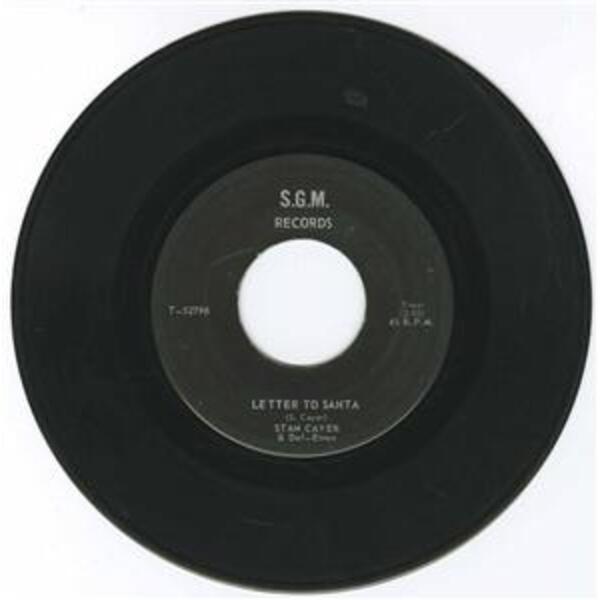
To capitalize on the momentum, Cayer recorded the holiday single “Letter to Santa” in late 1964 at Robin Spurgin’s studio on Broadway in Vancouver, using one of his unreleased Nashville tracks, “Crying on My Pillow,” as the B-side. According to Rutherford, because only three songs had been recorded in Nashville, a fourth track was cut locally with a group of Vancouver musicians that included Jim Rutherford (bass), Gerry Romaniuk (lead guitar), Tom Baird (piano), Ted Lewis (also known as Duris Maxwell) on drums, two female backing vocalists believed to be associated with The Valentines, and Cayer himself on rhythm guitar. The Christmas single performed well seasonally, prompting Cayer to issue a third single to spotlight the remaining Nashville recordings.
With proceeds from his early success, Cayer launched Top Teen Scene, a glossy, Vancouver-produced teenage music magazine modeled after Sixteen. The publication featured major international artists such as The Beatles and James Brown, alongside local advertisements and concert photography—much of it taken by Cayer himself—further reflecting his instinct for promotion and self-sufficiency.
By 1965, Cayer had shifted his focus toward producing, publishing, and managing other artists. Through SGM Records and Astral Music Publishing, he worked with a growing roster that included The Shags, Bernard John & the Bats, and The In-Crowd, the latter featuring Ross Turney and Larry Borisoff, both of whom would later become prominent figures in Vancouver’s rock scene. As his operations expanded, Cayer formalized his management activities under Rols Royce Bookings, which by the late 1960s had become one of Vancouver’s most active independent booking agencies.
In 1968, seeking a practical way for clubs and promoters to sample his artists, Cayer produced a four-track promotional EP featuring The Look, The Reign, The Silver Chalice Revue, and The Sound Set. Pressed by Compo Company in Quebec with a picture sleeve printed in Vancouver, the record was distributed primarily to venues and schools and proved effective in securing bookings. Around this time, Cayer was briefly approached by another developing agent interested in collaboration—Bruce Allen, who would later become one of Canada’s most influential music managers.
One of Cayer’s most sustained projects was Long Time Comin’, a reconfiguration of The Shags that emerged by the late 1960s. Between 1970 and 1972, he produced a series of singles for the group on SGM Records, including “Paper Rose” and “Downhill Slope,” some of which were distributed nationally through London Records of Canada.
Throughout the 1970s, SGM Records released a diverse catalog that included Sunday, David Sinclair, Cam Molloy, Flashlight, B. Jay Roberts, Beth Wright, Marv Wilson, and others, spanning rock, pop, country, gospel, and specialty projects, including television-related releases such as Daybreak for CHEK-TV. One oft-recounted episode involved gospel-soul singer Shirley Granger, who reportedly transferred ownership of her 100-foot schooner, Black Eyes, to Cayer in settlement of studio debts; the vessel later appeared on the cover of her 1977 LP Amidst the Black Eyes.
According to Rutherford, Cayer also maintained a small recording studio in a garage located in the alley behind his home on 12th Avenue in Vancouver, near Vancouver General Hospital, where he accumulated quality equipment and produced recordings that were regarded as surprisingly strong for such a modest setup.
In 2001, The Renegades reunited in Port Alberni for a Teen Town Reunion and invited Cayer to rejoin the group. Rutherford recalls that the band rehearsed for several hours to revisit material from 1960, after which Cayer delivered a strong performance. Audio and video recordings from the reunion are known to exist.
In later years, Cayer shifted his attention to real estate and other business ventures, achieving financial stability outside the music industry while remaining a familiar figure in Vancouver’s local business community.
Stan Cayer passed away on October 16, 2016, after a battle with liver cancer. Though he never became a national star, his legacy is deeply embedded in Canadian independent music history. As an artist, entrepreneur, and early architect of self-contained indie operations, he demonstrated how persistence, adaptability, and sheer hustle could sustain a music career entirely on one’s own terms.
-Robert Williston


No Comments