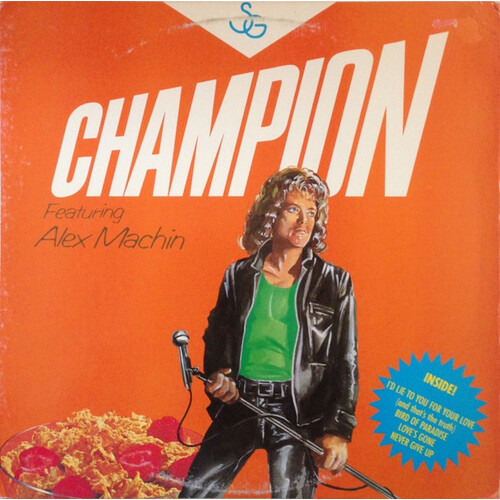
Insight
Champion was a short-lived Canadian rock band built around singer and songwriter Alex Machin, best known from A Foot In Cold Water. The group released one album, but its history stretched back several years and crossed through Los Angeles, Michigan and Toronto before ending abruptly when its record label collapsed.
After A Foot In Cold Water, Machin spent several years in Los Angeles working as a staff songwriter for United Artists Publishing Company and Preferred Sound Recording Studio. The period gave him time to develop as a writer away from the band that had made his name. Through Los Angeles lawyer Gary Turnbull, Machin met keyboardist Robyn Robins, an early member of Bob Seger’s musical circle, and the two began putting together a new group called Champion.
Machin and Robins moved to Robins’ native Michigan, where they recruited bassist Dave Rose and guitarist John Duva. Champion began playing live and developing material there. During the same period Machin worked with Mark Farner of Grand Funk Railroad on a song he had written in Los Angeles, with Farner adding background vocals to a recording Machin kept.
By the early 1980s Machin was looking back toward Canada. Canadian rock acts were enjoying increasing international success, and he saw an opportunity to rebuild Champion closer to home. The group changed again, with Rose and Duva staying connected to the project while the recording lineup expanded to take in several established Canadian and British musicians.
Solid Gold Records signed Machin in 1983. A later account of the negotiations says the label wanted Machin rather than Champion as a group, leaving him to carry the existing band into the record deal. Pre-production began soon afterward, with Brian Allen chosen to produce. Allen had been guitarist and principal songwriter with Toronto and was already closely associated with the Solid Gold roster.
The album sessions brought together a strong group of players. Machin handled lead vocals. John Duva and Ashley Mulford supplied guitars, with Brian Allen adding guitar, keyboards and backing vocals. Dave Rose and Mike Gingrich handled bass, Paul Hannah played drums, and Leo Sullivan contributed saxophone. Sharon Alton also appears in secondary album documentation as a backing vocalist.
Mulford brought substantial experience of his own. He had played with the British band Sad Café and had recently worked with Chilliwack. Rose was active elsewhere in Canadian rock and would become associated with David Wilcox. The record that came out of these sessions was a Machin-centred project built from Champion’s existing core and a circle of experienced studio musicians, more than a document of a fixed working band.
Brian Allen produced the sessions at Eastern Sound in Toronto, with Peter Mann engineering and Mike Baskerville handling additional engineering. The album credits also identify pre-production at Perceptions Studio and post-production at McLear Place, with Peter Norman involved at the later stage.
The self-titled Champion album was prepared for release through Solid Gold Records in 1984. RPM reported in August that the company was planning a large national campaign around the debut. “I’d Lie To You For Your Love (And That’s The Truth)” was selected as the first single, scheduled to ship August 13 in both seven-inch and twelve-inch formats, with the album set for September 12. A tour was also being planned.
The album contained ten tracks: “I’d Lie To You For Your Love (And That’s The Truth),” “Never Give Up,” “Runnin’ From My Love,” “It Ain’t Easy,” “Bird Of Paradise,” “Sin Sensation,” “Love’s Gone,” “Don’t Wait For Me,” “Hold On” and “One Of The Boys.”
Much of the writing came from Machin. “Runnin’ From My Love,” “Sin Sensation,” “Love’s Gone,” “Hold On” and “One Of The Boys” were credited to him alone, while several others were collaborations. “Bird Of Paradise” was written by Snowy White. “I’d Lie To You For Your Love (And That’s The Truth)” came from outside the Champion writing circle and was treated as the lead single.
The album sat squarely in the polished melodic rock of the period. Machin’s voice remained the centre of the record, while the production was broader and more radio-oriented than much of A Foot In Cold Water’s earlier work. Allen’s arrangement and production gave the songs the clean guitar and keyboard weight associated with Canadian arena rock in the first half of the 1980s.
RPM reviewed the album in October 1984 and treated it favourably. The magazine described Champion as an appropriate vehicle for Machin’s distinctive voice and developed songwriting, singled out “I’d Lie To You For Your Love” and “It Ain’t Easy,” and credited Ashley Mulford and John Duva with much of the guitar punch. It also praised Allen’s production for avoiding the sameness found in some contemporary hard-rock records.
The first single received radio exposure, and a promotional video was made for “I’d Lie To You For Your Love (And That’s The Truth).” According to Machin, the video went into regular rotation on MuchMusic. The clip survives today as a low-quality television recording, preserving a rare visual record of Champion during the brief period when Solid Gold was attempting to launch the band nationally.
The lead single acquired an unusual afterlife. Champion released “I’d Lie To You For Your Love (And That’s The Truth)” in 1984. A song under the closely related title “I’d Lie To You For Your Love” then surfaced twice in 1985, first on Danny Spanos’s album Looks Like Trouble, where it reached No. 42 on the US Mainstream Rock chart, and then in a Bellamy Brothers version that went to No. 2 on Billboard’s country chart and No. 3 on RPM’s Canadian country chart. That song is credited to Frankie Miller and Jeff Barry, with Howard and David Bellamy added for their lyrical changes, while Champion’s Canadian pressing credits Truth, Terry and Machin. The Solid Gold label does treat the track as an outside song, publishing it through England Publishing Company while assigning the rest of the album to Solid Gold Publishing, Chrysalis Music and United Artists Publishing. Song databases now index Champion’s recording as the earliest version of the Miller and Barry song, but that entry is user-contributed, and the conflict between the two sets of credits needs to be resolved from the label copy and the publishing registrations before Champion can be described as the first to record it.
The label then collapsed. By October 1984 Billboard was reporting serious financial trouble at Solid Gold. CBS had taken over Canadian distribution and had advanced the company money, but the label was struggling with production costs and disappointing international arrangements. Champion was named among the artists caught in the uncertainty surrounding the company.
Machin later said the timing could hardly have been worse. The Champion album arrived just as Solid Gold went into receivership. The promotional campaign stalled, the video disappeared from rotation, and the record lost the infrastructure needed to turn its early attention into sustained sales or touring.
That failure explains why Champion left such a small footprint despite the musicians involved and the national push that had been planned. The band had a label campaign, a commercial single, a music video, national trade coverage and a tour being organized when the company behind it stopped functioning.
Champion did not make a second album. Machin eventually returned to A Foot In Cold Water, taking part in the band’s 1988 reunion and later performances. He also moved into commercial voice work, singing television and radio jingles for companies including Molson, Budweiser, McCain, Chrysler and Hostess.
The Champion album acquired a second life in the 1990s. Machin’s own history says it was reissued on CD in Europe through Long Island Records. The CD edition added “Can’t Go Back” and an original version of “Love’s Gone” to the ten tracks from the Canadian LP. Current listings date the Long Island edition to 1994.
-Robert Williston
Gallery
Images
3 images
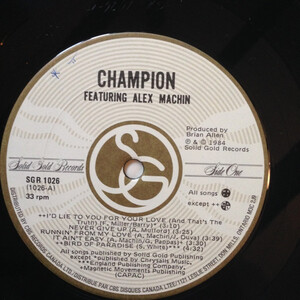
Champion - Champion (Featuring Alex Machin) Side One
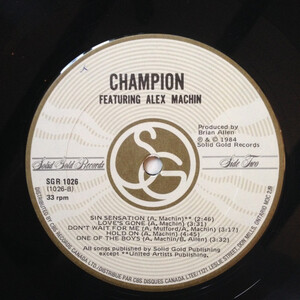
Champion - Champion (Featuring Alex Machin) Side Two
Champion (Featuring Alex Machin)
Media
Videos
1 video
Credits
Musicians
Alex Machin: lead vocals
Brian Allen: guitar, keyboards, backing vocals
John Duva: guitar, backing vocals
Ashley Mulford: guitar
Mike Gingrich: bass
Dave Rose: bass, backing vocals
Paul Hannah: drums
Leo Sullivan: saxophone
Songwriting
‘I’d Lie To You For Your Love (And That’s The Truth)’ written by Troy Truth, Billy Terry and Alex Machin
‘Never Give Up’ written by Alex Machin and J. Mulford
‘Runnin’ From My Love’ written by Alex Machin
‘It Ain’t Easy’ written by Alex Machin and G. Pappas
‘Bird Of Paradise’ written by Snowy White
‘Sin Sensation’ written by Alex Machin
‘Love’s Gone’ written by Alex Machin
‘Don’t Wait For Me’ written by Alex Machin and J. Mulford
‘Hold On’ written by Alex Machin
‘One Of The Boys’ written by Alex Machin
Production
Produced by Brian Allen
Arranged by Brian Allen and Champion
Engineered by Peter Mann
Additional engineering by Mike Baskerville
Assistant engineer: Alex Machin
Recorded at Eastern Sound
Post-production by Peter Norman
Artwork
Cover by Dean Motter and Modern Imageworks
Photography by Douglas Brown
Hair by Fine Lines
Make-up by Maja
Publishing
Published by Solid Gold Records
Published by Chrysalis Music
Published by United Artists Publishing
Copyright
© & ℗ Solid Gold Records
Physical Release
Vinyl LP
Canada
Manufactured by Solid Gold Records
Distributed by CBS Records Canada Ltd.
Lacquer cut at Columbia Records Pressing Plant, Don Mills, Ontario
Liner Notes
MAPL - Canadian Content
Rights Society: CAPAC
Additional Information
Matrix / Runout, Side A: SGR-1026-A 1A2H2
Matrix / Runout, Side B: SGR-1026-B 1A2H2
No Comments