Insight
The Courriers were an Ottawa-based folk trio whose brief recording career in the early-to-mid 1960s captured a very specific moment: when the North American folk boom was peaking, coffee houses were gateways to national exposure, and a young Canadian act could plausibly find itself moving between synagogue halls, university concerts, CBC studios, and rooms in Greenwich Village—sometimes all within the same year.
The group formed in 1958 around boyhood friends Mark Max and Russell Kronick, initially singing together in camp and community settings before formalizing as a performing act. Their earliest lineup included teenage singer Cayla Mirsky, and the group briefly performed under the name the Folklores before adopting the Courriers, a name that better fit their widening repertoire and ambitions. Both Max and Kronick came to folk music through the powerful example of Pete Seeger and the Weavers—not as imitators, but as young musicians who understood that folk could be dramatic, funny, fast, and intensely audience-facing.
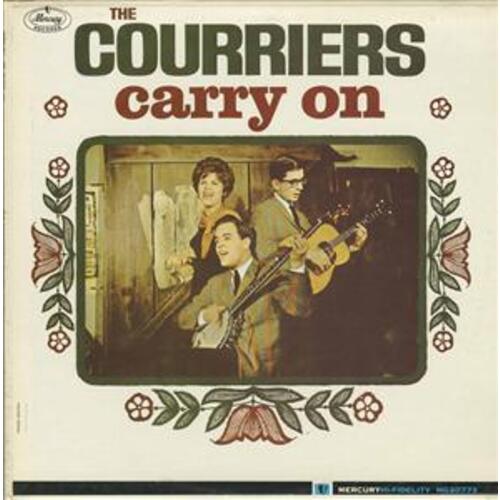
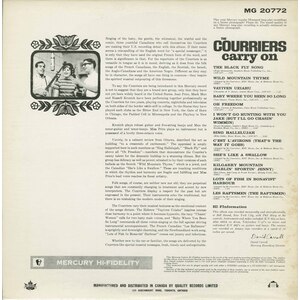
By 1961–62, management and bookings began pulling them beyond Ottawa into Montréal club work, U.S. college dates, and industry auditions in New York. When Mirsky left, the Courriers found a remarkable replacement in Jean Price, whose presence added a true ballad voice and expanded the group’s range. With Price, the Courriers cut their debut album for Mercury, The Courriers Carry On (recorded in 1962; issued 1963), a high-energy set that moved confidently through traditional material, gospel, and international folk themes. It was the record that introduced many listeners to the group—particularly via “Sing Hallelujah”—and it remains their most celebrated and sought-after release, prized for its speed, clarity of diction, and “build to the climax” vocal arranging that made the trio sound larger than it was.
The Courriers’ live history was equally telling. They played the American circuit in the places that mattered: the Bitter End in Greenwich Village, the Gate of Horn in Chicago, and university stages where folk groups could deliver full-concert bills. Their repertoire also allowed them to connect across cultural lines—whether singing Hebrew material, French-Canadian songs, or spirituals like “Oh Freedom”—and they earned a reputation for being entertainers as much as “folkies,” a stance that sometimes put them at odds with purists but won them broad audiences.
After Jean Price left, the group continued with Pam Fernie, shifting toward a slightly more produced and commercially contemporary sound as the folk marketplace itself evolved. Their Canadian recordings for RCA Camden—most notably From Sea to Sea (1964)—reflected that maturation: more measured pacing, richer harmony thinking, and originals that helped define their identity, including Kronick’s title song “From Sea to Sea” and “Cherry Bough Tree.” Around the same time, the Courriers were recognized at home as a leading Canadian folk act, including being named top folk group by RPM in 1964 (an award stream that would later align with the early Juno era), and they undertook major touring and broadcast work, including their own CBC television series.
By 1966, the practical realities that shadowed many folk-era groups—career decisions, health, and the changing musical landscape—began to close the first chapter. Kronick pursued law; Max built a distinguished professional life in arts promotion and communications; and the original momentum of the early 1960s folk circuit faded as popular taste moved rapidly toward rock and electrified singer-songwriters. Yet the Courriers never truly disappeared: the music remained deeply local in Ottawa memory, and decades later Max and Kronick returned to the stage for reunion performances and benefit concerts, proving that the spark that powered their early records was rooted less in fashion than in genuine musical chemistry.
Today, the Courriers are remembered as a rare Canadian example of a folk group that briefly touched the U.S. circuit while still sounding unmistakably like what they were: sharp, ambitious young performers from Ottawa who believed folk music could be both disciplined and fun—delivered at full speed, with every word meant to land.
-Robert Williston
Musicians
Mark Max: tenor guitar, tenor banjo, vocals
Russell Kronick: guitar, 5-string banjo, vocals
Jean Price: spoken voice
Songwriting
Written by Wade Hemsworth: ‘The Black Fly Song’
Written by Stuart Hamblen: ‘I Won’t Go Hunting With You Jake (But I’ll Go Chasin’ Wimmin)’
Traditional, adapted by The Courriers: ‘Wild Mountain Thyme’; ‘C’est L’Avirons (That’s the Way It Goes)’; ‘She’s Like a Swallow’; ‘Lots of Fish in Bonavist’ Harbour’; ‘Les Raftsmen (The Raftsmen)’
Traditional: remaining selections
Production
Manufactured by Quality Records Limited
Distributed by Quality Records Limited
Artwork
Photography by Frank Gauna
Gallery
Images
2 images
Courriers - Carry On
Carry On
Media
Videos
0 videos
No videos available for this title.
Credits
In Transit
No Comments