Insight
The Cry were a Canadian new wave and pop-rock band formed in Toronto, Ontario, at the end of the 1970s by Kimball Fox (born Kimball Meyer), following his departure from The Stampeders at the height of their commercial success.
Fox had spent the previous decade as drummer and vocalist in The Stampeders, one of Canada’s most successful pop groups of the 1970s, contributing to a remarkable run of Top 20 hits that included “Sweet City Woman,” “Wild Eyes,” “Carry Me,” and “Hit the Road Jack.” By 1979, having achieved sustained national success within a mainstream pop framework, Fox chose to step away in search of a more contemporary and artistically flexible direction.
The Cry took shape around Fox and keyboardist Robo MacPherson, with guitarist Gary Scrutton—who had also passed through the later lineup of The Stampeders—and bassist Brian Whitty completing the initial core. Seeking a clean break from his previous public identity and musical expectations, Fox adopted a new stage name and shifted his focus toward fronting the band. Drummer Billy Wade (formerly of Leigh-Ashford and Moxy) was brought in to handle percussion during the group’s earliest phase.
Musically, The Cry aligned themselves with the emerging new wave movement, blending sharp guitar lines, synthesizer textures, and concise pop songwriting. The band signed with Orient Records, distributed nationally by RCA, and released their self-titled debut album in 1980. Produced by Willi Morrison and Ian Guenther at Amber Studios in Toronto, the album established The Cry as a polished, radio-ready act with modern sensibilities. The material was largely written by Fox, with notable contributions from MacPherson—including “You” and “Razor’s Edge”—and a striking cover of The Kinks’ “I’m Not Like Everybody Else.” Singles such as “Crackdown” and “Can’t Get Close” supported an extensive cross-Canada touring schedule that kept the band on the road for much of the following year.
The band’s second album, Leave Your Bones in the Hall (1981), marked both a refinement and a transition. Drummer Billy Wade was replaced by Chas Mitchell, and the songwriting became more collaborative. While Fox remained the dominant voice, MacPherson’s “Congratulations” emerged as a key track and second single, alongside songs such as “Small Talk,” “Such a Crime,” and “She Was Only Dancin’.” The album retained the new wave foundation of the debut while leaning further into melody and atmosphere, reflecting a band growing more confident within its identity.
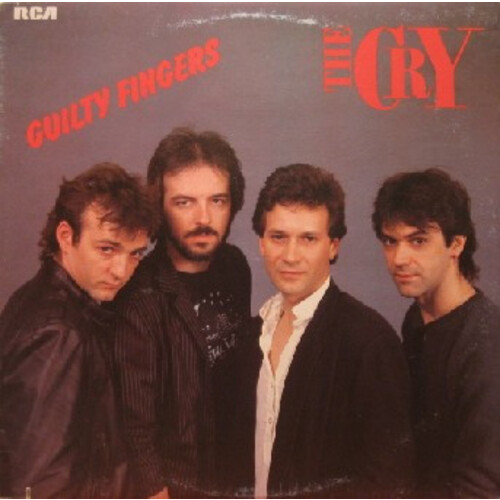
By 1982, internal changes again reshaped the group. Fox returned to the drum stool, reducing The Cry to a four-piece lineup. With Orient Records closing its operations, RCA assumed full responsibility for the band’s third album, Guilty Fingers, produced once again by Morrison and Guenther. The record represented a stylistic shift toward a smoother, pop-oriented sound, highlighted by songs such as “This Time,” “Last Lonely One,” and “Paper Dolls,” as well as a cover of Jimmy Ruffin’s Motown classic “What Becomes of the Broken Hearted?” A single pairing “Lookin’ for Love” with “This Time” showed early promise, but mounting internal tensions—both within the band and with management—soon brought the project to an end. The Cry disbanded shortly after the album’s release.
Following the group’s dissolution, Fox pursued acting throughout the 1980s, becoming a familiar presence in Toronto’s theatre community. He later returned to music in the mid-1990s with the reformation of The Stampeders and released his first solo album, A View from the Moon, in 2013.
Guitarist Gary Scrutton remained active in the industry as a road manager and guitar technician. Robo MacPherson and Brian Whitty transitioned into session and professional performance work, with MacPherson later joining Mike McKenna and the Slidewiders, while Whitty developed a parallel career as a specialist live performer.
Though their lifespan was brief, The Cry occupy a distinct place in Canadian music history—as a bridge between 1970s mainstream pop professionalism and the cleaner, more modern pop-rock aesthetics of the early 1980s, driven by artists willing to reinvent themselves rather than coast on past success.
-Robert Williston
Musicians
Kimball Fox: drums, lead vocals
Gary Scrutton: guitar, vocals
Robo MacPherson: keyboards, lead vocals
Brian Whitty: bass guitar
Production
Produced by Willi Morrison and Ian Guenther
Recorded and mixed by George Semkiw
Manufactured and distributed by RCA Inc.
Pressed by Cinram
Artwork
Photography by Kim Crowder
Notes
Released in 1982 on RCA (catalogue NKL1-0453).
Follow-up LP to the band’s 1980 self-titled debut, continuing The Cry’s polished new wave–leaning rock sound into the early 1980s.
Gallery
Images
1 image
Guilty Fingers
Media
Videos
0 videos
No videos available for this title.
Credits
In Transit
No Comments