Insight
An MoCM exclusive: both albums by Winnipeg producer and engineer Dan Donahue, Long Distance Runner (1978) and Motion (1980), are now streaming only at citizenfreak.com.
Dan Donahue made two albums under his own name, then spent more than four decades as one of Manitoba's busiest record producers and recording engineers. He was born in Winnipeg in 1951 and grew up in Fort Garry, the younger brother of Jim Donahue, one of the city's best-loved coffeehouse folk singers. Jim's name shared billboards with Joni Mitchell and Gordon Lightfoot. The Folkways records Jim brought home, with their thick booklets on where each song came from, were among the first records Dan studied closely. "Jim set the standard for every other folk performer in town," Dan said years later. He fought his piano lessons, picked up the banjo, and switched to guitar after the Beatles played The Ed Sullivan Show.
By 15 he was in bands around Fort Garry, starting with Safe & Sound, and by 1970 he was in a lineup of Love Cyrkle alongside Rob Langdon, Suzanne Goebel, Al Fieldhouse and Greg Gardner. He co-wrote 'Wind, Rain and the Seashore', the flip side of the group's Franklin Records single, although the label credits Langdon alone. An offshoot band built on original material came apart when its singer could no longer perform, and Dan walked away from rock. Lowering the drinking age to 18 had pushed Winnipeg bands out of community clubs and into bars that wanted covers. "I didn't want to play in the rock world because I just hated it, the politics of it, the economics of it," he says. "The folk scene seemed to be so much more civil."
He went solo while studying at the University of Manitoba, where he graduated in 1975. Much of his writing came out of northwestern Ontario, on canoe trips around Kenora and on freight trains he and his friends hopped east through the Shield, sometimes riding all the way to Toronto. His first record was a joke that caught fire. In the winter of 1974-75, as CBC Radio's As It Happens campaigned to make the beaver an official national symbol, Dan wrote 'I'm a Real Canadian Beaver Boy' in his bedroom and mailed it in. The show played it, the response was strong, and he pressed it as a single on his own Freckles Music label with 'Where Went the Railroad?' on the flip. Opening for Valdy before two or three thousand people at the University of Winnipeg, he closed with it. "Every time I hit the chorus, they'd all start laughing at the top of their lungs. I thought, well, it's sort of funny, but it's not that funny." Someone had to explain the double meaning to him afterward.
He played the second Winnipeg Folk Festival in 1975, on a bill with Bruce Cockburn, Stan Rogers, Sylvia Tyson, Valdy and his brother Jim, and returned in 1976, 1978 and 1980. CBC work followed, including segments for the folk series Touch the Earth in Toronto. He met Stan Rogers there on a Sunday afternoon at producer Paul Mills's house, where Rogers was sleeping off the night before on the living-room floor.
Long Distance Runner (Freckles Music WRC 343) was cut in 1977 on eight tracks at Kolossal Studios, a small room under a Winnipeg music store, with engineer Richard Denischuk and a cast of local players. "None of us knew what we were doing," Dan says. He wrote most of it after a trip through Europe, and 'Madrid' tracks a missed phone call and a train out toward Lisbon. The record is full of prairie and Shield imagery: a sister's heart "born on this eternal Prairie" in 'Welcome Home Sister', frosted windows and freight trains in 'Wild Canada'. 'Good Times (Sunny Uganda)' sends up the headline appetite for violence with a hijacked airliner landing in "sunny Uganda," written a year after Entebbe, and 'Skewbald' is a traditional Irish racing ballad. Dan played nearly everything himself, from guitars and piano to banjo, Irish whistles and harmonica. It came out in 1978, found an unexpected following in Japan, where it was written up in music magazines, and still draws collectors, some of whom write to him looking for copies. 'Wild Canada' has since been anthologized on the folk-rock collectors' series Folk Funk & Trippy Troubadours.
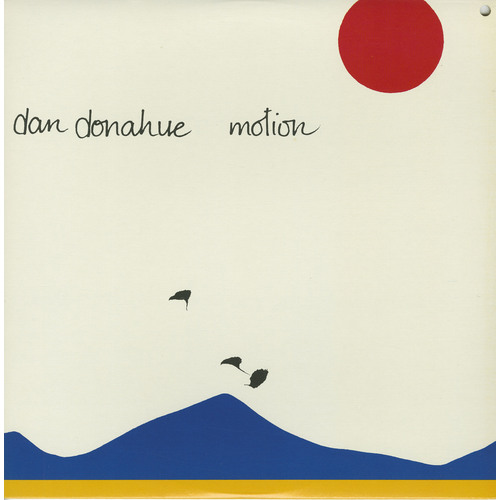
Motion (Freckles Music WRC1-1406) was a much bigger undertaking. Produced by Bill Garrett, it was recorded between November 1979 and September 1980 at three studios: Century 21 and Wayne Finucan's studio in Winnipeg, and Grant Avenue Studio in Hamilton, where Daniel Lanois engineered in the house he ran with his brother Bob. Sylvia Tyson, Jude Johnson, Pat Godfrey, David Woodhead and Winnipeg guitarist Danny Casavant were among the players. The songs look outward: a backyard fallout shelter stocked with a Betamax in '(If They're Gonna Drop) The Big One', energy shortages and Saudi oil in 'You Didn't Listen', street kids in 'When Home Provides No Comfort', and colonial wars in 'African Sun'. The insert printed every lyric in French as well as English. 'Christine' and 'Same Old World' were issued as a single.
Working at Grant Avenue changed his direction. Lanois was about to begin his run with Brian Eno, and Dan watched him closely. "I was so enthralled with the studio process because it was very different than what I had known up to that point." He had also started to feel boxed in by what folk audiences expected of him. A miserable outdoor show in Thunder Bay in 1980 settled it, and he stopped performing. Then the phone started ringing. He had already played electric guitar on Heather Bishop's first album, Grandmother's Song (1979). She brought him back to play and mix Celebration (1981) and then to produce Bellybutton (1982), her first children's album. He never went back to performing as a career. "There was never a grand plan," he says. "I just followed my instincts and the opportunities when they presented themselves."
Over the next four decades Donahue produced, by his own count, more than 300 albums, and close to 400 counting his engineering work, often playing on them as well. He worked with Connie Kaldor, Valdy, Heather Bishop, Carmen Campagne and Fred Penner, co-producing Penner's Happy Feet (1992), which Entertainment Weekly named its children's album of the year. Lullaby Berceuse, Kaldor and Campagne's bilingual album of lullabies, won the 1989 Juno Award for Best Children's Album, and projects he worked on have drawn more than 20 Juno nominations in all. By 1998, when Manitoba gave him the Prix Manitoba for distinguished service, the province already counted more than 100 albums. He wrote jingles, themes and scores for film and television, and turned down an offer from the CBC to become a network producer so he could stay independent. He also built a second practice recording orchestras, choirs and classical ensembles, including the Winnipeg Symphony Orchestra, the University of Manitoba School of Music and the Winnipeg Singers. He co-produced the Canadian Chamber Choir's In Good Company (2010) with Julia Davids, and in 2024 co-produced, recorded and mixed Deborah Romeyn's We Are Made of Stars, the seventh of her albums he has worked on.
He was a founding member of the Manitoba Audio Recording Industry Association, the body that became Manitoba Music. He has served on the boards of the Manitoba Chamber Orchestra, Manitoba Music and the Music Professionals of Manitoba, was vice chair of Artists in Healthcare Manitoba, and in 2018 was named chair of Manitoba Film and Music, a post he held through 2022. He works today as Dan Donahue Creative from his Lion's Den studio in Winnipeg. About 25 years ago he secured federal money toward an online archive of Manitoba music, but the province never came on board. He now hosts Transcontinental on Winnipeg's CJNU and produces short radio histories of Manitoba music, and he hosts the station's presentation of the 12-hour CHUM documentary The Story of the Beatles, the band that put a guitar in his hands. He is also co-producing an album that reimagines Manitoba songs, from Bob Nolan's 'Cool Water' to Ray St. Germain, which will come with a book in the manner of the Folkways records his brother brought home.
-Robert Williston, (interview with Dan Sept 24, 2026)
Gallery
Images
6 images
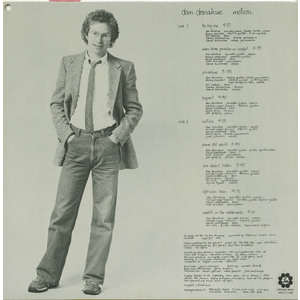
Dan Donahue - Motion BACK
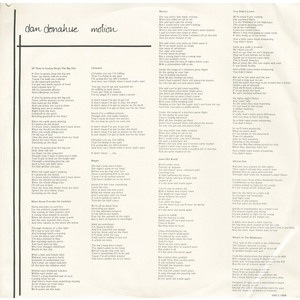
Dan Donahue - Motion INSERT SIDE 01
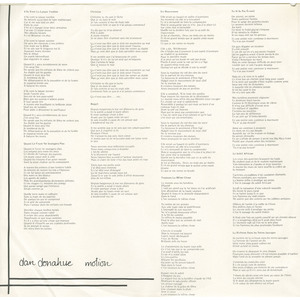
Dan Donahue - Motion INSERT SIDE 02
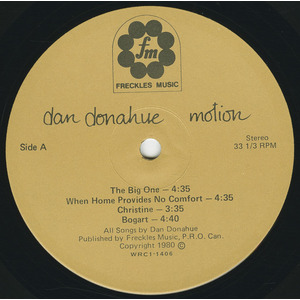
Dan Donahue - Motion LABEL 01
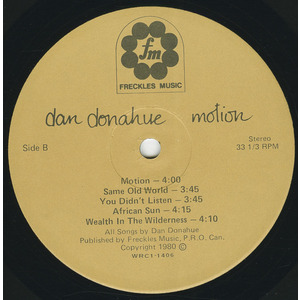
Dan Donahue - Motion LABEL 02
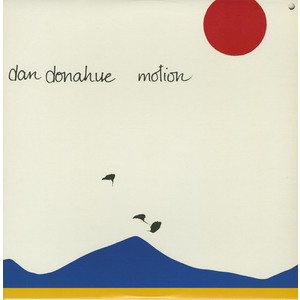
Motion
Media
Videos
0 videos
No videos available for this title.
Credits
Musicians
Dan Donahue: acoustic guitar, electric guitar, acoustic piano, Fender Rhodes, synthesizer, vocals, percussion
Danny Casavant: electric guitar, 6-string bass, high-string acoustic guitar, vocals
Bill Wallace: bass
David Woodhead: bass
Harvey Kostenchuk: drums, percussion
David Lewis: drums, percussion
Matt Zimbal: percussion
Michael “Pepe” Francis: electric guitar, acoustic guitar
Pat Godfrey: piano, Fender Rhodes
Ed Roth: synthesizer, Fender Rhodes, Hammond organ
Ilena Zaramba: vocals, percussion
Jude Johnson: vocals
Sylvia Tyson: vocals
Songwriting
All songs written by Dan Donahue
Published by Freckles Music, P.R.O. Canada
Production
Produced by Bill Garrett
“The Big One” and “Christine” produced by Bill Garrett and Dan Donahue
Ron Dann: charts
Technical
Recorded between November 1979 and September 1980
Recorded at Grant Avenue Studios, Hamilton, Ontario by Danny Lanois
Recorded at Finucan Studios, Winnipeg, Manitoba by Clive Perry
Recorded at Century 21 Studios, Winnipeg, Manitoba by Ralph Watts
Mastered at The Lacquer Channel, Toronto, Ontario
Artwork
Jamie Campbell: front cover
Gerry Kapelow: back cover photograph
Melodie Doherty: lettering
Susan Gfellner, Mona Gautier and John Hutchings: French translations
Release
Freckles Music
WRC1-1406
Copyright 1980
Freckles Music
4 River Park Close
Winnipeg, Manitoba R2M 4T8
(204) 255-1818
Special thanks
Mom
Pam
Bill G.
Danny C.
Dad
Jamie
The Lanos
Wayne Finucan
Clive Perry
All the players who opened my music and my eyes
No Comments