Insight
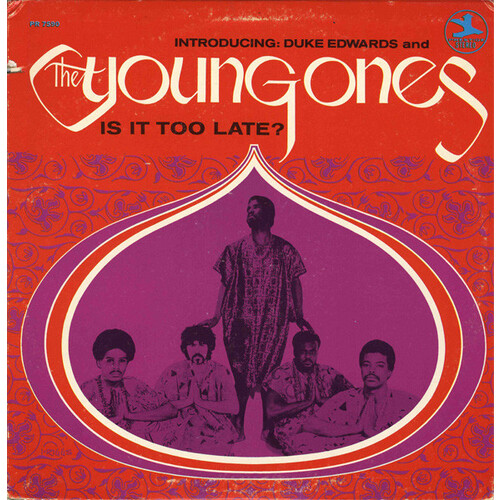
In March 1968 a band of robed musicians from Montréal’s Black nightclub scene had people lining up outside the Penny Farthing in Toronto’s Yorkville Village. Within six weeks the American jazz label Prestige was recording them in Montréal. Duke Edwards & The Young Ones lasted little more than a year, and their only album, Is It Too Late?, was made in Montréal on April 29 and 30, 1968, by musicians from Montréal, Toronto and the United States. It is one of the most adventurous records made in Canada in the 1960s.
Eddie “Duke” Edwards Jr. was born in New Orleans on February 24, 1936, into a Creole family with generations of jazz musicians in it. He started out in the US Coast Guard’s drum and bugle corps, studied music in Boston, and in 1961 followed the chitlin’ circuit north into Canada. He played Montréal’s Harlem Paradise that year, brought Duke Edwards and The Emperors back there in January 1963, and drummed with Sun Ra’s Arkestra in the early 1960s. Toronto became his base. With booking agent Ron Scribner he worked as musical director and co-manager of Jon & Lee & The Checkmates, one of the city’s hottest live acts and the band that later gave Rhinoceros John Finley, Michael Fonfara and Peter Hodgson. When the group, renamed The Jon-Lee Group, issued its lone single on Sparton in 1967, the B-side was Edwards’ instrumental ‘Pork Chops’. The A-side, ‘Bring It Down Front’, reached number 23 on the RPM chart that October.
Organist Jeff St. Julian Brown was born in Philadelphia on June 14, 1940, the son of a Methodist pastor. He sang in The Challengers with his cousin, the jazz organist Larry Young Jr., played in the Birdlanders alongside Woody Shaw, and worked as singer and musical director for Shep & The Limelights and Little Anthony & The Imperials before touring behind Solomon Burke and Rufus Thomas. In 1962 he came to Montréal with the Earl Lett Quartet for a booking at the Grand National and decided to stay. His Jeff Brown Quartet packed the Grand National and Harlem Paradise, then became the house band at the Esquire Show Bar on Stanley Street, the city’s leading soul room, where they backed the Motown acts and touring American stars passing through. Brown also cut a single, ‘Ain’t That A Groove’, for the short-lived Dinosaur label.
Edwards settled in Montréal in 1967. Later biographies, drawing on Edwards’ own account, name him musical director of Expo 67, though no Expo record of the appointment has been found. During one of Brown’s sets at the Esquire, Edwards asked him to put together a new jazz act, and in July 1967 Brown built it from his own house musicians: Toronto guitarist Wayne Prue, Toronto drummer Clayton Johnston, Pittsburgh-born trombonist Dickie McGee and Bernard Moore on tenor saxophone and flute. Edwards fronted them as singer, narrator and percussionist. The Montreal Gazette later counted 52 instruments among the six of them.
Edwards wrote no charts. He handed the band an idea and let them build it into what he called a cycle, a continuous piece that could run 45 minutes through jazz, blues, gospel, African rhythm, calypso and spoken narration. By April 1968 RPM reported 72 cycles in the book, among them ‘A Tribute To Africa’, ‘A Trip To The New World’ and ‘A Tribute To Billy Joe’. The band called its music Ratamalic (the McGill Daily printed it as Ramadalic), a word Edwards assembled from Egyptian names and a term for total awareness. On stage they wore bright Egyptian-style robes and greeted the audience with a salaam before and after every show. Their revue A Touch Of Black, a musical history of Black life in North America, ran fourteen weeks at Le Club, upstairs from the Le Drug club on Mountain Street, where the McGill Daily’s listings billed the band in November 1967 as Jeff Brown & The Young Ones. They also played the Black Bottom and the African pavilion’s Salle africaine at Expo 67.
In March 1968 club owner John McHugh brought the Young Ones to the Penny Farthing. The first nights drew small crowds. Word travelled through the Village, and by the end of the run RPM reported hundreds of people turned away from a full house. Promotion man Paul Findlay brought an RPM writer to a 10 PM set, and the writer stayed until 3:30 in the morning. The Toronto Star photographed Prue, Edwards, Moore and McGee on that stage on March 18. In April the band made the same impression at Stanstead College in Quebec’s Eastern Townships.
Prestige A&R director Cal Lampley signed Edwards to the label in the spring of 1968. The sessions took place in Montréal on April 29 and 30, with Lampley producing and Michel Éthier of the RCA Victor studios engineering. Richard Woodson played trombone in place of McGee, and Doug Richardson, a Toronto tenor player who had worked in Montréal for the past ten years, joined Moore on ‘Black Elephant’. Rudy Van Gelder cut the lacquers in New Jersey. Is It Too Late? (Prestige PRST 7590) appeared that summer. Side one held the thirteen-minute title piece and ‘Black Elephant’. Side two was the 21-minute suite ‘Man’, in three movements: ‘Don’t Cry Baby’, ‘Why?’ and ‘Reach For A Star’. Prestige also edited ‘Is It Too Late?’ into a two-part single (Prestige 45-706), and sent radio stations a promotional single coupling ‘Don’t Cry Baby’ with a track RPM listed as ‘Why Don’t They Leave Us Alone’.
The band worked hard through the spring and summer. After a week at the Night Owl in Toronto they played the Hawks Nest and the Sapphire Tavern, and on June 5 they opened for Cream at Massey Hall, playing for an hour without a break. RPM’s reviewer liked the idea but found too much preaching for a concert hall. They opened for Cream again at Montréal’s Centre Paul-Sauvé on June 11 and for Jefferson Airplane in the same arena on July 12. In between, the Gazette sent readers to the New Penelope to hear “the group many consider the best in the city.” They played the pop festival at the Autostade on July 17, the Black Bottom in August, and the University of Hartford in Connecticut with the poet LeRoi Jones.
Prestige’s Canadian distributor, Musimart, worked the album hard, with Shelly Rosenberg pushing it in Ontario. In Montréal, CFOX picked the album, CJAD gave it exposure, and CJMS said it would push it. By the end of September Musimart was reporting it as a solid seller in Montréal, and it was moving in New York and Detroit too. Edwards later said he ended the group after learning the album had caught the attention of militant activists in Detroit. His one-year Prestige contract had been his alone and never covered the band. On September 30 RPM told its readers the Young Ones were no more and called Brown “one of the best organists in North America,” though the band still played Yale University on October 5 and was back at the Black Bottom that November. Edwards also recalled that Prestige had recorded about three albums’ worth of material. Only one was issued. The Young Ones reunited for a performance at Detroit’s Easter Jazz Festival on April 6, 1969.
Edwards formed The Duke Edwards Cycle with former Checkmates guitarist Larry Leishman and bassist Herman Pittman, playing La Licorne in Montréal in November 1968 and drawing a contract offer from Polydor. Before it was signed, Rhinoceros manager Sid Bernstein brought Leishman into the Elektra band in the summer of 1969 and Edwards that autumn. Edwards sang and drummed on Rhinoceros’ final album, Better Times Are Coming (1970), and co-wrote five of its songs: the title track ‘Better Times’ with Michael Fonfara and John Finley, and ‘Old Age’, ‘Sweet, Nice ’N’ High’, ‘Lady Of Fortune’ and ‘Rain Child’ with Leishman. He left the band in 1970, and in 1972 he led Papa Dukie and the Mud People, a travelling commune that spent 22 months on the Mississippi River levee at Wallace, Louisiana, working for better race relations. In 1985 he founded the Louis Armstrong Foundation in New Orleans and led it until his death. He died on March 20, 2016.
Clayton Johnston went on to work with Sonny Greenwich, Don Thompson, Nelson Symonds and Charlie Biddle. Doug Richardson joined the Canadian rock band Motherlode in 1970, played with Roland Kirk, and around 2000 co-founded the hard bop group Kollage with his childhood friend Archie Alleyne. Richard Woodson stayed in Montréal, playing on Jean-Claude Labrecque’s film Le dernier des coureurs des bois and on Les Sept Paroles du Québec with Michel Donato and Raôul Duguay. Michel Éthier won the first Juno Award for Recording Engineer of the Year in 1976. Jeff Brown remained in Montréal until his death in 2003.
The album was hard to find for decades. In 2017 Soul Jazz Records put ‘Is It Too Late?’ on Soul Of A Nation: Afro-Centric Visions In The Age Of Black Power, issued alongside the Tate Modern exhibition of the same name.
-Robert Williston
Gallery
Images
3 images
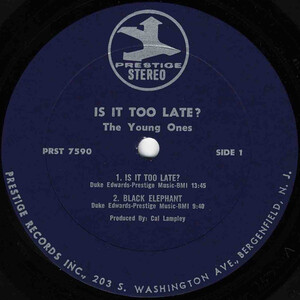
Edwards, Duke & the Young Ones - Is It Too Late? Side 1
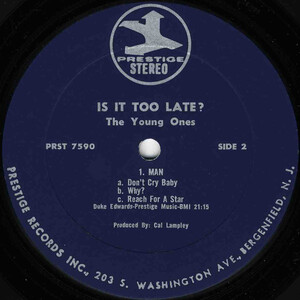
Edwards, Duke & the Young Ones - Is It Too Late? Side 2

Is It Too Late?
Media
Videos
0 videos
No videos available for this title.
Credits
Musicians
Duke Edwards: vocals, spoken word, percussion
Bernard Moore: tenor saxophone, soprano saxophone, flute
Richard Woodson: trombone
J. St. Julian Brown: organ
Wayne Prue: guitar
Clayton Johnston: drums
Additional Musicians
‘Black Elephant’
Doug Richardson: tenor saxophone
Songwriting
‘Is It Too Late?’ written by Duke Edwards
‘Black Elephant’ written by Duke Edwards
‘Man’ written by Duke Edwards
Production
Produced by Cal Lampley
Recorded by Michel Ethier
Lacquer cut by Rudy Van Gelder at Van Gelder Studio, Englewood Cliffs, New Jersey
Publishing
All compositions published by Prestige Music – BMI
Manufacturing
Prestige Records Inc.
203 South Washington Avenue, Bergenfield, New Jersey, USA
Liner notes
MAN
WITH ALL HIS SPLENDOR AND MATERIAL WEALTH, STILL FINDS NO PEACE WITHIN HIMSELF. COULD IT BE THAT HE IS LOST IN A MATERIALISTIC JUNGLE OR COULD IT BE THAT PERHAPS HE HAS FORGOTTEN HIS PURPOSE?
MAN SPENDS MOST OF HIS LIFE CHASING WHAT HE IS GIVEN FROM BIRTH. THE RIGHT TO MATERIAL WEALTH. YET THE THOUGHT OF LIFTING HIMSELF BEYOND A MATERIAL LIFE HAS LONG BEEN FORGOTTEN. FOR THIS IS THE DAY OF PLENTY.
DUKE EDWARDS
In an era where race communication could mean the difference between life and death, music can play an all important part. Whether Montreal's Young Ones realize it or not they have come up with a working communicable vibration that could be termed “A Genesis of sound”. Peter Harris of the Toronto Star tabs them “A musical tapestry with a message”. Others see a “Revolutionary new sound”, and “An inoffensive racial message”.
Now—the Young Ones. Wayne Prue, lead guitarist; Julian Brown, on organ; Clayton Johnston, the drummer; Richie Woodson, on trombone; and Bernard Moore, who doubles on tenor sax and flute. They are such accomplished musicians, they no doubt are all capable of playing several instruments.
Leader of the group, Duke Edwards, narrator and lead singer, gives his group an idea, no charts, no cautions, just an idea. They take it from there, and what comes out usually lasts 45 minutes. It has you clenching your fists, tapping your toe, clapping your hands, and just about sets you up for one of the loudest “hallelujahs” you are capable of, but you don't. You're all of a sudden jolted back into realizing that you've been listening to a message. Whether it's A Tribute To Africa, A Touch Of Black, A Trip To The New World, or A Tribute To Billy Joe, this “cycle”, as Edwards dubs it, has you hooked. It's not an offensive message on racial problems, it's a “revival of the thinking man's music”.
There is no possible way of putting in print what the Young Ones convey with their music. It's more than a potpourri of the classics, rhythm and blues, jazz, country, Afro-Cuban, calypso and pop. It's rather, an experience. To categorize the sound of the Young Ones would be too difficult. It's in no recognizable bag. Let's just label it “indiscribably beautiful”.
The Young Ones have been together for over a year and most of this time was spent “jamming” and getting to know the musical capabilities of each other. Duke Edwards, who has several outstanding musical credits including studies at the Boston Conservatory of Music is responsible for the putting together of the 72 cycles which make up the repertoire of the group. Their first appearance in Montreal caused somewhat of a shock, which is unusual for the famed cosmopolitan town. They staged a revue called A Touch Of Black which was held over for 14 weeks at Montreal's Le Club. The revue was a musical history of the North American Negro, but aimed mainly at the south. Edwards has arranged portions of this revue as a very well put together 45 minute cycle, which has turned out to be one of the favorites. As can be seen by the cover photo, the Young Ones wear colorful Egyptian style robes. This is a very important part of their role, as is their salaam-like entreaty before and after each performance. One might, if one were prejudiced, read Black Power or Black Muslim into the image of the Young Ones. Some critics have, but as far as any others are concerned if there was any indication of hate or racial prejudice, the Young Ones are not only superb musicians but masters at deception.
IT HAS BEEN SAID THAT MUSIC IS THE WINGS OF HAPPINESS. LAUGHTER, THE HANDS OF PEACE. IF SO, THEN WE DEDICATE OUR ENTIRE EXISTENCE TO YOU THE PEOPLE. FOR IF WE HAVE BROUGHT JOY AND PEACE TO BUT ONE OF YOU THROUGH OUR MUSIC, THEN OUR LIFE HAS NOT BEEN IN VAIN.
No Comments