
Insight
Formed in Ottawa in 1962, the Esquires were among the most important early architects of Canadian rock and pop music, helping establish a professional infrastructure for domestic artists at a moment when the British Invasion was transforming the international charts. Drawing heavily on the instrumental sound of Cliff Richard and the Shadows, the group quickly distinguished itself through disciplined musicianship, sharp arrangements, and a growing local following that soon extended well beyond the capital.
The band was co-founded by guitarist Gary Comeau and bassist Clint Hierlihy while both were still in high school. They were joined by rhythm guitarist Paul Huot and drummer Richard Patterson, with vocalist Bob Harrington fronting the group during its earliest phase. Initially focused on instrumentals, the Esquires developed a polished stage presence and became regular performers at high-school dances, teen clubs, and Ottawa’s Pineland Pavilion, where they served as the house band beginning in 1963. Their reputation grew rapidly, aided by enthusiastic local press and frequent television appearances.
That same year, the Esquires were invited to appear on a Dick Clark all-star show in Montreal, backing singer Andy Kim and sharing the bill with major American acts. Capitol Records representatives in attendance soon signed the group, making the Esquires the first Canadian pop group to secure a major-label recording contract. Their debut Capitol single, a cover of the Shadows’ instrumental “Atlantis,” reached number one in Ottawa in 1963, followed by the similarly successful “Man from Adano.” Capitol, impressed by the group’s radio reception, rushed the Esquires into the studio to record their debut album.
As the British Invasion gained momentum in 1964, the Esquires were ideally positioned to benefit. Their clean-cut image, tight musicianship, and Shadows-influenced guitar work aligned naturally with the era’s dominant sound. They toured extensively, opening concerts for the Rolling Stones, the Beach Boys, the Dave Clark Five, Roy Orbison, and other visiting stars, while continuing to headline shows across Canada.
A key turning point came with the arrival of singer Don Norman, who replaced Harrington following the early Capitol singles. Norman’s strong, Cliff Richard–influenced voice shifted the Esquires decisively toward a vocal-driven format with harmonies, expanding their appeal beyond instrumentals. Reflecting on the change, Gary Comeau later wrote that with Norman in the lineup, “it turned into a vocal band with harmonies,” a transformation that led directly to the group’s biggest hit.
That hit was “So Many Other Boys,” released in 1964 and sung by Norman. The single climbed to #9 on the RPM national chart in January 1965 and cemented the Esquires’ status as one of Canada’s leading homegrown acts. Industry columnist Bob McAdorey famously noted Capitol’s surprise at the record’s success, recalling how the Esquires defeated major British acts on Toronto radio’s Battle of the New Sounds. The band’s momentum was further recognized when they won Top Vocal Instrumental Group at the inaugural RPM Awards — a precursor to the Juno Awards.
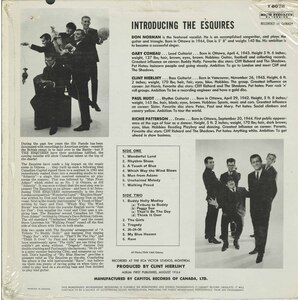
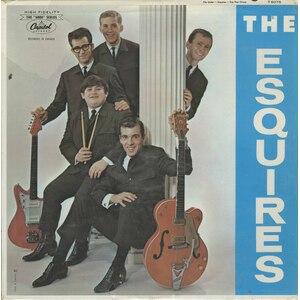
The Esquires’ debut LP, Introducing the Esquires, released in August 1964 and recorded at RCA Victor Studios in Montreal, captured the band at its peak. Produced by Clint Hierlihy, the album blended Shadows-style instrumentals, vocal pop, and rhythm-and-blues material, showcasing both Norman’s vocal range and the group’s instrumental precision. It remains one of the defining Canadian albums of the mid-1960s.
Despite their success, internal tensions and shifting musical priorities began to strain the group. Norman’s departure in 1965 was abrupt and contentious, later described by him as an ambush that left him suddenly outside the band he had helped elevate. His exit marked the beginning of a turbulent period for the Esquires, who continued briefly with Columbia Records and a rotating lineup that included several future notable musicians, among them Bruce Cockburn.
By 1967, the Esquires had disbanded, their brief but influential run complete. In the years that followed, their legacy only grew. Archival film footage discovered in the early 1990s — showing the original lineup performing “Man from Adano” in a studio setting — came to be regarded as one of the earliest Canadian music video prototypes, reinforcing the group’s reputation as pioneers.
The Esquires reunited in 1987 for a one-off benefit concert for the Children’s Hospital of Eastern Ontario, with the City of Ottawa officially proclaiming the day “Esquires Day.” Their recordings have since been reissued and reassessed, and the band is now widely recognized for opening doors at a critical moment in Canadian music history — not only as hitmakers, but as trailblazers who proved that Canadian rock and pop records could compete on a national stage.
-Robert Williston
Musicians
Don Norman: vocals, guitar, triangle
Gary Comeau: lead guitar, six-string bass
Paul Huot: rhythm guitar
Clint Hierlihy: bass, six-string bass
Richard “Richie” Patterson: drums
Songwriting
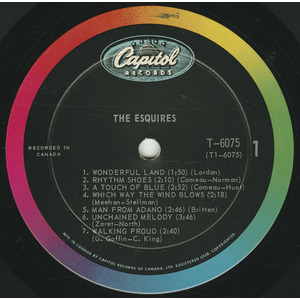
‘Wonderful Land’ written by Jerry Lordan
‘Rhythm Shoes’ written by Don Norman and Gary Comeau
‘A Touch of Blue’ written by Gary Comeau and Paul Huot
‘Which Way the Wind Blows’ written by Stellman and Meehan
‘Man from Adano’ written by Dave Britten
‘Unchained Melody’ written by Alex North and Hy Zaret
‘Walking Proud’ written by Gerry Goffin and Carole King
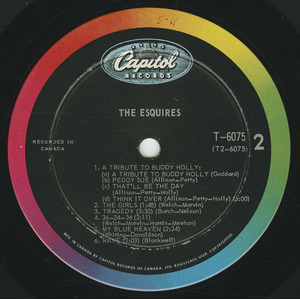
‘Tribute to Buddy’ written by Goddard
‘Peggy Sue’ written by Buddy Holly, Jerry Allison, and Joe B. Mauldin
‘That’ll Be the Day’ written by Buddy Holly
‘Think It Over’ written by Buck Owens
‘The Girls’ written by Bruce Welch and Hank Marvin
‘Tragedy’ written by Fred Burch and Gerald Nelson
‘36-24-36’ written by Bruce Welch and Hank Marvin
‘My Blue Heaven’ written by Walter Donaldson and George A. Whiting
‘Rave’ written by Blackwell
Production
Produced by Clint Hierlihy
Recorded at RCA Victor Studios, Montreal, Quebec
Manufactured by Capitol Records of Canada, Ltd.
Printed by Parr’s
Artwork
Photography by Tsin Van
Liner notes:
INTRODUCING THE ESQUIRES
DON NORMAN is the featured vocalist. He is an accomplished songwriter, and plays the guitar and triangle. Born in Ottawa in 1944, Don is 5’ 8” and weighs 140 lbs. His ambition is to become a successful singer.
GARY COMEAU… Lead Guitarist… Born in Ottawa, April 4, 1943. Height 5 ft. 6 inches; weight, 137 lbs; hair, brown; eyes, brown. Hobbies: Guitar, football and collecting records. Greatest influence on career: Buddy Holly. Favorite disc stars: Cliff Richard and The Shadows. Pet Hates: Insincere people and going steady. Ambition: To go to London and meet Cliff and The Shadows.
CLINT HIERLIHY… Bass Guitarist… Born in Vancouver, November 26, 1945. Height, 6 ft. 2 inches; weight, 170 lbs; hair, fair; eyes, blue. Hobbies: The group. Greatest influence on career: Jet Harris. Favorite disc stars: Cliff Richard and The Shadows. Pet hates: Poor rock ’n’ roll groups. Ambition: To be a recording engineer and have a gold disc.
PAUL HUOT… Rhythm Guitarist… Born in Ottawa, April 29, 1942. Height, 5 ft. 8 inches; weight, 145 lbs; hair, black; eyes, brown. Hobbies: Sports, music and cars. Greatest influence on career: Sister. Favorite disc stars: Peter, Paul and Mary. Pet hates: Social climbers and canary yellow. Ambition: To tour the world.
RICHIE PATTERSON… Drums… Born in Ottawa, September 20, 1944. First public appearance at the age of four as a dancer. Height, 5 ft. 2 inches; weight, 170 lbs; hair, dark brown; eyes, blue. Hobbies: Reading Playboy and dancing. Greatest influence on career: Parents. Favorite disc stars: Cliff Richard and The Shadows. Pet hates: Anything white. Ambition: To get ahead in show business.
During the past few years the Hit Parade has been dominated with recordings by American artists—recently the British swept in to take over in the Battle—but if THE ESQUIRES have their ambitions fulfilled, the coming months will show Canadian talent at the top of the charts!
The Esquires have made a big impact on the music scene in Ottawa… they built up such a following that Canadian-Capitol signed them to a contract in 1963 and immediately rushed them into a recording studio to wax “Atlantis”—a single that received extensive air play across the country. This was followed by “Man From Adano” which ended up as No. 1 in Ottawa, as did “Atlantis”. It was soon evident that the next step was to present The Esquires on an album—and here it is! Introducing THE ESQUIRES instrumentally is the Jerry Lordan composition “Wonderful Land”. “Rhythm Shoes” was written by Don and Gary and features Don on lead vocal. Next is the moody instrumental “A Touch of Blue” written by Gary and Paul. “Which Way The Wind Blows” was taken from the popular English movie “Just for Fun”. Don supplies the vocal and Clint uses a six-string bass. The Esquires’ second Canadian hit “Man From Adano” (written by Ottawa’s Dave Britten) follows. The old standard “Unchained Melody” and the recent Steve Lawrence hit “Walking Proud” round off the first side of this album with Don on both tracks.
Side two opens with The Esquires’ arrangement of “A Tribute to Buddy Holly” and features Don singing “Peggy Sue”, with vocals on “That’ll Be The Day” and “Think It Over” by Paul and Gary respectively. The boys unanimously agree “The Girls” are one thing they couldn’t get along without. “Tragedy” features Don double-tracking and Paul supply the harmony. “36-24-36” is a spicy number featuring Clint, and measures up very well. Don’s handling of “My Blue Heaven” provides a pleasant relief as The Esquires go cha-cha. Concluding the album is the wild instrumental “Rave”, but I believe there was plenty of raving going on when Gary decided to play lead on a six-string bass and Don decided to play lead guitar.
Gallery
Images
4 images
Esquires - Introducing The Esquires
Esquires - Introducing The Esquires LABEL 01
Esquires - Introducing The Esquires LABEL 02
Introducing The Esquires
Media
Videos
0 videos
No videos available for this title.
Credits
In Transit
No Comments