Insight
Garfield was a Canadian rock band built around singer, songwriter and multi-instrumentalist Garfield French, whose work moved from the ambitious, progressive-leaning end of mid-1970s Canadian rock into the more polished melodic and AOR territory of the early 1980s. Formed in London, Ontario, the group combined strong songwriting with a broader instrumental palette than most Canadian rock acts of the period, incorporating flute, synthesizers, electric cello, Mellotron and layered vocal arrangements into a sound that could shift from theatrical art-rock to radio-conscious pop-rock without entirely losing its identity.
French did not initially set out to become a professional musician. By his own account, the turning point came in his final year of high school, when he performed one of his first original songs at a year-end concert and was strongly encouraged by both a teacher and his principal to take his songwriting seriously. Shortly afterward he spent an extended period travelling through Europe, returning to Canada with new material and a clearer sense of direction. Over the next several years he assembled musicians, refined his writing, and developed the band that would become Garfield.
The group’s best-known early lineup included Garfield French (lead vocals, guitar, piano), Walter Lawrence (guitar), Paul O’Donnell (guitar, harmonica, banjo), Maris Tora (bass), Dennis French (drums, percussion), Chip Yarwood (flute, synthesizers), and Jacques Fillion (keyboards and string textures), with Bob Hill also appearing during the period surrounding the first album. This was the version of Garfield that established the band’s identity on stage: a highly arranged, musically ambitious act whose live presentation and European-influenced sound set it apart from more straightforward bar-band contemporaries.
Garfield’s first major break came after opening for 10cc, which led to label interest and the shortening of the act’s name from The Garfield Band to simply Garfield. Their debut album, Strange Streets, was released in 1976 on Polydor in Canada and Mercury in the United States. Recorded in San Francisco at His Master’s Wheels and produced by Elliot F. Mazer, the album introduced Garfield as a distinctive Canadian act working somewhere between melodic rock, progressive pop and lightly theatrical art-rock. It produced the Canadian singles ‘Give My Love To Anne’ and ‘Old Time Movies’, both of which helped establish the band’s early profile.
The follow-up, Out There Tonight, was recorded at Wishbone Recording Studio in Muscle Shoals, Alabama, with Terry Woodford and Clayton Ivey producing. By this point Garfield had moved into a more confident and expansive studio phase, still drawing on the band’s layered arrangements but with a stronger U.S. commercial push behind it. The single ‘Private Affair’ became especially important in San Antonio, where influential broadcaster Joe Anthony took an interest in the band and gave the track substantial airplay. Garfield was now working well beyond the Ontario and Quebec circuit, touring across Canada and into the United States while building a following in select American markets.
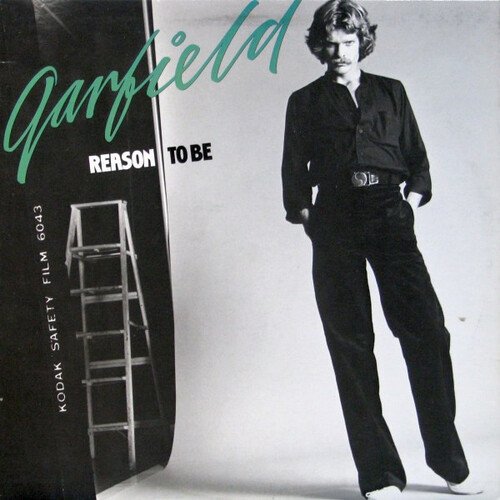
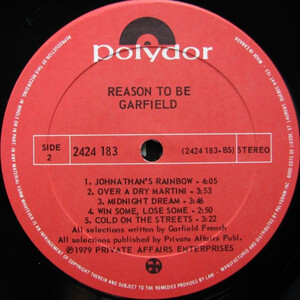
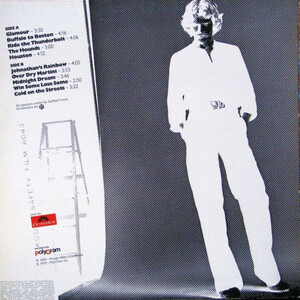
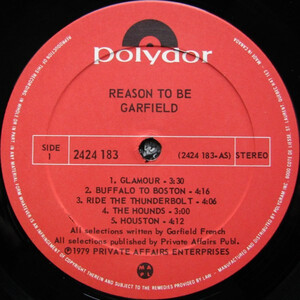
That momentum was interrupted by the collapse of Capricorn Records, which left one of Garfield’s planned follow-up albums unreleased and stalled what had been their most promising period of U.S. exposure. Like many Canadian acts of the era, Garfield found itself caught between strong creative development and the realities of label instability. Rather than disappearing, however, the band regrouped in Canada and continued forward with Reason To Be in 1979, produced by Dixon VanWinkle. The album included ‘Buffalo To Boston’, a track that helped keep Garfield active in Canadian AOR circles and confirmed that the band could adapt its earlier progressive tendencies into a more direct radio-rock format.
Garfield’s final major album of the original period was Flights Of Fantasy, released in 1981 on Polydor. Recorded at Springfield Sound in London, Ontario, mixed at Trident Studios in London, England, and produced by Dan Donovan and Garfield French, it documented the band’s most streamlined and contemporary sound. By then Garfield had evolved considerably from the more expansive ensemble heard on Strange Streets, with the project functioning more as a tighter studio-centred vehicle around French and a changing circle of collaborators. That shift helps explain why the later album credits differ from recollections of the earlier touring lineup. After Flights Of Fantasy, Garfield’s original recording career came to a close, reportedly ending with a final major live appearance alongside Rush at the Montreal Forum.
For many years Garfield’s discography appeared to end there, but the story was never quite finished. Material recorded during the Wishbone / Muscle Shoals period eventually resurfaced decades later as Lost In The Shoals, finally bringing one of the band’s long-unreleased projects into circulation. French also continued to revisit and extend the Garfield catalogue through later releases, preserving the project not simply as a short-lived 1970s–1980s band, but as a body of work that reflected both the ambition and the vulnerability of Canadian rock acts trying to bridge regional success, U.S. label interest, and long-term survival in a difficult industry climate.
-Robert Williston
Gallery
Images
5 images
Garfield - Reason To Be (2)
Garfield - Reason To Be (4)
Garfield - Reason To Be (3)
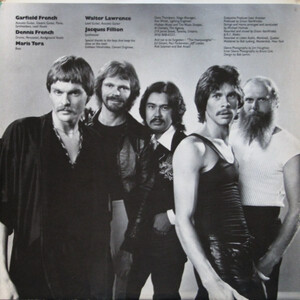
Garfield - Reason To Be (1)
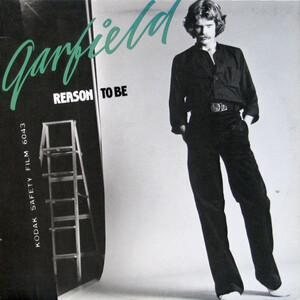
Reason To Be
Media
Videos
0 videos
No videos available for this title.
Credits
Musicians
Garfield French: lead vocals, acoustic guitar, rhythm guitar, piano, synthesizer
Walter Lawrence: lead guitar, acoustic guitar
Maris Tora: bass
Dennis French: drums, percussion, backing vocals
Jacques Fillion: synthesizer
Songwriting
Written by Garfield French
Production
Produced by Dixon VanWinkle
No Comments