Insight
Huevos Rancheros were a Canadian instrumental rock trio from Calgary, Alberta whose ferocious blend of surf, garage, rockabilly, and punk energy made them one of the most internationally visible Canadian underground bands of the 1990s. Active primarily between 1990 and 2000, the group built a reputation on volume, velocity, and reverb, stripping rock ’n’ roll to its barest essentials at a time when alternative music was dominated by vocal-centric styles and grunge theatrics.
The band formed in the summer of 1990, jokingly claiming their motivation was the promise of free beer, though their emergence was rooted in a desire to play loud, instrumental, singer-free rock ’n’ roll. The original lineup consisted of guitarist Brent J. Cooper, bassist Graham Evans, and drummer Richie Lazarowich, who adopted the onstage moniker Richie Ranchero. Drawing inspiration from surf pioneers, Link Wray, garage punk, and classic rock instrumentalists, the trio emerged from Calgary garages with a sound that was equal parts primitive and precise.
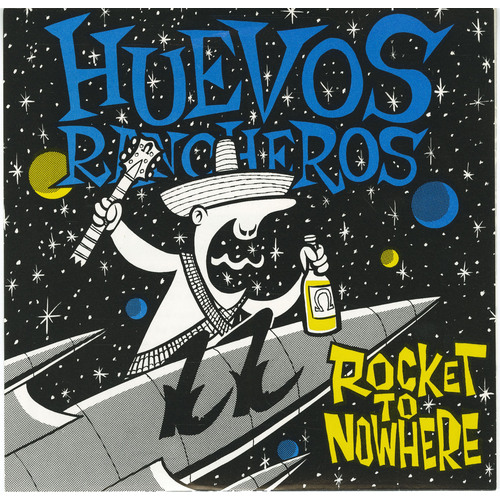
Their first release, the independently produced six-song cassette Huevosaurus (1990), immediately set the template: blistering tempos, fuzzed guitar leads, and rhythm sections locked into relentless forward motion. The tape caught the attention of Dave Crider, founder of Estrus Records in Bellingham, Washington, a key figure in the Pacific Northwest garage-rock revival. This relationship led to vinyl releases, compilation appearances, and the now-legendary Rocket to Nowhere 7-inch EP in 1991, cementing the band’s standing within the international garage and surf underground.
After extensive touring and near-constant live performances in Calgary clubs, Huevos Rancheros expanded their reach south and west. A pivotal moment came with the release of the single Cindy With An ’S in 1992, accompanied by a video and followed by a full-length album. Their debut LP Endsville appeared in 1993 on Seattle’s C/Z Records, placing the band alongside a roster of respected alternative and underground artists and marking their transition from cult single act to full-album force.
Rather than slowing down, the group entered a period of extraordinary productivity. Throughout the mid-1990s, Huevos Rancheros appeared on more than a dozen singles and compilations while continuing to tour aggressively. Their instrumental tracks found unexpected second lives in feature films, independent cinema, and a wide range of action-sports media, including skateboarding, surfing, snowboarding, and ski films circulated across North America, Europe, Asia, and Australia. Their music’s cinematic punch and momentum made it especially attractive for visual media.
The year 1995 proved transformative. In addition to further singles and compilation tracks, the band self-funded a video for Gump Worsley’s Lament, which received heavy rotation on MuchMusic. A whirlwind North American tour followed, highlighted by an opening slot for Henry Rollins at New York’s CBGB. The trio then retreated to record their second full-length album Dig In!, returning home to Canada and releasing it through Mint Records. A subsequent six-week European tour included a BBC recording session with John Peel — the first ever by a Calgary-based band — marking a historic milestone for the city’s music scene.
In early 1996, Huevos Rancheros released another video, Rockin’ the Henhouse, which earned the MuchMusic award for Best Independent Video of 1995/96. Later that year, original bassist Graham Evans departed, sparking rumours of an impending breakup. Instead, the band regrouped with the addition of bassist Tom Kennedy, ushering in a new phase. The resulting album Get Outta Dodge was released by Mint Records in September 1996 and quickly became the group’s most widely recognized work.
Get Outta Dodge generated three videos, with the title track receiving strong rotation on MuchMusic and MTV’s M2, alongside Shadow of the Apache and What a Way to Run a Railroad. The latter track gained additional exposure when the band appeared with Don Ho in a Canadian beer commercial in 1997. Touring continued relentlessly across Canada and the American West Coast.
The band’s international profile peaked in 1998 when Get Outta Dodge was released in Europe by Konkurrent Records in Amsterdam. A highly successful European tour followed with fellow Mint artists Duotang, taking Huevos Rancheros through the United Kingdom, the Netherlands, Belgium, Germany, Spain, and for the first time, Italy, France, and Switzerland. That same year, the album earned a Juno Award nomination for Best Alternative Album, representing the most significant mainstream recognition of the band’s career.
As a transitional release between albums, Mint issued the 7-inch single The Wedge in 1999, timed to coincide with a cross-Canada tour supporting Reverend Horton Heat. During this period, bassist Tom Kennedy briefly stepped away following the birth of his daughter, with Keith Rose of Royal Grand Prix filling in on bass for touring duties.
Work on the band’s fourth full-length album occupied much of 1999 and early 2000, coinciding with Huevos Rancheros’ tenth anniversary. Released in May 2000, Muerte del Toro (Death of the Bull) was recorded at Sundae Sound in Calgary with producer Dave Alcock of Chixdiggit and marked several firsts for the band, including organ and piano contributions by Pat McGannon and Mint Records’ first vinyl LP release by the group. A video for Diamond Head followed, along with extensive touring.
Soon after, changing personal priorities and family commitments led the band into an unannounced hiatus. Although no formal breakup was declared, Huevos Rancheros did not release further albums after 2000. Richie Lazarowich went on to perform with Hurricane Felix, The Black Coffee Cowboys, Loaded Dice, the Rowdymen, and later Eve Hell & The Razors, while Brent J. Cooper formed the instrumental trio The Ramblin’ Ambassadors. The band has since reunited occasionally for special performances, including benefit concerts supporting a journalism scholarship in memory of Calgary Herald music critic James Muretich, often featuring Graham Evans returning on bass.
Huevos Rancheros remain one of Canada’s most internationally successful instrumental rock acts of the 1990s, celebrated for proving that volume, velocity, and melody could speak louder than words.
-Robert Williston
Musicians
Coop: guitar (guitarskin rug)
Thee Evster: bass (bassoon)
Itchy: drums (drums n’ such)
Songwriting
All songs written by Los Tres Huevos except:
‘Ace O’ Spades’ written by Fred L. Wray Sr. and Mark Cooper
Production
Lacquer cut at K Disc Mastering
Artwork
Artwork by Tomb
Notes
Issued as volume 9 in the Estrus Crust EP series. Copies sold through Estrus mail order included a red-and-white oval vinyl sticker with the band’s name. All runout markings are hand-etched, with “Kdisc” stamped on both sides
Gallery
Images
6 images
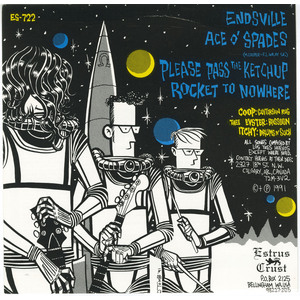
45-Huevos Rancheros - Rocket to Nowhere BACK
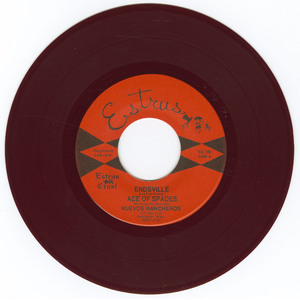
45-Huevos Rancheros - Rocket to Nowhere VINYL 01
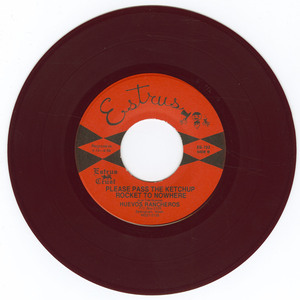
45-Huevos Rancheros - Rocket to Nowhere VINYL 02
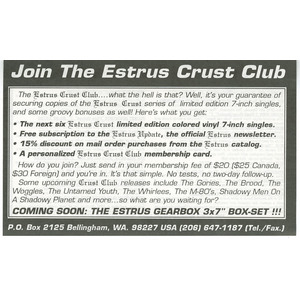
45-Huevos Rancheros - Rocket to Nowhere INSERT SIDE 01
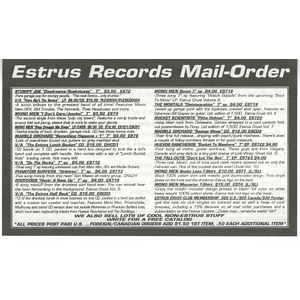
45-Huevos Rancheros - Rocket to Nowhere INSERT SIDE 02
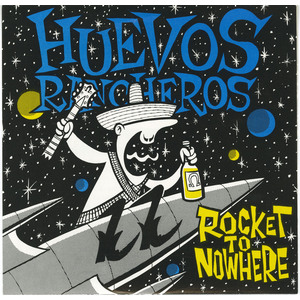
Rocket to Nowhere
Media
Videos
0 videos
No videos available for this title.
Credits
In Transit
No Comments