Information/Write-up
Le Komuso à Cordes stands as a quietly adventurous statement from mid-1970s Quebec, arriving at a moment when the province’s progressive scene was expanding well beyond rock convention into more textural, exploratory territory. Recorded in Montreal between early 1975 and the summer of 1976, the album is entirely instrumental and unfolds as a carefully balanced conversation between acoustic sensitivity and emerging electronic colour. Rather than pushing for overt virtuoso display, Michel Madore shapes the record around atmosphere, pacing, and tone, allowing themes to develop gradually and organically.
Madore’s twelve-string guitar functions as the album’s emotional anchor, often sounding more like a compositional voice than a lead instrument. Around it, string synthesizers, piano, and subtle electronic textures drift in and out of focus, creating a floating, almost architectural sense of space. The music avoids obvious climaxes in favour of slow momentum: passages expand, dissolve, and reform, giving the listener time to absorb the harmonic detail and the shifting instrumental roles. There is a calm confidence throughout, as if nothing is rushed and nothing needs to prove itself.
The ensemble contributes greatly to this sense of balance. Ron Proby’s soprano saxophone glides between lyrical restraint and gently biting edge, while his synthesizer work blends seamlessly with Madore’s string textures rather than competing for attention. Drummer Mathieu Léger supplies constant motion without heaviness, colouring the music with rolls, bells, and gongs that feel closer to orchestral shading than rock percussion. Bass parts—shared between Errol Walters and Fernand Durand—remain fluid and supportive, grounding the music without pinning it down. Phillippe Beck’s acoustic piano and Fender Rhodes add warmth and harmonic depth, especially in the quieter, reflective moments.
Each piece serves a distinct role in the album’s arc. The opening section draws the listener into Madore’s sound world with gentle, spiralling figures and phased electronics, establishing the album’s meditative tone. As the record progresses, longer pieces stretch outward, introducing more rhythmic insistence and a subtle space-rock energy without ever losing their poise. The extended “Juggernaut” is the album’s most expansive moment, hovering between propulsion and suspension, its length justified not by excess but by careful layering and gradual transformation. The closing track returns to a more fragile atmosphere, ending the album with bell tones, breathy textures, and a sense of quiet ascent.
While comparisons to European space-rock and progressive jazz are inevitable, Le Komuso à Cordes never feels derivative. Its personality is distinctly Quebecois: introspective, refined, and less concerned with spectacle than with immersion. The album sits comfortably alongside the era’s more celebrated local progressive releases, yet it follows its own internal logic, privileging mood and cohesion over stylistic bravado.
With only a modest original pressing and no reissues, Le Komuso à Cordes has remained something of a hidden gem, but its appeal lies precisely in its understatement. It rewards attentive listening, revealing new details with each return, and remains one of the more elegant and self-contained progressive albums to emerge from 1970s Quebec—a work where space, silence, and restraint are every bit as important as sound.
-Robert Williston
Musicians
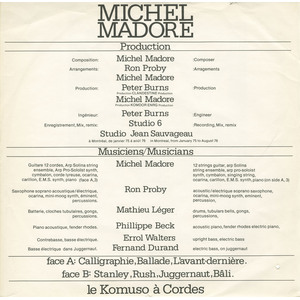
Michel Madore: twelve-string guitar, ARP Solina String Ensemble, ARP Pro-Soloist, EMS synthesizer, cimbalom, singing strings, ocarina, carillon, piano (on ‘L’Avant-Dernière’)
Ron Proby: soprano saxophone (acoustic and electric), Mini-Moog synthesizer, Eminent organ, ocarina, percussion
Mathieu Léger: drums, tubular bells, gongs, percussion
Phillippe Beck: acoustic piano, Fender Rhodes electric piano
Errol Walters: upright bass, electric bass
Fernand Durand: electric bass (on ‘Juggernaut’)
Songwriting
All compositions by Michel Madore
Arranged by Ron Proby and Michel Madore
Production
Produced by Peter Burns (Clandestine Production) and Michel Madore (Komdor Enrg Production)
Engineered by Peter Burns
Recorded, mixed, and remixed at Studio 6 and Studio Jean Sauvageau, Montreal, Quebec, January 1975 to August 1976
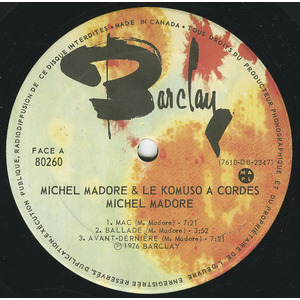
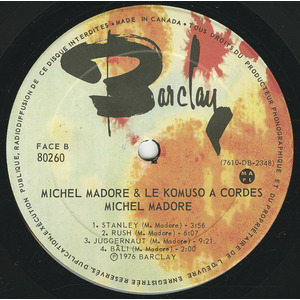
Lacquer cut at Disques SNB Ltée
Pressed by Quality Records Limited
Record company: Les Disques Barclay Ltée
Artwork
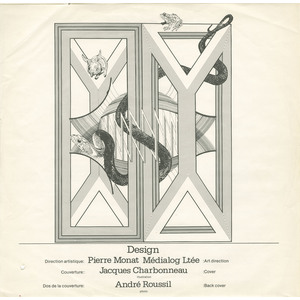
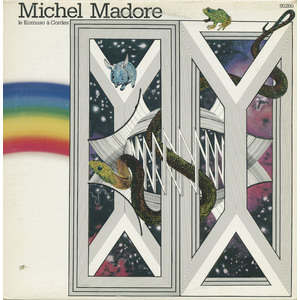
Art direction by Pierre Monat
Design by Médialog Ltée
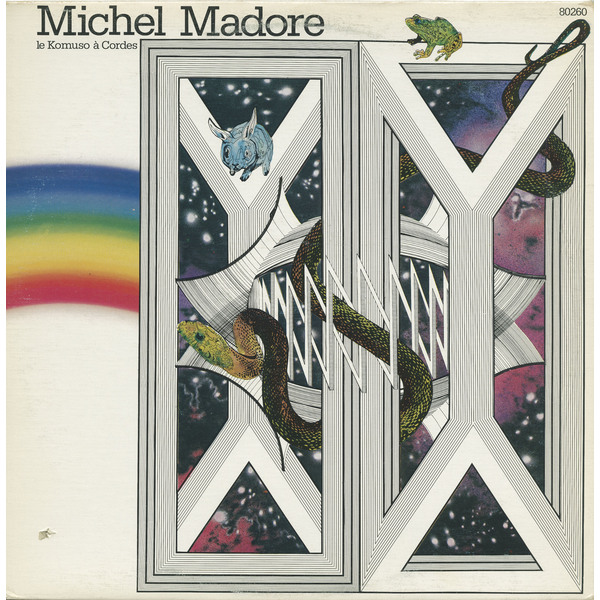
Cover illustration by Jacques Charbonneau
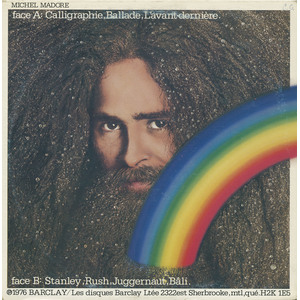
Back cover photography by André Roussil
Artist bio:
Michel Madore emerged in the late 1960s and early 1970s as a singular figure within Quebec’s creative underground, equally drawn to music, visual art, and experimental forms that resisted easy categorization. Born in Montreal in 1949, Madore studied visual arts in Quebec at a moment when boundaries between disciplines were dissolving. From the outset, his work reflected a broader philosophical outlook: creation as an act of free will, intuition, and inward exploration rather than stylistic conformity.
In the mid-1970s, Madore began to translate these ideas into music. Working in Montreal between 1975 and 1976, he conceived two parallel projects. One was a full-band instrumental exploration rooted in progressive rock, jazz, and emerging electronic textures, resulting in Le Komuso à Cordes, released on Barclay in 1976. The other was a more conceptual and experimental work that would later evolve into La Chambre nuptiale. These projects were not conceived as commercial exercises but as extensions of Madore’s wider artistic practice, emphasizing space, tone, and gradual transformation over traditional song structures.
Le Komuso à Cordes placed Madore at the quieter, more introspective end of Quebec’s progressive spectrum. Surrounded by musicians drawn from the province’s jazz and avant-rock circles, he created music that balanced acoustic instruments with synthesizers and tape-era electronics, allowing textures to breathe and unfold at their own pace. The album’s calm, meditative quality reflected Madore’s interest in atmosphere and inner motion rather than surface virtuosity, distinguishing him from many of his contemporaries while firmly situating him within the fertile Montreal scene of the period.
In 1977, Madore relocated to Paris, a move that marked a gradual shift away from public musical activity and toward a deeper immersion in visual art. Although he completed and presented La Chambre nuptiale after returning temporarily to Canada—where it was premiered as part of a special exhibition—music increasingly became one element within a much wider creative universe rather than a primary focus. By the early 1980s, Madore had largely withdrawn from recording, dedicating himself fully to painting, drawing, and sculpture.
Over the ensuing decades, Madore established an international reputation as a visual artist, particularly in France and Asia. His work came to be defined by spare, flowing lines, restrained use of colour, and an emphasis on silence, gesture, and negative space. A pivotal moment occurred in 2001, when a visit to Xi’an, China’s ancient capital, and the Han Yang Ling Mausoleum provoked a profound emotional response. The encounter with history, time, and elemental form left a lasting imprint on his artistic language.
Drawing from both Western abstraction and Eastern calligraphic traditions, Madore developed a highly personal visual vocabulary. His ink drawings and large-scale works—often executed with charcoal pencil and Chinese ink—are marked by meandering, interlacing lines and carefully controlled empty space. These elements intertwine and overlap in ways that suggest movement, breath, and internal rhythm, echoing the same sensibility that once guided his music. Nature and humanity, restraint and expression, coexist in quiet tension.
This convergence of philosophies was particularly evident in major exhibitions, including his 2011 solo presentation in Shenzhen during the Sino-French Cultural Spring, where large ink paintings and monumental sculptures were unveiled. Created in near-isolation at his Paris studio, these works were informed by long periods of contemplation on what it means to remain spiritually “alive” in the modern world. A sense of purified vitality runs through them, shaped by meditation, simplicity, and resolve.
Though his recorded output is small, Michel Madore’s legacy within Canadian music remains significant. Le Komuso à Cordes and La Chambre nuptiale stand as audio counterparts to a lifelong artistic journey—documents of a creator for whom sound, line, and silence are simply different expressions of the same inner pursuit.
-Robert Williston
No Comments