Insight
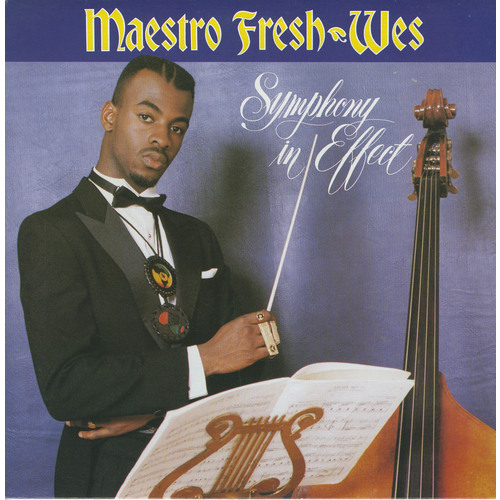
When Symphony in Effect appeared in 1989, Canadian hip-hop was still largely invisible to the country’s mainstream music infrastructure. Rap existed in pockets — community radio, dance floors, MuchMusic after-hours, and live showcases — but there was no clear precedent for a full-length, nationally distributed Canadian rap album that sounded confident, local, and commercially viable without mimicking American regional scenes. Symphony in Effect didn’t just fill that gap; it defined it.
Recorded primarily at Don Valley Sounds in Markham and released on Attic/LMR Records, the album arrived fully formed — not as a tentative experiment, but as a statement of arrival. From the opening bars of “Drop the Needle,” Maestro Fresh-Wes positions himself not as a novelty or outsider, but as a conductor assembling a complete musical architecture. The album’s classical metaphor is not decorative: its structure is deliberate, its pacing carefully controlled, and its sequencing divided into two “concertos,” reinforcing the idea that hip-hop here is being treated as composed music rather than disposable street product.
Lyrically, Maestro balances confidence, pedagogy, and accessibility. Tracks like “The Mic’s My Piece” and “I’m Showin’ You” function as declarations of skill and presence, but they avoid empty bravado. His delivery is articulate, rhythmically precise, and intentionally clear — a crucial factor in the album’s crossover success. Unlike many contemporaries who leaned heavily into regional slang or hyper-local references, Maestro crafts lyrics that are intelligible across demographics while remaining rooted in Toronto’s emerging Black urban culture.
The production on Symphony in Effect is similarly strategic. Rather than chasing the abrasive minimalism of late-1980s East Coast rap or the funk-heavy West Coast sound, the album adopts a polished, groove-oriented aesthetic that borrows equally from hip-hop, funk, R&B, and pop radio sensibilities. The Davis brothers’ production, alongside contributions from Beat Factory personnel, emphasizes clarity, melodic hooks, and rhythmic swing. This approach made the record radio-friendly without sacrificing credibility, a balance few rap albums of the era managed successfully.
“Let Your Backbone Slide” stands as the album’s cultural keystone. Its infectious groove, call-and-response structure, and DJ-centric framing made it immediately accessible while foregrounding hip-hop fundamentals. The track’s success — becoming the first Canadian rap single to chart internationally and the genre’s first domestic mega-hit — was not accidental. It distilled the album’s mission into a single track: hip-hop as celebration, instruction, and community ritual. Crucially, it did so without softening its identity or obscuring its origins.
DJ LTD’s presence throughout the album reinforces this ethos. Turntablism is not relegated to novelty breaks but integrated into the album’s musical logic, most explicitly on “LTD’s On The Wheel(s) Of Fortune,” where DJ performance is foregrounded as musicianship rather than embellishment. By naming, crediting, and structurally featuring the DJ within the album’s concept, Symphony in Effect reflects hip-hop’s foundational emphasis on the DJ as an active creative partner, not merely a supporting role.
The album’s success — nearly double platinum sales, a peak at #4 on the RPM Albums Chart, and the inaugural Juno Award for Rap Recording of the Year — reshaped industry assumptions about Canadian hip-hop. More importantly, it reshaped audience expectations. Symphony in Effect demonstrated that a Canadian rap artist could sound unmistakably local while competing on a national and international stage. It opened doors not through imitation, but through articulation: articulating a voice, a place, and a structure that made sense within Canada’s cultural ecosystem.
In retrospect, the album’s lasting importance lies not just in its hits or accolades, but in its function as a blueprint. It established a professional standard for Canadian hip-hop recording, presentation, and ambition. Later generations — from underground artists to chart-toppers — would inherit a landscape fundamentally altered by its success. Symphony in Effect did not merely introduce Canadian rap to the mainstream; it legitimized it as an enduring part of the country’s musical canon.
More than three decades on, the album remains a landmark not because it represents a beginning, but because it still sounds like a confident assertion of purpose. It is hip-hop presented without apology, without parody, and without compromise — a symphony not in aspiration, but in effect.
-Robert Williston
Musicians
Maestro Fresh-Wes: vocals
DJ LTD (A. Swaby): turntables (except “Fortissimo”)
First Offence: turntables (“Fortissimo”)
Farley Flex: vocals (“LTD’s On The Wheel(s) Of Fortune”)
Corey “Koko” Whittington: vocals (“Private Symphony”)
Songwriting
All songs written by W. Williams (p/k/a Maestro Fresh-Wes)
Production
Produced by Peter Davis and Anthony Davis for First Offence Productions
Co-produced and conducted by W. Williams
Produced by Maximum 60 for Beat Factory Productions
Produced by Stanley McCook (S. Blank)
Engineered by Peter Davis
Engineered by Anthony Davis
Engineered by K. MacFarlane
Engineered by W. Sobczak
Recorded at Don Valley Sounds, Markham, Ontario, Canada
Mastered at Frankford-Wayne Mastering Labs, New York
Artwork
Art direction by Lee Lebowitz
Photography by W.E. Williams
Hair and makeup by Valerie Henry
Notes
Artistic direction and management by Farleyflex Management, Scarborough, Ontario, Canada
Turntables by A. Swaby (p/k/a DJ LTD) except “Fortissimo” by First Offence
Fabricated / manufactured by Cinram Limited
Distributed by A&M Records Limited
Under license from Attic Productions Limited
Made in Canada
Album dedicated to the memory of Michael Anderson
SPECIAL THANKS TO: God, my family, D.J. LTD and his family, Farley Flex and his family.
ALSO: First Offence, my dancers Rocksee and Bullwinkle, S. Blank, Beat Factory, Much Music & Electric Circus, Joel Goldberg, Hope Melanson, Stevie B. LMR, Corey Whittington, Loot, Spinnasem, Streetzound & talent magazines, CKLN (Ron & Ex.), XHPR (Mastermind), Capone and Mitch, CHIN, Lawrence Fisher, D.J. Nice, my man Marls, Derek Ryan Productions, Steve Benton, DJ Greg, J.M. Bogurus, Claire Radock, Raquel James, Valerie Henry, Carla Scott, Captain Kirk, Apollo (43), Al Bee, Sheryl Dove, Lake Puran, LMR Highschool, SRT Boys, Bill Warmington, Dex Dandala, K-Oss, the Pottinger family, Rachel Cowan, Wendy Shelton, Forth Scratch, Caper, R.T. staff, Jennifer Ross, Heidi Davison, Darson family, DJ Greg and Gregory Ellis.
PEACE TO: Dream Warriors, Michie Mee and L.A. Luv, the Beat Factory family, King Tee, D.J. Aladdin, Rumble and Stonyk K-Force, 2 Great Anchory Bong, M.C. Thrust, D. Shan, Fly K., Unity Force and all other conscious Black organizations, East Park Posse, Self Defense, B Cool, Cool K, Howard Hughes, Gangstarr, and all other rappers that we met at the New Music Seminars, Ben Johnson, Lennox Lewis, Egerton Marcus and all other Black Canadian athletes, all the boys from Destiny, Apex, Nathaniel Swaby, Khalid Pottinger, Cyretta and Kenyetta Swaby, Victoria Henry, Gerry Martinez, Richard Small, Clive Brown, DJ Jed, Victoria Williams, Gavin Palmer, Donovan Lane, South Side Renegades, Romantic C., Joey Lencach, All the Posse from T.O., N.Y., Ottawa and Wizards.
EXTRA THANKS TO: The members of my symphony — all rappers, DJs, radio stations, and everyone else affiliated with the progression and expansion of Rap Music — YOU’VE MADE THIS ALBUM POSSIBLE.
This album is dedicated to the memory of MICHAEL ANDERSON.
Gallery
Images
5 images
Maestro Fresh Wes - Symphony in Effect SIGNED COVER INSERT
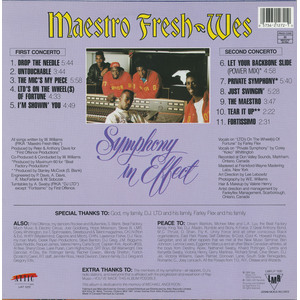
Maestro Fresh Wes - Symphony in Effect BACK
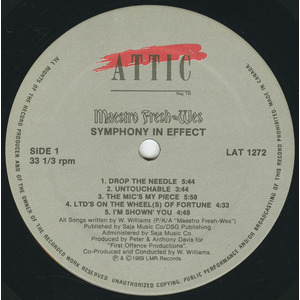
Maestro Fresh Wes - Symphony in Effect LABEL 01
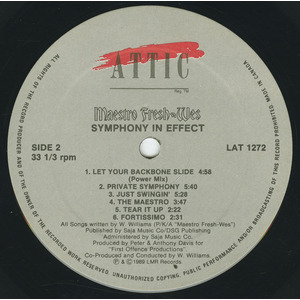
Maestro Fresh Wes - Symphony in Effect LABEL 02
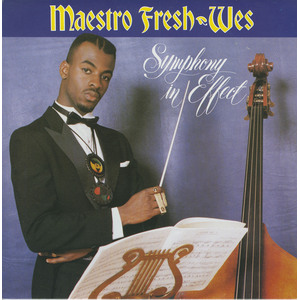
Symphony in Effect
Media
Videos
0 videos
No videos available for this title.
Credits
In Transit
No Comments