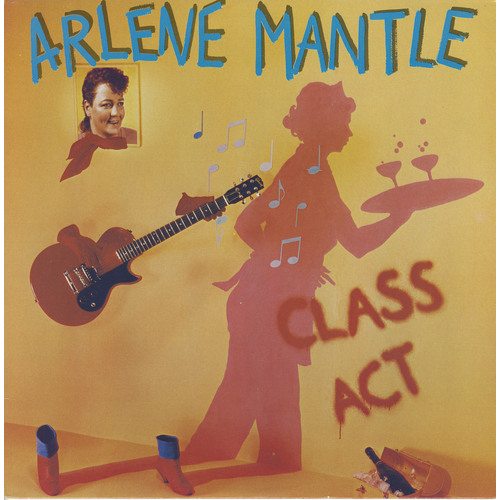
Insight
Arlene Mantle was a fearless and uncompromising voice in Canadian music — a self-described “poor, beaten, lesbian woman” who transformed her life’s struggles into songs that spoke truth to power. Across four decades, from taverns and union halls to rallies, student protests, and international solidarity tours, she championed the working class, women’s liberation, queer identity, and grassroots resistance. She remains one of Canada’s most vital — if underrecognized — political songwriters.
Born in Toronto in 1940, Mantle made her first recorded appearance under the stage name Arlene Gordon, releasing the LP Games People Play in 1969 on Hi-Lite Records (HI 2209). The album was recorded at Sound Canada Studios in Don Mills, Ontario, and featured session musicians such as Roy Penny, Gerald Hall, and Michael (Mickey) Andrews, the latter of whom helped Arlene land her first job as a singer. Though trained by no formal method, Mantle quickly gained a reputation in the Toronto country scene for her strong voice, honest lyrics, and songwriting talent — much of which was already in evidence on that debut album.
By the early 1980s, Mantle re-emerged under her real name, Arlene Mantle, and became one of the most powerful voices in the intersection of music and activism. She founded the On the Line Music Collective, releasing a string of politically-charged folk albums that included Class Act (1986), In Solidarity (1988), and Full Circle (1994). These recordings — rooted in feminist and labour movements — tackled themes of poverty, justice, sexuality, and resistance. Songs like “Moving Mountains,” “Smash the Right,” and “Our Bodies Are Our Own” became rallying cries at protests and conferences across Canada.
In 1986, Mantle co-wrote the protest anthem The Battle of 66 Street in collaboration with striking meatpacking workers at the Gainers plant in Edmonton, Alberta. Written during a collective songwriting session on July 21, 1986, and released as a 45 rpm single by On the Line in partnership with the United Food and Commercial Workers Union, the track became a frontline anthem for labour rights. The B-side featured a newly adapted version of “Which Side Are You On?” with lyrics by David Durning, further connecting Mantle’s work to the folk protest lineage.
A master of participatory songwriting, Mantle facilitated thousands of workshops with unions and community groups, helping people transform their lived experiences into singable political messages. “She had the knack for inducing people to express the hard times they were having,” recalled anti-violence activist Deb Parent, who dubbed her “the oral history keeper.”
In 1983, she toured post-coup Chile with Bruce Cockburn, and contributed to solidarity compilations like A Time to Stand Together / Le Temps de s’unir (1987). Despite never achieving commercial fame, her music became essential listening for activists and organizers across the country. As Sid Ryan of the Ontario Federation of Labour put it, “She had an incredible talent for working with marginalized people, and women in particular, across the Americas.”
Mantle also stood as a proud and visible lesbian artist. “She was outspoken; she voiced things that many people couldn’t say,” said longtime manager Jayne Walker. Angela Robertson of Blockorama noted that Mantle’s songs “about the reality of working women’s lives” still resonate today.
Though she lived most of her life in poverty — including years at the Bain Co-op in Toronto — Mantle was fiercely generous with her time and music, often performing for free when the cause called. Her daughter Lynn and son Dean both recall being raised around music, community, and constant activism. “She used to drag me along to bars when I was little,” Dean remembers. “I can still hear her voice coming from downstairs.”
Arlene Mantle died on September 10, 2012, at age 72. In May 2013, a tribute concert was held at Trinity-St. Paul’s United Church as part of the Mayworks Festival, featuring artists like Lillian Allen, Faith Nolan, Grupo Taller, and others who had been touched by her voice and vision.
As her family wrote:
“She lit her candle in the wind. She changed our lives with her songs and her courage to sing them. She stood for overcoming personal adversity and standing up to greed.”
-Robert Williston
Gallery
Images
4 images
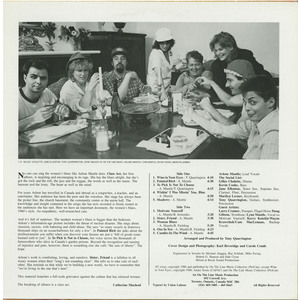
Arlene Mantle - Class Act BACK
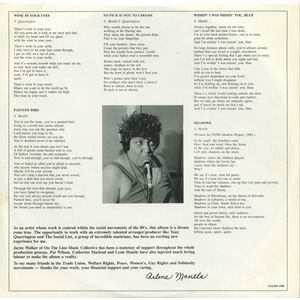
Arlene Mantle - Class Act INSERT SIDE 01
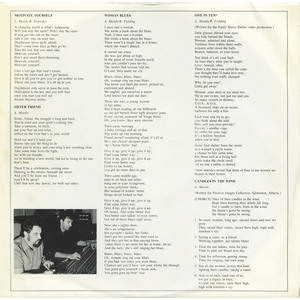
Arlene Mantle - Class Act INSERT SIDE 02
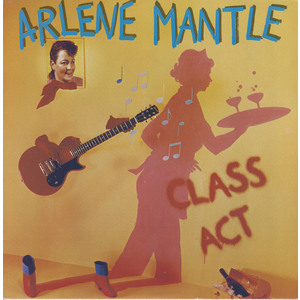
Class Act
Media
Videos
0 videos
No videos available for this title.
Credits
Musicians
Arlene Mantle: lead vocals
Gilles Cholette: drums
Kevin Cooke: bass
Jane Ellenton: tenor sax, soprano sax, clarinet, flute, percussion
Marilyn Lerner: keyboards
Tony Quarrington: guitars, synthesizer, percussion
Guest artists
Larry Cramer: trumpet, flugel horn
Doug Gibson: trombone
Lynn Mantle: vocal on 'Motivate Yourself'
Kerry Knickle: backing vocals
Wayne Krawchuk: backing vocals
Cam MacLennan: backing vocals
Songwriting
'Wine in Your Eyes' written by Tony Quarrington
'Painted Bird' written by Arlene Mantle
'To Pick Is Not To Choose' written by Arlene Mantle and Tony Quarrington
'Wishin’ I Was Missin’ You, Blue' written by Arlene Mantle
'Shadows' written by Arlene Mantle
'Motivate Yourself' written by Lynn Mantle and R. Ironsides
'Sister, Friend' written by Arlene Mantle
'Woman Blues' written by Arlene Mantle and R. Fielding
'One in Ten' written by Arlene Mantle and R. Fielding
'Candles in the Wind' written by Arlene Mantle
Production
Arranged and produced by Tony Quarrington
Engineered in Toronto by Michael Alaggia, Ray Soldiuk, Mike Ewing, Robert G. Hanson and Dale Clyne
Mixed at Brock Sound Productions
Cover design and photography by Karl Beveridge and Carole Conde
Typeset by Union Labour
Canadian content
Produced in Toronto, Ontario
Published by On The Line Music Collective
An On The Line Music Production
692 Coxwell Ave., Toronto, Ontario, Canada M4C 3B6
Copyright
All songs copyright 1986 and published by On The Line Music Collective (ProCan), except 'Wine in Your Eyes', copyright 1986, Saska Toons (CAPAC) and On The Line Music Collective (ProCan).
Notes
'One in Ten' written for the Emily Stowe Shelter video production.
'Candles in the Wind' written for Positive Images Collective, Edmonton, Alberta.
'Shadows' written for PAND Shadow Project, 1984.
Liner notes
No one can sing the women’s blues like Arlene Mantle does. Class Act, her first album, is inspiring and encouraging in its rage. She has the blues alright, but she’s got the rock and the roll, the jazz and the reggae, the words as well as the music. The humour and the irony. The heart as well as the mind.
For years Arlene has travelled in Canada and abroad as a songwriter, a teacher, and an entertainer. Her audience has been the poor and the voiceless. Her stage has always been the picket line, the church basement, the community centre or the union hall. The knowledge and insight contained in the songs she has now recorded is firmly rooted in the audiences she has met. Here we have an important document, the women’s blues, 1980’s style. An empathetic, well-researched case.
And it’s full of surprises. The modern woman’s blues is bigger than the bedroom. Arlene’s information-age picture includes the threat of nuclear disaster. She sings about classism, racism, wife battering and child abuse. She sees “so many vessels in distress/a thousand ships on an ocean/harbours for only a few”. In Painted Bird she talks about the disillusionment you suffer when you discover your dreams are just a “bill of goods some bastard sold to you”. In To Pick is Not to Choose, her voice serves the thousands of farmworkers who slave in Canada’s garden prisons. Beyond the recognition and naming of injustice and pain, however, there is something else she calls “the rain of liberty”. The hope.
Arlene’s work is comforting, loving, and sensitive. Sister, Friend is a lullabye to all weary women when their “song’s not sounding clear”. She tells us to take care of each other. She reminds us that while we’re building a new world, we have to remember that “we’re living in the one that’s here”.
This material launches a full-scale grievance against the culture that has silenced women.
The breaking of silence is a class act.
Catherine Macleod
Artist note
As an artist whose work is centred within the social movements of the 80’s, this album is a dream come true. The opportunity to work with an extremely talented arranger/producer like Tony Quarrington and The Social List, a group of incredible musicians, has been an exciting new experience for me.
Jayne Walker of On The Line Music Collective has been a mainstay of support throughout the whole production process. Pat Wilson, Catherine Macleod and Lynn Mantle have also injected much loving labour to make the album a reality.
To my many friends in the Trade Union, Welfare Rights, Peace, Women’s, Gay Rights and Solidarity movements — thanks for your work, your financial support and your caring.
Arlene Mantle
Label and matrix/runout
On The Line Music Production
OTL003-1986
All Rights Reserved
No Comments