Insight
Charlie Panigoniak (ᓵᓕ ᐸᓂᒍᓂᐊᖅ) was born March 7, 1946, in a camp near Chesterfield Inlet, in what is now Nunavut. He grew up in the Kivalliq and spent most of his life in Arviat and Rankin Inlet. He was among the first Inuit singer-songwriters to build a large recorded repertoire in Inuktitut, and for half a century his voice came out of radios across the North.
His first instrument was his father’s, a guitar built from milk cans, string and nails. Panigoniak carved from an early age, and an ivory sculpture attributed to him and dated 1959 survives in the Inuit Art Foundation archive.
In 1967 he was sent south to the Ninette Sanatorium in Manitoba for tuberculosis treatment. Lorna Panigoniak later recalled that he met a First Nations patient there who played him music he had never heard. He bought his first real guitar in hospital for fourteen dollars, with money earned from selling carvings.
He wrote his earliest songs in English. Lorna remembered that the language was hard for him and that the songs only began to work when he turned to Inuktitut. From then on the subjects came straight out of his own life: hunting, family, childhood, romance, illness, humour, religion, and the Inuit organizations taking shape around him.
He composed in his head rather than on paper, and a song could change from one night to the next. He took pleasure in rewriting a verse mid-performance and catching the room off guard. “That’s the way I like to sing. I don’t want to use the same words all the time.”
CBC producer Doug Ward heard him sing in 1973 and arranged sessions in Toronto. Nine songs came out of them, issued in 1975 as the CBC Radio Canada broadcast records LM 291 and LM 292. ‘Makatay’ looked back on hunting and fishing. ‘Inimay’ remembered being bounced on his mother’s knee. ‘Where Is Panigoniak’ came from producer Ira Stewart asking for one short song to close a session. ‘Pahlamee’ named a place where Charlie and his family lived through the hardship of the 1950s, when his father walked a long way looking for help. ‘From Sanitorium’ dealt with the southern hospitals so many Inuit knew from the inside. On the second record, ‘Ougua’ was a love song, ‘Meepay’ was about the woman who would become his wife, ‘I.T.C.’ told the beginnings of Inuit Tapirisat, and ‘John 3:16’ put the verse into Inuktitut.
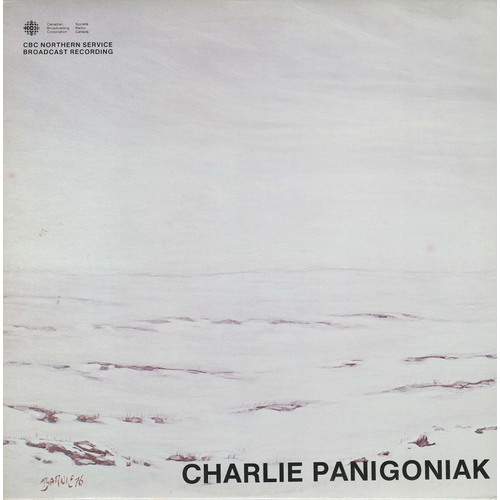
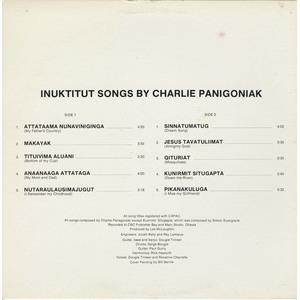
The CBC Northern Service kept recording him. Inuktitut Songs was cut at CBC Frobisher Bay and Marc Studio in Ottawa, with Dougie Trineer, Paul Gurry, Rick Haworth, Serge Bougie and Roxanne Charrette backing him and Les McLaughlin producing. The songs covered his father’s country, his parents, childhood, dreams, mosquitoes, life on the river and a girlfriend he missed. Boot Records reissued the album commercially in 1981 as My Seasons, and Inuktitut magazine reported that the Boot releases were quickly popular throughout the North.
Other records reached listeners outside the commercial trade entirely. La Fédération des Coopératives du Nouveau-Québec issued Songs by Charlie Panigoniak and Charlie Panagoniak at Xmas, and an EP carrying the imprint of Inuktitut magazine went out under the name Eskimo Point. A 1983 discography in Inuktitut listed the CBC, co-operative and broadcast records together, showing how his recordings circulated through community radio stations, schools and cultural centres across the North.
Inuktitut Christmas & Gospel Songs followed on the CBC Northern Service, pairing his own Inuktitut songs with English carols. Its notes describe a singer who had stopped imitating the popular performers of the day and turned to original Inuit material, and who by then had played across the Northwest Territories, Yukon, Alaska and Greenland. They also caught his humour: “In Alaska they call me Charlie Pride and ask for my autograph!”
Ethnomusicologist Lynn Whidden studied him after fieldwork at Eskimo Point and published Charlie Panigoniak: Eskimo Music in Transition in 1981. She identified elements of both country music and older Inuit musical practice in his songs and called it a transitional style.
By then Lorna Tasseor was his wife and his regular partner on stage. They had met in Arviat, and she recalled that Charlie taught her to sing before they began performing together. Their 1981 CBC Northern Service album Just for Kids was sung in Inuktitut, about relatives, animals, travelling and being a child. CBC was still advertising it years later as a record about family life in the North.
He played everywhere in northern Canada and travelled to Alaska, Greenland and Ireland. He appeared on CBC radio and television, on APTN and the Inuit Broadcasting Corporation, and on CBC’s True North, performed at the first Inuit Circumpolar Conference in Iqaluit in 1983, at the Nunavut Day celebrations in 1999, and at Inuit Tapiriit Kanatami’s thirtieth anniversary in 2001. He worked as a CBC broadcaster in Rankin Inlet and with the Inuit Broadcasting Corporation, and once called an Ottawa Senators game against the Montreal Canadiens in Inuktitut, play by play.
In 2012 he was invested into the Order of Nunavut. He explained himself plainly at the ceremony: “I composed songs to lift the spirits of the people.”
By 2016 Parkinson’s disease had taken most of his travelling and performing. That August, musicians and friends gathered in Arviat for a tribute concert, and he took the stage himself. Lorna said that among everything he had done, he valued having written his lyrics in Inuktitut and having shown younger people that their language belonged in popular music. Northerners had long since begun calling him the father of Inuktitut music. The Nunavut Commissioner’s Performing Arts Award came later that year.
His health kept him in Ottawa for part of his last years. His daughter Charlene brought him home to Nunavut, and on the way north he asked to stop at the CBC in Iqaluit to see the people at the station where he had spent so much of his working life. He died at home in Rankin Inlet on March 6, 2019, the day before his seventy-third birthday. Mourners at his funeral were asked to bring guitar picks instead of flowers.
-Robert Williston
Gallery
Images
4 images
Charlie Panigoniak - Inuktitut Songs BACK
Panigoniak, Charlie - Inuktitut Songs
Panigoniak, Charlie - Inuktitut Songs
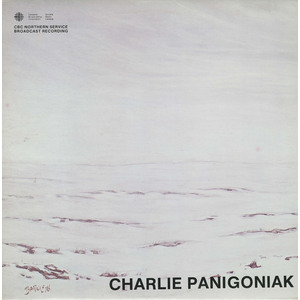
Inuktitut Songs
Media
Videos
0 videos
No videos available for this title.
Credits
Musicians
Charlie Panigoniak: vocals
Dougie Trineer: guitar, bass, banjo, vocals
Paul Gurry: guitar
Rick Haworth: harmonica
Serge Bougie: drums
Roxanne Charrette: vocals
Songwriting
‘Attataama Nunaviniginga’ written by Charlie Panigoniak
‘Makayak’ written by Charlie Panigoniak
‘Tituvima Aluani’ written by Charlie Panigoniak
‘Anaanaga Attataga’ written by Charlie Panigoniak
‘Nutaraulausimajugut’ written by Charlie Panigoniak
‘Sinnatumatug’ written by Charlie Panigoniak
‘Jesus Tavatuliimat’ written by Charlie Panigoniak
‘Qituriat’ written by Charlie Panigoniak
‘Kunirmit Situgapta’ written by Simon Siyagrarik
‘Pikanakuluga’ written by Charlie Panigoniak
All song titles registered with CAPAC
Production
Produced by Les McLaughlin
Engineered by Jonah Kelly and Ray Lemieux
Recorded at CBC Frobisher Bay and Marc Studio, Ottawa
Artwork
Cover painting by Bill Barnie
Release
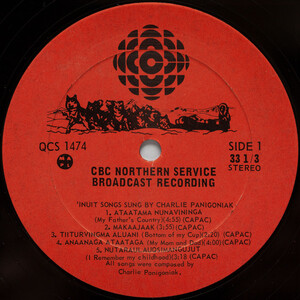
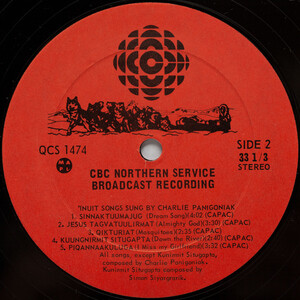
CBC Northern Service Broadcast Recording QCS 1474
Stereo
No Comments