Insight
Piledriver occupies one of the strangest corners of Canadian heavy metal history. What appeared in 1984 to be a mysterious Toronto speed-metal band in leather, spikes and masks had no band behind it. Piledriver began as a studio project put together during the early explosion of underground heavy metal, built on outrageous songs, invented musicians, pseudonyms and a visual identity pitched at the same level. At the centre of it stood vocalist Gordon “Gord” Kirchin, the one participant who would eventually turn the fiction into something real.
Kirchin knew Ottawa musician and producer Leslie Howe from Mainstream, a bar band the two had played in together. Howe later developed a recording and songwriting partnership with Louise Reny. According to Kirchin, Howe reached him while he was on the road and described a heavy-metal recording project that would have no actual band behind it. They needed a voice heavy enough to carry it. Kirchin agreed, returned to Ottawa and recorded the vocals over a few days in August 1984.
The label behind the project was Cobra Records, run by Zoran Busic through his Canadian company Maze Music. Kirchin later described the commercial idea in plain terms: make a heavy-metal record, give it a striking cover, press a modest quantity and ride the rapidly growing metal market. Kirchin was 22 and had never sung on a commercially released album. Once he heard the songs he treated the session as a real opportunity and threw himself into the performance. What had been conceived as a disposable studio exercise became Metal Inquisition.
The names printed on the record preserved the illusion that Piledriver was a working group. Kirchin became “Pile Driver.” Howe appeared as guitarist “Bud Slaker” and as producer and engineer “BUD,” while the songwriting name “Sal Gibson” stood in for Louise Reny. The sleeve added rhythm guitarist “Knuckles” Akimbo and drummer “Former” Lee. In fact Howe played the guitars and bass and programmed the drums, with real cymbals overdubbed on top, while Kirchin supplied the vocals. Reny and Howe wrote the material. The fictional personnel and the ridiculous names did more than hide the musicians involved. They became part of Piledriver’s identity.
The Canadian release credits the sessions to Rattlesnake Studios, Belgium, another detail that fed the mystery around the project. Kirchin later said he helped devise the mythology and the names while being told to keep the real story quiet. He received a small session fee for his vocals and was not identified publicly by his own name.
Even the figure on the cover was not Kirchin. Photographer Patrick “Flash” Harbron shot the scene at Toronto’s Gasworks, using the club stage and lighting to suggest a live performance, and the leather-clad executioner was Toronto radio personality Craig Jones. Kirchin recalled waiting to be called to Toronto for a costume fitting, then receiving the finished album and discovering that somebody else had been photographed as the character he had voiced. The image became inseparable from Piledriver all the same, and eventually from Kirchin himself.
Released by Cobra in October 1984, Metal Inquisition carried seven tracks: “Metal Inquisition,” “Sex With Satan,” “Sodomize The Dead,” “Witch Hunt,” “Pile Driver,” “Human Sacrifice” and “Alien Rape.” Pounding traditional heavy metal, emerging speed-metal aggression, crude humour and deliberately provocative lyrics made the record hard to mistake for anything else. Kirchin’s rough, theatrical vocal gave the invented character a personality strong enough to outgrow the marketing exercise behind it.
The album began circulating well beyond Canada. Roadrunner licensed it for Europe and HME handled the United States. Reviews and references turned up in metal publications and fanzines in several countries. Kirchin remained largely anonymous through all of it. He later described hearing Piledriver coming out of stereos and hearing audiences sing its lyrics while he was playing ordinary bar gigs, with no way to claim the record publicly.
American distribution produced another odd chapter. Concern over some of the titles led to an altered version in which “Alien Rape” became “Alien Raid,” while “Sex With Satan” and “Sodomize The Dead” gave way on some editions to “Lust” and “Twister.” Those two replacements came from another Cobra studio construction, Convict, on whose 1985 album Go Ahead...Make My Day! Kirchin sang under the name Terry “The Con” Browning. Some copies were mispressed, producing versions whose printed titles did not match the music on the record.
The controversy around Metal Inquisition carried the Canadian project into American political history. On September 19, 1985, the United States Senate Committee on Commerce, Science and Transportation held its hearing on explicit content in popular music, the session associated with the Parents Music Resource Center and remembered for the appearances of Frank Zappa, Dee Snider and John Denver. During a presentation by Pastor Jeff Ling, Piledriver came up as an example of music combining sexual violence and occult imagery, and material from the album was read into the record. A fragment of Ling’s presentation later surfaced in Zappa’s “Porn Wars” collage on Frank Zappa Meets the Mothers of Prevention.
By then the original creative team had moved on. Howe and Reny concentrated on One To One, whose 1985 album Forward Your Emotions produced Canadian hit singles and three Juno Award nominations. The pair later worked with the young Alanis Morissette before continuing through One 2 One, Sal’s Birdland and Artificial Joy Club. Their departure meant a second Piledriver record would have to be something different.
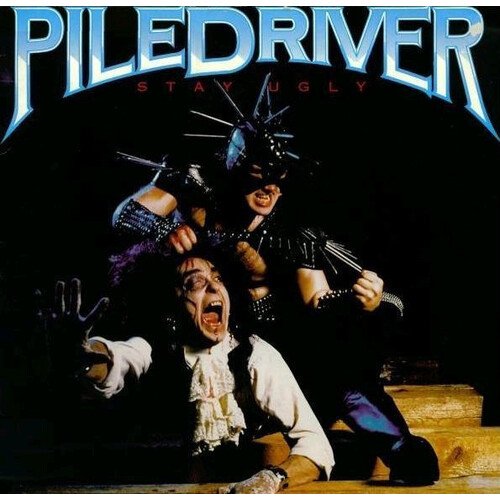
For Stay Ugly, released by Cobra in 1986, Kirchin remained the voice while almost everything behind him changed. The record was made principally by Virgin Steele’s David DeFeis and Edward Pursino, working with bassist Mike Paccione and drummer Robert Espizito.
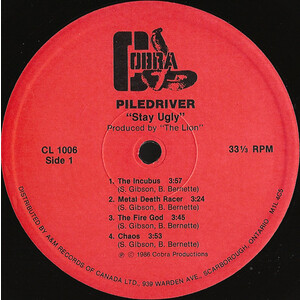
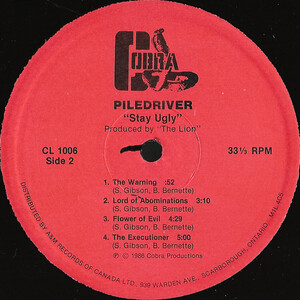
The sleeve again used Piledriver-style identities. Kirchin was billed as Pile Driver on vocals, “Bruizer” Bernette appeared on lead guitar, Sal Gibson on bass, “Hammer” on drums, John Savage on rhythm guitar, and DeFeis appeared as “The Lion” on the production credit. The songs were credited to B. Bernette and S. Gibson.
DeFeis later recalled that he and Pursino wrote the album quickly and cut the instrumental tracks with Paccione and Espizito before flying Kirchin to New York. Kirchin recorded his vocals in a couple of hours and was driven back to the airport the same night.
Stay Ugly contained “The Incubus,” “Metal Death Racer,” “The Fire God,” “Chaos,” “The Warning,” “The Lord Of Abominations,” “Flowers Of Evil” and “The Executioner.” It was not the work of the musicians responsible for Metal Inquisition. Kirchin was the only confirmed performer common to the two Piledriver albums.
Kirchin recognized the difference immediately. He later recalled wondering how listeners could fail to notice that the second album sounded like an entirely different band. Stay Ugly pushed further toward speed and thrash metal, and to Kirchin it had lost some of the songwriting and character of Metal Inquisition. For a proposed third Piledriver record he decided to take control himself.
That third record was to be called Shock. Kirchin wrote and recorded material meant to define Piledriver on his own musical terms. During the project his relationship with Cobra collapsed over money. Kirchin later recalled that the promised recording advance was withdrawn while the album was already underway.
He ended Piledriver’s relationship with the label and renamed the project Dogs With Jobs. Lyrics were rewritten to move away from the Piledriver character, and Shock appeared through Fringe Product in 1990. A second Dogs With Jobs album, Payday, followed in 1993.
For years Piledriver seemed finished. Then the arrival of the internet changed Kirchin’s understanding of what had happened to the records. Searching for Piledriver online during the 1990s, he found an international following he had never known existed. The two albums had travelled for years through licensed editions, reissues, bootlegs, tape trading and collectors. Kirchin began writing directly to listeners and documenting his version of the project’s history. He also went after royalties from the early recordings, though he said those efforts came to nothing.
As the twentieth anniversary of Metal Inquisition approached, the idea of finally putting Piledriver on a stage took hold. Encouraged by Canadian metal supporter Ray “Black Metal” Wallace, Kirchin began assembling musicians and brought the character into a live setting. An early attempt proved unstable, but guitarist Mark “Kinky Pork Cream” Kopernicky then contacted Kirchin and helped build a more committed lineup. Gerry “Glace Frothfritter” Keough joined on drums and Robert “Lobo El Fsnort” Tollefson on bass. For the first time, Piledriver existed as a working band.
Kirchin adopted the name The Exalted Piledriver, partly to separate his group from the many other acts using the Piledriver name around the world. The new band toured and performed material that for two decades had existed as records and mythology. Kirchin could finally inhabit onstage the leather-and-spikes character that had carried his voice since 1984.
The Exalted Piledriver released Metal Manifesto in 2008 through Northern Storm Records. Kirchin regarded it as the realization of what Piledriver could have been with a genuine band from the start. He produced the album himself and brought in veteran producer and engineer Neil Kernon to mix it. European appearances followed, including Germany’s Keep It True and Headbangers Open Air festivals, and later incarnations of the group continued performing in Canada and abroad.
The humour stayed fundamental. Kirchin rejected the idea that Piledriver was a parody or joke band. He saw its absurdity as part of heavy metal’s capacity for theatricality and fun. The music was taken seriously even as the lyrics, stage names, costumes and persona pushed into excess. That tension ran through the first album, where a manufactured project with a largely fictional sleeve and an intentionally ridiculous premise found a real audience that outlasted the commercial scheme behind it.
Gord Kirchin died of lung cancer on September 22, 2022, one day before his 61st birthday. In the weeks before his death he had publicly documented his cancer treatments and stayed engaged with music. His passing brought renewed attention to a career whose most famous chapter had begun almost by accident.
Piledriver’s history unfolded in reverse. The records came first, and the fictional musicians, fabricated biography, masks, aliases and mythology created the appearance of a band that did not exist. Listeners kept that imaginary band alive long enough for Gord Kirchin to make it real. What started as a Canadian studio metal project in 1984 grew into a cult catalogue, crossed into the international underground and the American censorship debate, and decades later became the performing band its original singer had never been given the chance to front.
-Robert Williston
Gallery
Images
3 images
Stay Ugly Side 1
Stay Ugly Side 2
Stay Ugly
Media
Videos
0 videos
No videos available for this title.
Credits
Musicians
Pile Driver: vocals
‘Bruizer’ Bernette: lead guitar
John Savage: rhythm guitar
Sal Gibson: bass guitar
‘Hammer’: drums
Songwriting
All songs written by ‘Bruizer’ Bernette and Sal Gibson.
Production
Produced by ‘The Lion’
Physical Release
Vinyl LP
United States
1986
Manufactured by Important Record Distributors, Inc.
Distributed by Important Record Distributors, Inc.
No Comments