Insight
Tumasi Quissa was an Inuk singer, songwriter, guitarist and carver from Nunavik. He was born August 28, 1948 at Niaqungnguuq, between Povungnituq and Akulivik. By 1976 his family was living in Akulivik, where hunting, fishing and carving were part of daily life.
That same year, while attending school in Moose Factory, Quissa saw the Billy Donson Band perform and started learning guitar. He was soon writing songs in Inuktitut and performing in other communities, and he went on to tour Nunavik, Nunavut, Ontario and Quebec.
His performances drew the attention of the CBC in Montreal, and his first recordings were made for the CBC Northern Service. They went out to northern radio on small 33⅓ rpm broadcast discs. QC 1235 paired him with Jopi Arnaituk of Wakeham Bay, one of the first Inuit performers featured on CBC northern radio, and the two often sang each other’s songs. QC 1411 featured his brother Henry Quissa and Joanasi Qaqutu. Both discs were also pressed on labels of La Fédération des coopératives du Nouveau-Québec.
Those recordings put him on national television. The people choosing a northern musician for a nationwide Canada Day broadcast listened through tapes of Inuit performers and kept returning to Quissa. Some of them travelled to Povungnituk to meet him and Henry in person, and the brothers’ Canada Day performance was a success.
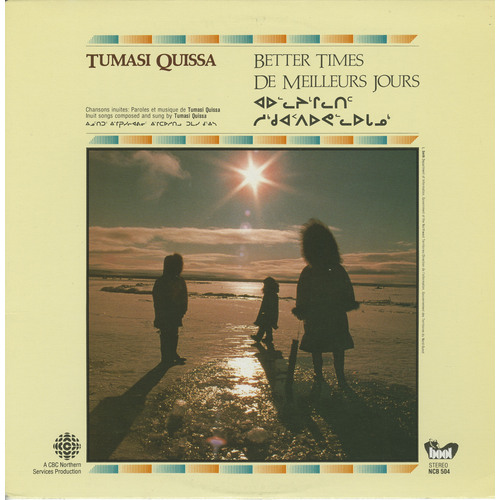
In 1981 Boot Records released Better Times / De meilleurs jours, drawn from CBC Northern Service broadcast recordings and issued through a joint initiative of Boot and the Hudson’s Bay Company. On it Quissa takes on the voices of his characters, from an old man, an old woman and their young son in dialogue about hospital pills to a talking skull. ‘Angiyuliruma Attatagogani’ sets the French song ‘Chevaliers de la table ronde’ to Inuktitut words about the thrill of the hunt, and the title song looks at change in the North and finds reasons for hope. Better Times was one of six Inuit and First Nations albums Boot issued in the series. A January 1982 report on Boot’s northern series stated that each of the six albums had sold about 10,000 copies, with strong interest in Greenland and Germany as well as Canada.
In the summer of 1982 Quissa formed the Akulivik Band with Eli Angijuq on lead guitar, Jimmy Alaiko on drums and Timothy Aliku on bass, while he sang and played rhythm guitar. The four wrote songs together and played music festivals and the occasional community dance, sometimes with Asa Anoutak on accordion. With Quissa the band played folk and country. Without him, the others played rock.
Quissa was also a working sculptor, known in the art world as Tumasi Illuta Quissa. His stone carvings include Two Hunters and Lumaaq: The Legend of the Blind Boy, and his work was shown in the Winnipeg Art Gallery’s 2004–05 exhibition The Faye and Bert Settler Collection.
In 1996 he recorded the eleven-song Tumassi Quitsaq for Inukshuk Records at Inukshuk Studio in Inukjuak, his first CD. Producer André Brassard played harmonica and tambourine, Eric Gaudet handled acoustic and electric guitars, and Akulivik Band members Timothy Aliqu and Jimmy Alayco played bass and drums. Singing entirely in Inuktitut over his 12-string acoustic guitar, Quissa built the album on blues-rock, with turns into country and western and progressive rock.
Tumasi Quissa died in 2008. In 2015 the Montreal Inuktitut radio program Nipivut hoped to use Geronimo Inutiq’s electronic remix of his song ‘Ingutaapiga’ as its theme. In 2019 the Avataq Cultural Institute included him in its anthology of popular Nunavik songs, where compiler Nelly Duvicq-Mangiok named him among her favourites. “The lyrics are so funny,” she said. “Some are a play on words.”
-Robert Williston
Gallery
Images
2 images
Tumasi Quissa - Better Times De Meilleus Jours BACK
Better Times / De Meilleus Jours
Media
Videos
0 videos
No videos available for this title.
Credits
Musicians
Tumasi Quissa: guitar, vocals
Henry Quissa: musician, Side 1
Joanasi Qaqutu: musician, Side 1
Jopi Arnaituk: musician, Side 2
Songwriting
Inuit songs composed and sung by Tumasi Quissa
‘Angiyuliruma Attatagogani’ is identified in the liner notes as a traditional French song, ‘Chevaliers de la table ronde’, adapted into Inuktitut
Production
Produced by Les McLaughlin
Music produced by the Northern Service of the Canadian Broadcasting Corporation
Derived from CBC Northern Service Broadcast Recordings
Artwork
Graphics: DesignCollaborative, Cambridge, Ontario
Cover printed and fabricated in Canada
Release
Tumasi Quissa – Better Times / De meilleurs jours
Stereo
© ℗ 1981 Boot Records Limited
Manufactured and distributed in Canada by Boot Records Limited
1343 Matheson Boulevard West, Mississauga, Ontario, Canada L4W 1R1
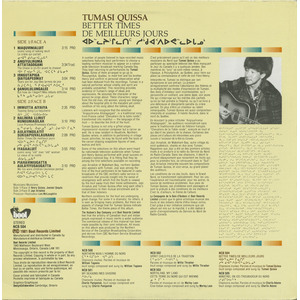
A number of people listened to tape-recorded music selections featuring Inuit performers to choose a leading northern musician to appear on a nation-wide television broadcast marking Canada Day. They kept returning to performances by Tumasi Quissa. Some of them arranged to go up to Povungnituk, Quebec, to meet him and his brother Henry and confirm in personal observation what had been deduced from the recordings. Tumasi is a natural performer whose vitality and spirit are probably unmatched. This recording provides evidence of Tumasi’s range of ideas and expressions. He assumes the character of the person he sings about. These characters range from the old man, old woman, young son dialogue about the hospital pills to the macabre yet comic rendition of his song about the talking skull.
Listeners will recognize that the selection “Angiyuliruma Attatagogani”, is a traditional song from France called “Chevaliers de la table ronde”, transformed into Inuktitut — the language of the Inuit — to describe the thrill of the hunt.
Tumasi Quissa is not only a gifted singer, impressionist musician composer but a carver as well. He is now resident in Akudlivik, Northern Quebec where, in addition to performing in village music activities, he may be found with the tools of the carver shaping soapstone figures of seal, walrus and bird.
Some of the selections on this album were heard by nationwide television audiences when Tumasi and Henry Quissa performed with great success on Canada’s national day. It is fitting that they be among the first selections available on recording.
Jopi Arnaituk of Wakeham Bay, northern Quebec also appears with Tumasi. Jopi was among the first of the Inuit performers to be featured in radio broadcasts of the CBC northern radio service in renditions that provide insight into the sense of strangeness with which first the South is viewed by the Inuit away from their home settlements. Jopi Arnaituk and Tumasi Quissa often sing each other’s compositions to their mutual enrichment and to that of their listeners.
Northern conditions for the Inuit are undergoing great change. For some it is dramatic; for others, it is seen as bringing many problems. But there are aspects of change that for Tumasi Quissa indicate Better Times, the theme piece of this album.
The Hudson’s Bay Company and Boot Records Limited feel that the artistry of Canadian Inuit and Indian people expressed in music merits a wider audience. The commercial release of this material has been made possible by their joint initiatives. All music on this album was produced by the Northern Service of the Canadian Broadcasting Corporation, and derives from CBC Northern Service Broadcast Recordings.
No Comments