Insight
Rapid Tears were one of the earliest and most formidable heavy metal bands to emerge from Toronto, Ontario, arriving at a moment when Canadian hard rock was evolving into something faster, heavier, and more disciplined. Formed in 1977, the band helped define the city’s underground metal scene before the genre had fully taken shape in Canada, combining a powerful twin-guitar attack, strong vocal harmonies, and a hard-driving rhythmic precision that placed them at the front edge of early Canadian metal.
At the center of that sound was guitarist, vocalist, and principal songwriter Michael J Miller, whose path toward Rapid Tears began long before the band itself. Raised in Goderich, Ontario, on Lake Huron, Miller came from a deeply musical family. His father, who served in the Air Force, played saxophone and clarinet; his mother played piano; his sister also played piano; and one of his brothers played guitar. Another brother brought home the latest CHUM Chart single every week from the local record store, keeping the household constantly connected to whatever was new on the radio. Miller also absorbed the changing sounds of the 1960s through The Ed Sullivan Show, where he first saw the new bands arriving in real time.
At age nine, he wanted a drum kit, but his parents refused on practical grounds: it was too loud. Instead, they steered him toward guitar. He agreed — on the condition that it be electric — and promptly received an acoustic. It turned out to be the right compromise. He began lessons, then quickly started teaching himself by ear, encouraged by siblings who challenged him to pick out riffs from records by Grand Funk Railroad, Deep Purple, and other hard rock acts of the day. Once he learned bar chords and began working out Alice Cooper songs on his own, his direction was set. By the time he was twelve, he was already developing into a serious player, and when his father saw how committed he had become, he bought him a Gibson in Grade 8.
Even before that, Miller had already tasted the thrill of performing. While still in Grade 5, he was recruited by older students for a school talent show after proving he could actually play the songs they were attempting. On the day of the performance, his teacher asked him to explain to the class why he was being excused from the room. When he said he had been invited to perform in the senior talent show, the class applauded. It was, in his own words, the first real taste of what being onstage felt like. Not long afterward, he joined a more serious local group, eventually renaming it Touch, and by Grade 9 that band was strong enough to open for Lighthouse in front of roughly a thousand people — an early indication that his teenage declaration to a classroom teacher was less fantasy than plan. Asked what he wanted to do with his life, he stood up and said plainly: “I’m going to be a rock star.”
By the time Rapid Tears formed in Toronto in 1977, Miller had already spent years building toward exactly that outcome. The band’s best-known recording lineup brought together Brian Frank on vocals, Michael J Miller on guitar and vocals, Clayton Bonin on guitar and vocals, Jon Wein on bass, and Rick Nemes on drums. Within that lineup were several threads that extended well beyond the band itself: Miller would later continue under MJM (Michael J Miller Band), while Nemes would later join Infernäl Mäjesty, drumming on their landmark 1987 LP None Shall Defy and also handling all vocals on the album, before later surfacing in Lethal Presence.
Before their vinyl releases, Rapid Tears documented their earliest sound on a private, unreleased three-song 1979 demo cassette featuring ‘Androids’, ‘Aftermath’, and ‘Preparation’. The tape was never officially issued and circulated only privately, though copies later leaked out. Miller has since noted that the band also recorded an extensive body of rehearsal material on cassette — likely close to a hundred songs captured on ghetto blaster tapes for self-evaluation, arrangement, and development — suggesting that the surviving Rapid Tears discography represents only a fraction of the group’s actual creative output. Some of that material may still survive in digital form following later archival transfers. The lineup on those sessions featured Brian Frank on vocals, Michael J Miller and Clayton Bonin on guitars, Adam Sherban on bass, and Rick Nemes on drums, with engineering credited to Doug Clements.
Rapid Tears’ first official release was the independently issued Guardian Records single ‘Operation Airlift’ b/w ‘Tomorrow’, released in 1980. Both tracks were recorded and mixed at Sounds Interchange. Although the record has since become a prized collector’s item in its own right, its greater significance lies in what it announced: Rapid Tears were already functioning as a fully original band at a time when most emerging hard rock acts still relied heavily on covers.
Rapid Tears followed that 1980 single with ‘Headbang’ b/w ‘Wonderland’, issued on Chameleon Records in 1981. Pressed in a small run and circulated mainly through local channels, the 45 further defined the band’s direction: ‘Headbang’ was lean, forceful, and unmistakably metal, while ‘Wonderland’ showed the melodic and structural discipline that would become one of Rapid Tears’ strengths. Four decades later, the single found new life when RidingEasy Records in California licensed ‘Headbang’ as the opening track on the 2021 compilation Scrap Metal Vol. 1.
A second private, unreleased demo was assembled as the band refined its material heading into Honestly. This 1982 tape was never issued commercially and circulated only privately, though copies later leaked out. According to Michael J Miller, it included ‘Keep Runnin’’ and ‘Down on You’ — not ‘Just for You’ — along with additional songs intended as working material for the Honestly album, some of which were never officially released.
Before the release of Honestly, two Rapid Tears tracks — ‘Discontent Intentions’ and ‘Heart of Predestination’ — appeared on the Chameleon Records compilation LP The Circuit, marking the beginning of the band’s association with the Toronto independent label that would issue the rest of their original vinyl catalogue. Chameleon’s small but memorable run also included releases by Pale Blue, Instructions, Cöld Wår, and Neon, placing Rapid Tears among a tight circle of early Toronto independent acts.
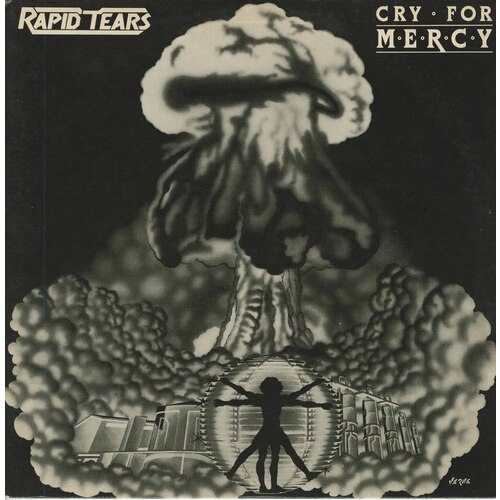
That breakthrough came in July 1982 with the release of Honestly, issued on Chameleon Records. The album established Rapid Tears as one of Canada’s most serious early metal contenders, combining sharp twin-guitar work, strong melodic instincts, and a disciplined attack aligned with the more advanced end of the international heavy metal movement then taking shape. The original LP appeared as a 12-inch black vinyl release (CR-575) in two distinct sleeve variations: a first pressing of 1000 copies featuring fantasy artwork by Verne Andru, followed by a second pressing of 1000 copies with a band photo cover — the image used on the back of the fantasy sleeve was repurposed as the front cover for the later pressing. Andru, born Verne Andrusiek, was a Canadian artist and animator associated with the Captain Canuck orbit, where he created the countercultural comic character Captain Cannabis. He later worked in animation, including cel painting on the National Film Board short Blowhard and projects connected with Hanna-Barbera and Nelvana’s Rock & Rule. His involvement adds an unexpected but fitting underground comics connection to the album’s visual identity.
In early 1984, Chameleon Records correspondence sent to Bob Nalbandian of Headbanger in California described Rapid Tears as “Canada’s metal assault” and claimed that Honestly had already created an “overwhelming wave on the European front,” indicating that the band was already being actively promoted beyond the local scene. Most of the album was recorded and mixed at Cottingham Sound in Toronto, while the earlier Guardian single tracks ‘Operation Airlift’ and ‘Tomorrow’ — originally recorded at Sounds Interchange — were remixed at The Sound Kitchen for inclusion. Clayton Bonin also played synthesizers on ‘Variations’.
By this point, Rapid Tears had already become a serious live draw. One of Miller’s clearest memories from the early years was an all-day outdoor concert at Molson Park near Barrie, likely around the era of the first single. As the day was winding down and night was starting to fall, there were only a few dozen people still hanging around when the band took the stage. By the middle of the opening song, Miller recalled, Rapid Tears had unleashed enough volume and sheer force that people began running in from everywhere — out of tents, out of the woods, out of parked cars — until the field filled with what he estimated at five to ten thousand people. For a young Canadian metal band still operating on the strength of a single 45, it was the kind of moment that told them they were onto something real.
Rapid Tears were also getting attention beyond the clubs. Citytv’s The New Music covered the band, giving them exposure that Miller recalled as being syndicated across major cities in every province. Toronto’s Q107 also featured them on its Saturday-night metal programming, and the station became the source of one of the band’s best stories. When ‘Headbang’ entered Q107’s “Rock Wars” listener-vote competition, Rapid Tears beat a string of major acts across the week — opening with a Monday-night win over Thin Lizzy, followed by victories over Streetheart and 10cc on subsequent nights — before finally being knocked out on Friday by Van Halen’s newly premiered version of ‘(Oh) Pretty Woman’. Losing to Van Halen may have ended the run, but the fact that a Toronto independent metal band had come that close to the Q107 Hall of Fame at all says plenty about the traction they had at the time.
After Honestly, but before Cry for Mercy, Rapid Tears recorded a third private, unreleased demo consisting of eight songs. According to Michael J Miller, this tape included ‘Garden of Eden’ and ‘Cell of Damnation’. Like the earlier two demos, it was never officially released and circulated only privately before copies leaked out. Other than the songs later issued on Honestly, Cry for Mercy, and The Circuit, the remaining demo material appears to have been lost to time.
By early 1984, Rapid Tears were moving into the next phase. A Chameleon Records press release dated February 14, 1984 described the band as “Canada’s heaviest metal rock group” and noted that they were recording a new 12-inch, four-song EP at Wexford Studios in Toronto. That release became Cry for Mercy, issued in March 1984, and showed the band tightening its attack even further with a heavier, more concentrated sound.
A 2006 CD compilation combining Honestly, Cry for Mercy, and four additional tracks was issued without the band’s knowledge or approval. According to Michael J Miller, no contract was ever made for that release, he had no involvement in it, and the issuing label remains unknown to him. A legitimate reissue arrangement followed in 2016, when Honestly, Cry for Mercy, and the two Rapid Tears tracks from The Circuit were licensed to the Greek label Sonic Age Records for release on its Cult Metal Classics imprint.
In recent years, Miller has returned to older material and begun shaping a possible third chapter, revisiting unfinished ideas and recasting them through the lens of a more experienced writer. He has described the process as reaching for “that extra can of soup in the back of the shelf” — something long set aside, but still there. As of his recent interview with Robert Williston, roughly eight songs were in progress, with Brian Frank still expected to contribute vocals.
After Rapid Tears, Michael J Miller carried that same songwriting drive and guitar-led vision into Adrenalin, whose album Dedicated was issued in Germany on Long Island Records in 1995 but never received a proper Canadian release. In 1999, he reunited with Rick Nemes on the lone Castle Of Pain promo CDr Dungeon Of Doom, a one-song private release that pushed into darker territory, with synth sitar and layered guitar textures adding to its doom-heavy atmosphere; the track also appeared on the Canadian Independent Box Set. He later returned under the MJM name, building an extensive post-1980s catalogue that has kept him recording and releasing well into the 21st century. If there is a single thread connecting the entire arc — from teenage stages in Goderich to Toronto metal clubs, private demos, lost tapes, unauthorized reissues, and a still-unfinished body of work — it is the one Miller summed up most clearly himself: “I’m someone who has never quit. Never.”
-Robert Williston, April 4, 2026
Gallery
Images
4 images
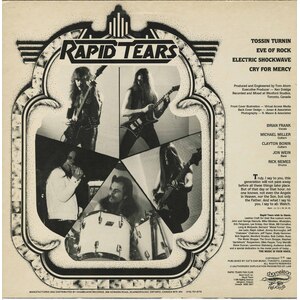
Rapid Tears - Cry for Mercy (EP)
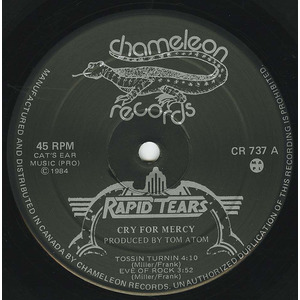
Rapid Tears - Cry for Mercy (EP) LABEL 01
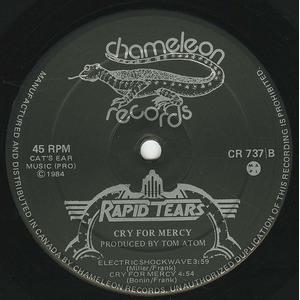
Rapid Tears - Cry for Mercy (EP) LABEL 02
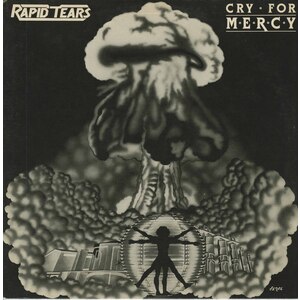
Cry for Mercy (EP)
Media
Videos
1 video
Credits
Musicians
Brian Frank: vocals
Michael Miller: guitars
Clayton Bonin: guitars
Jon Wein: bass
Rick Nemes: drums
Songwriting
All songs published by Cat's Ear Music, Toronto, Ontario
Production
Produced by Tom Atom
Engineered by Tom Atom
Executive produced by Ken Doidge
Recorded and mixed at Wexford Studios, Toronto, Ontario
Manufactured and distributed by Chameleon Records, Scarborough, Ontario
Artwork
Front cover illustration by Virtual Access Media
Back cover design by Jonan & Associates
Photography by R. Mason & Associates
Nuclear explosion cover art by Verne Andru
Notes
Copyright © 1984
Rick Nemes later played with Infernäl Mäjesty, Lethal Presence, and Castle of Pain.
Rapid Tears Fan Club
Send S.A.E. to:
Rapid Tears
1189 Kipling Avenue
Islington, Ontario
Canada M9B 3M7
Chameleon Records
28B Howden Road
Scarborough, Ontario
Canada M1R 3R4
(416) 757-8775
Liner notes
Truly, I say to you, this generation will not pass away before all these things take place. But of that day or that hour, no one knows, not even the Angels in Heaven, nor the Son, but only the Father. And what I say to you, I say to all: Watch.
Mark - Ch. 13, v. 30, 32, 33.
Thanks
Rapid Tears wish to thank: Leather Craft for their fine custom work, John and George Giaouris, Mike Bilodeau, Musicplex, Eric Ferguson, Lee Eckley, Ivor Hirak, Bill Cornelius, Long & McQuade, Bernard “Metal Forces” Doe, Joe Lado, Ralph Jimmy Burroughs, Jeff Chainsaw Chalmers, Jeff Taylor, Shelly Hammer, Bob Segarini, Wexford Studios, Bob Cobbin, Russ, The Music Shopper, The Drum Shopper, Stephan “Aardshock” Rooyackers, Gilles Paquin, Tony Marzilli, Steve Duncan, Lawrence Steilman, Audience Audio, and a special dedication to the metal youth of today ... THE MUSIC IS YOUR VOICE.
No Comments