Insight
Donn Reynolds was one of Canada’s most widely travelled country entertainers, a Winnipeg-born singer, guitarist, actor, broadcaster, recording artist, and champion yodeller whose career carried him through Canada, New Zealand, Australia, the United States, Britain, Europe, Morocco, and Spain. Known for decades as the “King of the Yodelers,” Reynolds built a career that was almost impossible to categorize neatly: part western troubadour, part vaudeville showman, part country vocalist, part international novelty phenomenon, and part old-school radio and television personality.
He was born Stanley Beresford Reynolds in St. Vital, Winnipeg, Manitoba, on June 26, 1921. As a boy he became fascinated by the recordings of British yodeller Harry Torrani, teaching himself to sing, yodel, and play guitar. By his early teens he was already performing publicly, and by the mid-1930s he was appearing around Winnipeg as “The Yodeling Ranger.” His earliest musical identity was rooted in western song rather than the later Nashville-style country market: cowboy ballads, yodel showcases, folk-derived material, and sentimental frontier songs formed the foundation of his repertoire.
Before his international career began, Reynolds spent several years at sea and in wartime service. As a teenager he worked with Canadian Pacific Steamships and later served in the Royal Canadian Air Force during the Second World War, where his singing led to work with the “Joe Boys,” a Canadian military entertainment unit that performed for Allied troops in Western Canada and Alaska. That wartime experience gave him a professional stage discipline that would serve him for the rest of his life.
After the war, Reynolds left Canada for the South Pacific. In 1947 he toured New Zealand under contract to R.J. Kerridge, then moved into Australia, where he quickly became known as “Canada’s Yodelling Cowboy.” He appeared on Australian radio, performed with travelling shows and circus companies, and recorded for Regal Zonophone. His Australian sides, including “That Old Bush Shanty Of Mine,” “Let Me Die With My Boots On,” “Just Saddle And Ride,” and “The Stockman’s Lullaby,” placed him among the early postwar country and western recording figures in Australia. He also appeared in the Ealing Studios film Eureka Stockade, adding a screen credit to an already expanding stage and radio résumé.
By 1949 Reynolds had moved into the United States market. His recording of “Texas Yodel” became an important calling card and helped establish him with American country and western audiences. During the early 1950s he recorded for labels including Aragon, Bullet, Lariat, and Blue Hen, often working in the borderland between country, western swing, radio transcription, and regional jukebox singles. His Lariat recordings with Eddie Cletro and the Round Up Boys show him working within the American western swing and country-pop circuit rather than simply as a novelty yodeller.
Reynolds’ reputation as a yodeller continued to grow during this period. He won the International Yodel Championship at the Pacific National Exhibition in Vancouver in 1950 and later won the United States Yodeling Championship in Washington, D.C., in 1956. His publicity often billed him as a “World Champion Yodeler,” a title that became inseparable from his stage identity.
In the mid-to-late 1950s Reynolds moved into another phase of his career, recording and performing in Britain and Europe. In the United Kingdom he recorded material later issued by His Master’s Voice and Pye Nixa, including The Donn Reynolds Song Bag. Those sessions are especially notable for their connection to producer Denis Preston and engineer Joe Meek, placing Reynolds briefly within one of the most interesting studio circles in late-1950s British popular music.
Reynolds also recorded for MGM in 1957, including “Rose Of Ol’ Pawnee,” “All Alone,” “Bella Belinda,” and “Blue Eyes Crying In The Rain.” These releases received North American and international issues, including Canadian, U.S., and U.K. pressings, showing the unusually broad reach of his catalogue for a Canadian country performer of the period.
While in Britain, Reynolds met Audrey Williams, a member of the vocal trio The Three Skylarks. They married in 1960, and she became known professionally as Cindy Reynolds. Donn and Cindy developed a husband-and-wife act that took them through Britain, Europe, Spain, and the Middle East before they returned to Canada in 1961. Their partnership became central to the next stage of his career, especially in Canadian television, club work, and duet recordings.
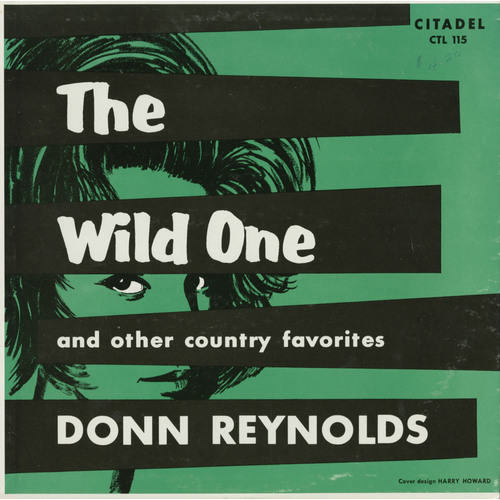
Back in Canada, Reynolds joined the national country television circuit. He appeared on Cross Canada Barndance and Red River Jamboree, then settled into the Toronto and Southern Ontario entertainment scene. His first Canadian LP, The Wild One and Other Country Favorites, appeared in the early 1960s on Banff and Citadel-related issues, gathering material from the Rank/Olympic Sound period and presenting him as both a western singer and country favourite.
Through the 1960s, Reynolds recorded steadily for Canadian labels including Quality, London, Arc, and Sparton. With Cindy, he released duet singles for London and Sparton, while his solo recordings continued to emphasize the yodel-centred western material that had made him distinctive. His Arc LP The Blue Canadian Rockies presented him explicitly as “King of the Yodellers,” drawing together cowboy standards, yodel showcases, and Canadian western imagery. The album’s back cover emphasized his appearances for armed forces audiences in Canada, the United States, Britain, Europe, Australia, and New Zealand, as well as his performances on major American country radio and television programs.
In 1967, Arc issued Springtime In The Rockies, recorded at Bay Studios in Toronto under the direction of Ben Weatherby. The album showed Reynolds working comfortably in the polished Canadian country LP market of the late 1960s while still retaining the yodel-centred identity that set him apart from more conventional country singers.
By the 1970s Reynolds was a veteran entertainer with decades of international experience behind him, but he remained active in Canadian country music. His 1974 Marathon album Songs Of The West returned directly to cowboy and yodel material and placed him in Southern Ontario, where he was hosting a country music program on CHWO in Oakville and continuing to perform around Canada and the United States.
One of the defining moments of Reynolds’ later career came on November 27, 1976, when he set a Guinness-recognized world record by yodelling continuously for seven hours and twenty-nine minutes. The feat revived national media attention and reinforced his image as a performer whose vocal stamina and technical command were central to his public identity. In 1979, Quality Records issued King Of The Yodelers on the Grand Slam label, packaging him not merely as a country singer but as a Canadian record-holder and specialist in a vanishing performance art.
Reynolds earned further attention in 1984 when he established a fastest-yodel record by producing five tones, including three falsetto tones, in 1.9 seconds. The achievement brought him into Guinness and Ripley’s Believe It or Not! circles and led to renewed television exposure. Later references also credit him with bettering that mark in 1990 on the BBC program Record Breakers.
In 1987, RCA/BMG Canada issued Donn Reynolds - King Of The Yodellers on cassette, bringing together familiar repertoire from across his career. By then, Reynolds represented a much older show-business tradition: the travelling western entertainer who had moved from radio to records, from circus and vaudeville stages to television, from military camps to nightclubs, and from 78 rpm shellac to cassette-era reissues.
Donn Reynolds died in Toronto, Ontario, on August 16, 1997. The following year, Donn Reynolds Parkette in Brampton was named in his honour. His recorded legacy crosses more territories and formats than most Canadian country artists of his generation: Australian Regal Zonophone 78s, Canadian radio transcriptions, U.S. independent country singles, MGM Nashville material, British HMV and Pye Nixa releases, Canadian Arc and Marathon LPs, Quality reissues, and RCA/BMG retrospective material.
The Museum of Canadian Music thanks Donn Reynolds’ son, Scott Reynolds, who first worked with us in 2012 and generously helped expand the biographical and discographical record of his father’s remarkable career.
-Robert Williston
Gallery
Images
4 images
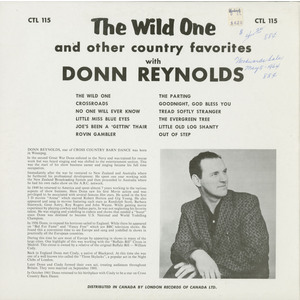
Donn Reynolds - The Wild One BACK
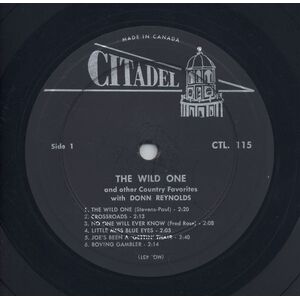
Donn Reynolds - The Wild One and Other Country Favourites
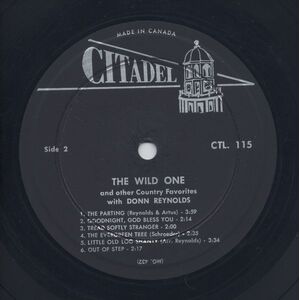
Donn Reynolds - The Wild One and Other Country Favourites
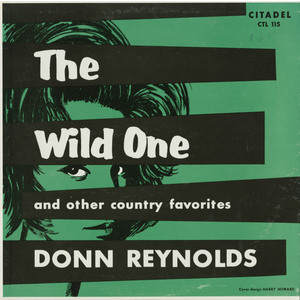
Donn Reynolds - The Wild One and other country favorites
Media
Videos
0 videos
No videos available for this title.
Credits
Songwriting
“The Wild One” written by Paul and Stevens
“Crossroads” written by Donn Reynolds
“No One Will Ever Know” written by Fred Rose
“Little Miss Blue Eyes” written by Don Helms and Merle Franklin Taylor
“Joe's Been A 'Gettin' Thair” written by Donn Reynolds
“Roving Gambler” traditional
“The Parting” written by Chic Artus and Donn Reynolds
“Goodnight, God Bless You” written by Donn Reynolds
“Tread Softly Stranger” written by Harry Robinson and Roy Tuvey
“The Evergreen Tree” written by Aaron Schroeder and Wally Gold
“Little Old Log Shanty” arranged by Donn Reynolds
“Out Of Step” written by Donn Reynolds
Production
Arranged by Bernard Ebbinghouse
Originally recorded May 1960 at Olympic Sound Studios, London, England
Artwork
Design by Harry Howard
Publishing
Distributed by London Records of Canada Ltd.
Notes
Originally recorded for Rank Records Ltd.
Made in Canada
Liner Notes
DONN REYNOLDS, star of CROSS COUNTRY BARN DANCE was born in Winnipeg.
In the second Great War Donn enlisted in the Navy and was trained for rescue work but was heard singing and was shifted to the entertainment section. This was the start of his show business career and singing became his full time occupation.
Immediately after the war he ventured to New Zealand and Australia where he furthered his professional development. He spent one year working with the New Zealand Broadcasting System and then proceeded to Australia where he had his own radio show on the A.B.C. network.
In 1949 he returned to America and spent almost 7 years working in the various aspects of show business. Here Donn saw his first movie motion and was privileged to be associated with several famous film stars. He acted in the first 3 D movie “Arena” which starred Robert Horton and Gig Young. He also appeared and sang in movies featuring such stars as Randolph Scott, Barbara Stanwyck, Gene Autry, Roy Rogers and John Wayne. While gaining movie experience by playing cowboy and Indian parts, he was not neglecting his favorite talent. He was singing and yodelling in rodeos and shows that needed a “boost” since Donn was destined to become U.S. National and World Yodelling Champion.
In 1956 Donn, to expand his horizon, sailed to England. While there he appeared on “Bid For Fame” and “Fancy Free” which are BBC television shows. He found this a convenient time to see Europe and sang and yodelled in shows in practically all the European countries.
During this time he saw most of Europe by appearing in shows in many of the large cities. One highlight of this was working with the “Buffalo Bill” Circus in Madrid. This circus is owned by a relative of the original Buffalo Bill — William Cody.
Back in England Donn met Cindy, a native of Blackpool. At this time she was one of a well known trio called the “Three Skylarks”, a popular act in the Night Clubs of London.
Later Donn and Cindy formed their own act, receiving audiences throughout Britain. They were married September 1960.
In October 1961 Donn returned to his birthplace with Cindy to be star on Cross Country Barn Dance.
No Comments