Insight
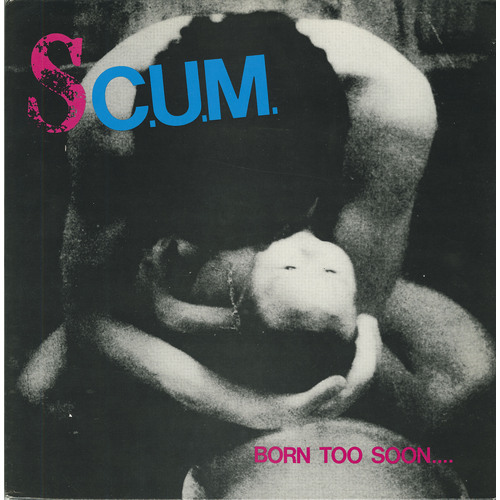
S.C.U.M. were one of the foundational bands of Montréal’s early hardcore punk movement, combining the velocity and confrontation of American hardcore with a distinctly local identity shaped by police harassment, skateboarding, bilingual urban culture and anger at political and social control. Formed on Montréal’s South Shore around 1980, the group remained active through several lineups until approximately 1988, leaving behind three demo cassettes, important compilation appearances and the 1985 album Born Too Soon....
The band originated when guitarist Georges Pearson and a group of high-school friends were repeatedly stopped and harassed by police because of their appearance and involvement in punk and skateboarding culture. Montréal’s metropolitan authority was then known as the Communauté urbaine de Montréal, whose initials appeared as C.U.M. Pearson and his friends responded by adding a large letter S to the insignia, transforming it into S.C.U.M. The initials were later expanded as Society Controlled Under Murderers, but the alteration of the C.U.M. symbol supplied the original inspiration.
The earliest version of S.C.U.M. developed around Pearson and Michel Cyr, who later became the guitarist in Unruled, together with a changing circle of South Shore musicians. Drummer Jean Gravel, also known as Jean Lortie, joined during the following year. Although some discographies date the band’s formation to 1981, Pearson’s account places its beginnings in 1980 and the establishment of a working lineup in 1981.
With few dependable venues available to young punk groups, S.C.U.M. organized parties in its rehearsal space. Admission money helped pay the rent, while the gatherings created a place where bands and audiences could meet beyond the commercial club system. Pearson later identified the political writing of Dead Kennedys and the early, unrefined power of Black Flag as especially important influences. The group absorbed the rapidly expanding California hardcore sound, but its lyrics and imagery remained firmly rooted in Montréal.
S.C.U.M. became closely associated with Cargo, the rough, volunteer-supported punk and hardcore venue at 4177 Saint-Denis Street. Active from 1981 until 1984, Cargo provided an essential home for local groups including S.C.U.M., Unruled, Fair Warning, No Policy, Genetic Control and Vomit and the Zits, while also presenting visiting bands such as D.O.A., Circle Jerks and Black Flag.
Surviving concert material documents S.C.U.M.’s growing presence during 1984. The group appeared with Fair Warning and Genetic Control, participated in a large bill that included Micro Edge, Direct Action, Social Distortion, Toxic Reasons and No Policy, and opened for D.R.I. at Cargo on May 21, 1984. These performances placed S.C.U.M. near the centre of Montréal’s first sustained hardcore wave.
By this period, the principal lineup consisted of Anthony Mark on vocals, Georges Pearson on guitar, Andrew Harder on bass and Jean Gravel/Lortie on drums. Pearson also used the name Yorgo, an identity that later became important in interpreting the personnel credits on the group’s album.
S.C.U.M.’s first recording was a three-song demo containing ‘So Much Hate,’ ‘No Hope Religion’ and ‘Exit Death.’ The performances were recorded during 1983 and circulated on a self-released cassette in 1984 without a printed cover. Its handwritten presentation reflected the informal international tape network through which hardcore bands exchanged music before obtaining record contracts or professional distribution.
The demo quickly carried S.C.U.M. beyond Montréal. ‘So Much Hate’ was selected for the international P.E.A.C.E. Benefit Compilation, assembled by MDC’s R Radical Records in association with Maximum Rocknroll. The double album gathered punk and hardcore bands from numerous countries, placing S.C.U.M. alongside Crass, Dead Kennedys, D.R.I., Subhumans, Mob 47, Negazione, B.G.K., D.O.A. and many others.
‘So Much Hate’ summarized the group’s early outlook. Its attack on police authority and accumulated social resentment was not imported political rhetoric; it grew directly from the experience of young South Shore punks confronting the Montréal institution whose initials had inspired the band’s name.
The year 1985 became S.C.U.M.’s most visible and productive period. Documented appearances included a major April engagement with Suicidal Tendencies, Sudden Impact and Genetic Control, followed later in the year by a performance with D.O.A. and the Syndicate.
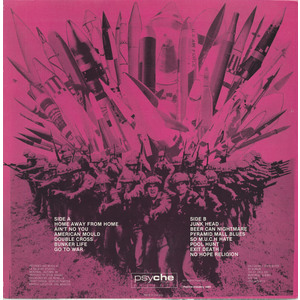
That autumn, the group entered La Majeure Studios in Montréal to record its first and only original-period album. The sessions were produced by Steve Kravac and engineered by Joe Petrella. The resulting record, Born Too Soon...., appeared through Psyche Industry Records as PIR 08.
The album identified Anthony Mark, Georges Pearson, Jean Lortie and Andrew Harder as S.C.U.M.’s personnel. However, its insert separately thanked Yorgo for playing bass on the album. Pearson later identified Yorgo as one of his aliases, indicating that Pearson performed the recorded bass parts in addition to guitar, while Harder remained documented as the group’s regular bassist.
Anthony Mark’s vocal performances gave Born Too Soon.... much of its dramatic character. Rather than delivering every lyric in a uniform hardcore bark, he shifted between accusation, sarcasm, panic and the voices of the different characters inhabiting Pearson’s songs. Jean Lortie’s drumming supplied an unusually mobile and sometimes angular rhythmic foundation, while Pearson’s writing moved between rapid hardcore, heavier mid-tempo passages and melodic figures associated with the developing skate-punk sound.
Pearson wrote the album’s songs, with Anthony Mark receiving additional songwriting credit for ‘Home Away from Home’ and ‘Pyramid Mall Blues.’ Music, lyrics and visual art were otherwise credited collectively to S.C.U.M., presenting the record as a unified political and artistic statement.
The thirteen songs on Born Too Soon.... examined imperialism, militarism, organized religion, conformity, addiction, police violence, nuclear destruction and the psychological pressures imposed upon young people. Although the language was confrontational, the writing rarely relied upon slogans alone. Pearson frequently adopted the perspective of the oppressor, the victim or the confused participant, allowing the songs to function as compact narratives.
‘Home Away from Home’ assumed the voice of a corporate imperialist describing the exploitation of poorer nations, the removal of natural resources and the political manipulation required to maintain economic control. ‘American Mould’ rejected enforced conformity and the demand that young people reproduce the values of the preceding generation.
‘Double Cross’ attacked organized religion as a system that converted belief and fear into money and obedience. S.C.U.M.’s criticism was directed not simply against personal faith, but against institutions that enriched themselves by manipulating their followers.
‘Bunker Life’ imagined nuclear survival as an empty victory in which the final living person remained buried beneath a destroyed world. ‘Go to War’ attacked military recruitment, American intervention and the manufacture of foreign enemies. ‘Junk Head’ examined drug dependency without romanticizing it, while ‘Exit Death’ confronted police violence, powerlessness and the pressure of life under institutional control.
‘Beer Can Nightmare’ satirized recreational hunters who treated the killing of animals as weekend entertainment. ‘Pyramid Mall Blues’ transformed a routine border crossing into an atmosphere of intimidation, suspicion and government surveillance. ‘Pool Hunt,’ by contrast, emerged directly from skateboarding culture, turning trespassing, property damage and suburban boredom into one of the album’s most immediate songs.
The album’s musical diversity prevented S.C.U.M. from sounding like a straightforward copy of its American influences. Fast hardcore passages stood beside slower, heavier structures, sudden rhythmic changes and narrative vocal performances. Later assessments associated the record with the developing skate-punk movement, particularly the Southern California scene surrounding J.F.A., Agression and B’last!, while Pearson described its multi-tempo construction as a continuing feature of his songwriting.
S.C.U.M.’s national exposure expanded when ‘Exit Death’ opened the 1985 compilation It Came from the Pit. Released by Psyche Industry, the album also included S.N.F.U., NoMeansNo, Sudden Impact, Stretch Marks, October Crisis, My Dog Popper and other Canadian underground groups. Its placement at the beginning of the record presented S.C.U.M. as one of the principal representatives of the country’s emerging hardcore culture.
By then, the group had progressed from rehearsal-room parties and handwritten cassettes to an internationally circulated compilation track, a nationally distributed LP and opening engagements with major touring performers.
S.C.U.M. remained active after the album’s release. Documented performances continued through 1986, including an engagement with Fair Warning and Bob’s Your Uncle, while surviving posters show the group still appearing later that year. S.C.U.M. returned to public bills as late as June 1988, when it performed with Birth Defects.
The later version of S.C.U.M. was substantially different from the lineup that recorded Born Too Soon..... By 1988, the group featured Patrick Oancia on vocals, Georges Pearson and Jim Ross on guitars, Keith Ambrose on bass and Dave Maraj on drums. Maraj was also credited under the name Dave Ghandi.
This lineup recorded the four-song cassette Gods of Blood, containing ‘Baptism of Fire,’ ‘Gods of Blood,’ ‘Lest I Forget’ and ‘The Next Step.’ The music presented a heavier and more metallic S.C.U.M., reflecting the increasing crossover between punk, hardcore, thrash and metal within Montréal’s underground.
The same four-song program also circulated as The Last Testament of S.C.U.M., with Braindead credited as executive producer. ‘Baptism of Fire’ later appeared on the 1989 Reargarde Presents the En Garde Compilation, extending the recorded legacy of the final lineup beyond its demo cassette.
Discographies generally place the band’s end around 1988, consistent with Pearson’s recollection that S.C.U.M. stopped performing after several personnel changes. The group left only one original-period studio album, but its music continued circulating through compilation records, copied tapes and collector networks.
A comprehensive CD edition of Born Too Soon.... appeared in 2006 through Sonik’s Chicken Shrimp and Paf! Disques, adding demo and compilation material to the original album. The release helped return S.C.U.M. to histories of Canadian punk after the original LP had become difficult to obtain.
Later writers increasingly recognized the group as an early Canadian link between first-wave hardcore, skate punk, UK82 aggression and the heavier crossover forms that followed. Its influence was acknowledged again in 2022 when Calgary group Motherfuckers recorded ‘Exit Death’ for Punk Canada Vol. 1, a cross-country collection of contemporary bands interpreting earlier Canadian punk songs.
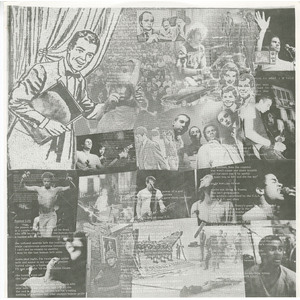
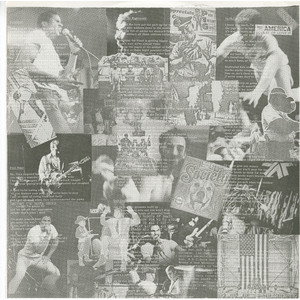
In 2023, Porterhouse Records released a newly remastered edition of Born Too Soon..... The limited pressing consisted of 500 opaque pink vinyl copies and recreated the original artwork while adding a revised lyric insert. Its accompanying download included ‘So M.U.C.H. Hate,’ ‘Exit Death’ and ‘No Hope Religion,’ identified as previously unreleased 1983 demo recordings.
The remaster placed greater emphasis on the grit and edge that the musicians believed had been softened during the original production. It presented the record not merely as a collector’s item, but as a significant document of Montréal and Canadian hardcore, driven by Pearson’s writing, Jean Gravel’s drumming and Anthony Mark’s theatrical vocal approach.
The S.C.U.M. story acquired an unexpected continuation during the COVID-19 lockdown. Jean Gravel contacted Pearson and jokingly asked whether he had written any new riffs. Pearson began composing, and within approximately six months the pair had developed fifteen songs intended for a second S.C.U.M. album.
Instrumental tracks and backing vocals were completed, but scheduling conflicts prevented Anthony Mark from finishing the lead vocals. After approximately two years without resolution, Pearson and Gravel approached Dan Izzo of the Motherfuckers, whose version of ‘Exit Death’ had impressed them.
Izzo completed the vocals within weeks. Rather than release the project under the S.C.U.M. name, the musicians presented it as Enough, a collaboration joining members of S.C.U.M. and Motherfuckers. The resulting album, Before My Eyes, continued Pearson’s preference for multi-tempo writing while combining hardcore urgency with slower and heavier passages.
Enough was not a formal S.C.U.M. reunion. It was instead a direct creative continuation involving the group’s principal songwriter and drummer, carrying forward musical ideas that had remained unresolved since the late 1980s.
S.C.U.M. occupied a crucial position in the development of Montréal hardcore. They formed before the city possessed a stable network of punk venues, produced their earliest music through rehearsal-room parties and handwritten cassettes, and became one of the groups associated with Cargo during the scene’s formative period.
Their catalogue connected several stages in the evolution of North American underground punk. The early demo reflected the international hardcore exchange represented by the P.E.A.C.E. compilation. Born Too Soon.... absorbed California punk, skate culture and Montréal political experience into a broader and more musically varied album. The final demos moved toward the heavier crossover sound overtaking hardcore by the late 1980s.
The group’s recordings also preserved an unusually detailed portrait of their era: Cold War anxiety, American interventionism, police authority, religious profiteering, drug dependency, environmental exploitation, corporate power and the struggle to retain an individual identity within systems designed to produce obedience.
S.C.U.M. were not simply ‘born too soon.’ They emerged at the precise moment when Montréal musicians were building a self-sufficient hardcore culture from almost nothing. Their original album, three demo cassettes and compilation appearances document that transformation, while the later reissues and Enough project demonstrate that the anger, invention and unfinished possibilities of their music continued to resonate decades later.
-Robert Williston
Gallery
Images
8 images
SCUM-Born Too Soon BACK
SCUM-Born Too Soon INSERT 01 SIDE 01
SCUM-Born Too Soon INSERT 01 SIDE 02
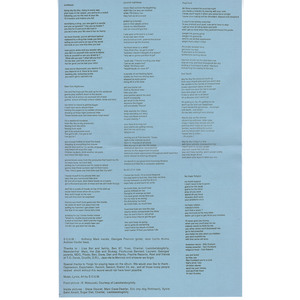
SCUM-Born Too Soon INSERT 02 SIDE 01
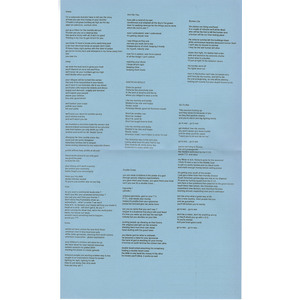
SCUM-Born Too Soon INSERT 02 SIDE 02
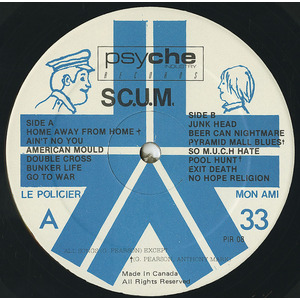
SCUM-Born Too Soon LABEL 01
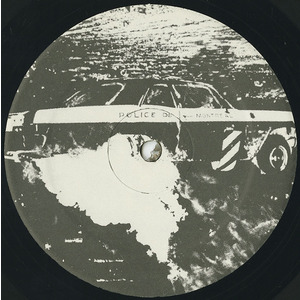
SCUM-Born Too Soon LABEL 02
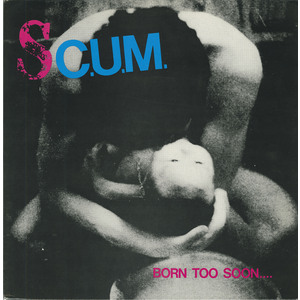
Born Too Soon….
Media
Videos
0 videos
No videos available for this title.
Credits
Musicians
Anthony Mark: lead vocals
Georges Pearson: guitar
Jean Lortie: drums
Yorgo Pitilos: bass
Andrew Harder: bass
Songwriting
‘Home Away from Home’ written by Georges Pearson and Anthony Mark
‘Pyramid Mall Blues’ written by Georges Pearson and Anthony Mark
All remaining songs written by Georges Pearson
Production
Produced by Steve Kravac
Recording and Mixing
Recorded and mixed at La Majeure Studios, Montréal, Québec, Canada, in autumn 1985
Engineered by Joe Petrella
Mastering and Lacquer Cutting
Mastered and lacquer cut by EL at Disques SNB Ltée.
Artwork and Design
Music, lyrics and artwork credited collectively to S.C.U.M.
Jacket design by Georges Pearson
Graphics execution by Dan Webster
Photography
Photography by Andrew Harder and Drew Crypt
Front photograph by K. Matsuzaki, courtesy of Laslobelabogbilly
Inside photographs by Steve Doucet, Marc Cave-Dweller, Eric ‘My Dog Robinson,’ Sylvie Saint-Amant, Sugar Diet, Chantal and Laslobelabogbilly
Distribution
Exclusively distributed by Horror
155 Saint-Paul Street East
Montréal, Québec, Canada, H2Y 1G8
Copyright
© ℗ Psyche Industry Records, 1985
All rights reserved
Additional Information
Made in Canada
Side A matrix/runout: PIR-08A SNB-EL
Side B matrix/runout: PIR-08B SNB-EL
No Comments