Insight
Shadowy Men on a Shadowy Planet were one of Canada’s most distinctive and influential instrumental rock bands, emerging from Toronto’s post-punk underground in the mid-1980s and redefining the possibilities of instrumental guitar music in a scene otherwise dominated by vocal-driven alternative rock. Equal parts surf-influenced twang, punk energy, lounge-pop irony, and experimental collage, the band built a body of work that was both playful and rigorously constructed, earning them a reputation as one of the most creative instrumental groups in Canadian music history.
The group was formed in Toronto in 1984 by guitarist Brian Connelly, bassist Reid Diamond, and drummer Don Pyle, whose shared history stretched back to earlier punk and new wave projects. Connelly and Diamond had previously played together in Calgary in the late-1970s punk band Buick McKane before relocating to Toronto, where they became involved in Crash Kills Five, an early hardcore-leaning group that released a single EP in 1980. After several years of side projects, Connelly, Diamond, and Pyle reconvened with a new focus on instrumental music, drawing inspiration from classic surf guitar, soundtrack music, exotica, post-punk minimalism, and the DIY aesthetics of Toronto’s emerging indie scene.
Signing to Cargo Records, Shadowy Men quickly established themselves through a steady stream of 7-inch singles and EPs during the second half of the 1980s. Rather than positioning themselves as a retro surf revival act, the band approached instrumental music as a flexible framework for humor, texture, and composition. Their song titles — often absurd, cinematic, or surreal — became a key part of their identity, while musically they blended reverb-drenched guitar lines with muscular, inventive rhythm section work that owed as much to punk and experimental rock as to The Ventures.
Their wider breakthrough came through their close association with the Canadian sketch comedy troupe The Kids in the Hall. Shadowy Men not only wrote and recorded the iconic theme song, “Having an Average Weekend,” but also supplied much of the incidental and transitional music used throughout the show’s early seasons. This exposure introduced the band’s sound to a national and international television audience and firmly linked their music with one of Canada’s most successful comedy exports. The relationship also reinforced the group’s reputation for combining sharp musical craft with a strong sense of humor, though the band consistently resisted being framed as a novelty act.
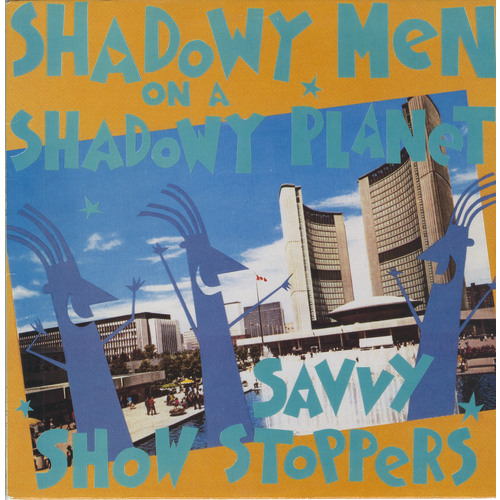
In 1990 and 1991, the group consolidated their singles and expanded their studio work into full-length releases, culminating in Savvy Show Stoppers and Dim the Lights, Chill the Ham, which showcased their increasingly confident blend of surf-styled guitar, organ textures, and tightly arranged rhythm tracks. The latter was recorded in Toronto and featured production involvement from Coyote Shivers, further refining their sound while maintaining their DIY ethos.
Their most sonically distinctive album, Sport Fishin’: The Lure of the Bait, The Luck of the Hook (1993), was recorded in Chicago with legendary engineer Steve Albini, who was a vocal admirer of the band and offered to work with them at Chicago Recording Company. The resulting album captured a rawer, more spacious sound, emphasizing the physical impact of the trio while preserving their melodic and conceptual quirks. The record is widely regarded as one of the strongest Canadian instrumental rock albums of the era.
Beyond their own releases, Shadowy Men were deeply embedded in the broader alternative music ecosystem of the time. They recorded a BBC John Peel Session — a rare achievement for a Canadian independent band — toured extensively in North America and the UK, and collaborated with artists such as Fred Schneider of the B-52’s, backing him on his 1996 solo album Just Fred. They also contributed music to films and television beyond The Kids in the Hall, including independent Canadian productions, further cementing their reputation as a go-to source for distinctive instrumental scoring.
In 1992, the band won the Juno Award for Instrumental Artist of the Year, defeating high-profile nominees and marking a rare moment of national industry recognition for a fully instrumental indie rock act. Despite this success, internal differences and diverging creative interests led to the band’s breakup in 1996.
After the split, Connelly formed and led Atomic 7, while Diamond and Pyle went on to form Phono-Comb with Dallas Good of The Sadies and Beverly Breckenridge of Fifth Column, continuing their exploration of instrumental and experimental rock. Diamond later also formed Danny & Reid’s Motion Machine. Tragically, Reid Diamond died of cancer in February 2001, cutting short a uniquely inventive career.
Shadowy Men on a Shadowy Planet’s legacy grew substantially in the years following their breakup. Their albums became sought-after cult classics, and the band was regularly cited by musicians, critics, and fans as one of Canada’s most important instrumental groups. In 2012, Connelly and Pyle reunited the band for select performances and a comprehensive reissue campaign, with Dallas Good stepping in on bass. The group’s catalog was remastered from first-generation tapes and reissued in deluxe editions, culminating in the expansive box set Oh, I Guess We Were a Fucking Surf Band After All, which helped solidify their historical standing.
Today, Shadowy Men on a Shadowy Planet are widely recognized as pioneers of Canadian independent instrumental rock — a band that combined technical skill, conceptual wit, and deep scene involvement to create a body of work that remains influential, distinctive, and unmistakably Canadian.
-Robert Williston
Musicians
Brian Connelly: guitar, keyboards, organ
Reid Diamond: bass, lead vocals
Don Pyle: drums, percussion, backing vocals
Songwriting
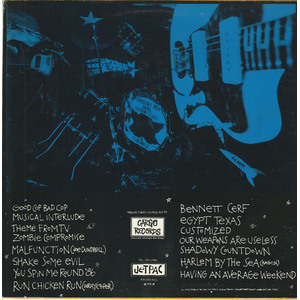
‘Good Cop Bad Cop’ written by Shadowy Men On A Shadowy Planet
‘Musical Interlude’ written by Shadowy Men On A Shadowy Planet
‘Theme From T.V.’ written by Shadowy Men On A Shadowy Planet
‘Zombie Compromise’ written by Shadowy Men On A Shadowy Planet
‘Malfunction’ written by Joe Dundrell
‘Shake Some Evil’ written by Shadowy Men On A Shadowy Planet
‘You Spin Me Round ’86’ written by Shadowy Men On A Shadowy Planet
‘Run Chicken Run’ written by Dick Dale (Wray), Duane Eddy (Cooper)
‘Bennett Cerf’ written by Shadowy Men On A Shadowy Planet
‘Egypt Texas’ written by Shadowy Men On A Shadowy Planet
‘Customized’ written by Shadowy Men On A Shadowy Planet
‘Our Weapons Are Useless’ written by Shadowy Men On A Shadowy Planet
‘Shadowy Countdown’ written by Shadowy Men On A Shadowy Planet
‘Harlem By The Sea’ written by Harlan Ellison (Hagen)
‘Having An Average Weekend’ written by Shadowy Men On A Shadowy Planet
Production
Produced by Coyote Shivers and Shadowy Men On A Shadowy Planet
Recorded by Bill Aldred (A1, A2, A5, A8, B2, B5, B6)
Recorded by Carson Foster (A7)
Recorded by Dave Bottrill (B1, B4, B7)
Recorded by Paul Edwards (A3, A4, A6, B1, B3, B4, B7)
Recorded by Todd Cuttler (A3, A4, A6, B3)
Notes
Compilation of 7-inch releases originally issued on the JetPac label.
Tracks B1, B4, B7 released August 1985.
Tracks A3, A4, A6, B3 released April 1986.
Tracks A1, A5, B2, B5, B6 released April 1987.
Track A7 circulated informally in June 1987.
Tracks A2, A8 released February 1988.
Plated at Greg Lee Processing (L-35721).
Variant pressing with black-and-white back cover, white labels, and sepia-tinted insert.
Includes 1-page insert detailing source release information.
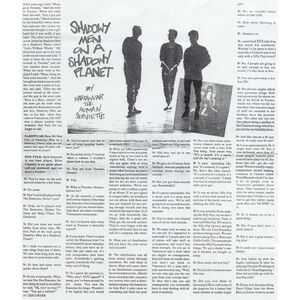
Shadowy Men On A Shadowy Planet
by Nardwuar The Human Serviette
Discorder Magazine, 1990
A few years ago I said, "Mom, go to Toronto." And she went to Toronto. When she came back she said, "Son, I got you some records." One record was by the band Rio whose members had nice hair styles; my mom though it was a girl band but but it was really a guy band. The other record was a seven incher by Shadowy Men On A Shadowy Planet called "Love Without Words." My mom had gone up to the lady in the record store and said, "I want to have the two hottest records in Toronto" and she was handed these records. When my mom went to England I said, "Mom, bring me back some records." And she brought me back some records. She went into a store in London and said, "Give me the hottest record in the store" and the guy in the store said, "Here is a Bros. record." So she does get the truth when she asks for the hottest records and boy, Shadowy Men are hot, so hot that when they came to Vancouver, 228-2847 was a phone number that drummer Don Pyle did not forget to call.
NARDWUAR: Now, Mr. Don Pyle of Shadowy Men On A Shadowy Planet, what are the names and ages of such a famous band as yours?
DON PYLE: Reid Diamond is our bass player, Brian Connelly is our guitar player and our combined ages are about a hundred.
N: You've been on the rock and roll scene for a few years.
D: Six years.
N: You've actually played with The Ramones, haven't you?
D: Yeah, we've played with The Ramones, Hüsker Dü, Jesus And Mary Chain, The Dundrells.
N: Did you learn any weird habits from these stars, Mr. Don Pyle of the rock group Shadowy Men On A Shadowy Planet?
D: I think we learned not to take drugs from any of them. We saw what long term drug use does to your brain cells.
N: So they had some weird quirks about them?
D: Kinda weird quirks. When we met Dee Dee Ramone, the first thing he said to us before he said, "Hi, how ya doin'?" was, "You got a valium?"
N: You've never said that to one of your opening bands, have you?
D: No, never, never. I've never taken a valium. I wouldn't know how to say that.
N: You are from Toronto, Ontario.
D: Yup.
N: What is Toronto, Ontario know for?
D: At the moment, it seems the Cowboy Junkies. Other than that, there are a lot of reasonable places to get tax returns done. And there are some excellent Vietnamese restaurants.
N: Isn't it known that every band in Toronto is basically signed?
D: Pretty much. There's a band called the Manteyes that I've never heard of, never seen play before; they just have an album that just came out. It's real sweepstakes time there now. Everybody's getting signed, everybody who's anybody sort of thing.
N: So I guess the question is, "Why aren't YOU signed?" I mean, you've been around for six years. You saw The Ramones do drugs. Wouldn't it be logical that you would have been signed long ago, to somebody BIG?
D: Well, we ARE signed with Cargo right now who are pretty much as big as we want to be signed with. There's not really any point with us even considering signing with a major label because we know that being an instrumental band and playing the sort of music we do, we have a pretty limited audience. We're not going to sell a million copies of an album. If we got signed by a major label, we would put out one album with them and then get dumped for not selling enough records and that would be the end of that. So if we go with somebody like Cargo, they do a great job. They get the records around. They're very happy with the number of records that we can sell for a company like them.
N: What sort of distribution did you have for your seven inch records?
D: The distribution was all doen pretty much through ourselves. We sold them at shows. More are more, there are no distribution companies for seven inch records... Mostly, those were done like; you have one person who runs a distribution company who heard you on John Peel's radio show or something and finds our your address and writes to you and saysm "Send me fifty records, please."
N: Did they end up in any weird places?
D: We got a lot of letters from Holland... there are people with wooden shoes buying our records.
N: But you got those records out. Remarkable?
D: It's pretty remarkable. For a seven inch, it's even more remarkable now. We're still going to do seven inch records. We're doing two more this summer.
N: You've done very limited runs of seven inch records.
D: We make only as many as we can sell. It's expensive to mail stuff in Canada and a lot of places will take stuff on consignment and won't buy them outright. So you go to Vancouver and a store takes ten singles on consignment, they sell them tne weeks later, you don't get back to Vancouver for a year and a half, and then they say, "Well, we can only pay you for one year from your receipt date." So they don't pay you and consequently you eventually have to stop dealing with almost everybody.
N: But you have some interesting releases such as your seven inch with a nice Jiffy Pop thing. Your motto was, "It's a record, it's a snack, half the fun's making it."
D: It went something like that. "It's a record, it's a game." No, that's the other record. "It's a record, it's a snack, it's a record, it's a snack." I think that was as complicated as the sales pitch got.
N: It was an actual Jiffy Pop with a seven inch record in it and one of the tracks was you shaking the Jiffy Pop.
D: It was actually Brian shaking the Jiffy Pop, but we don't need to get technical. Yeah, it was real Jiffy Pop. We went to the Jiffy Pop factory and got them. We saw Chef Boyardee products being made We saw them making Bits-n-Bites and Fiddle Faddle. The same people who make Jiffy Pop make those things. We got a dealer's rate on it because we bought so many.
N: How many did you buy?
D: The first five hundred came like that.
N: Did you ever think of throwing some LSD in with some of the popcorn for a bonus that some listener or reader might get?
D: No, we wouldn't know where to find LSD.
N: How about throwing in some -
D: - Sominex or -
N: - some local XXX type drug that would kill somebody. Wouldn't it be great to start a Tylenol-type scare only with a Jiffy Pop record?
D: No, if people are going to be nice enough to buy our record, I'd like them to live.
N: You also gave away a few free EPs
D: We did two singles which were giveaway things. Both were giveaways for shows we did at the Rivoli in Toronto which was where we did our first show. One was a live single of stuff we recorded at our birthday show the previous year. The other one was out bass player doing a medley of Neil Diamond songs which we also did for our birthday show.
N: And this was on a 46 rpm record. It really was 46 rpm?
D: It was approximately 46. It might have been 49. But it was definitely more than 45. Some people without pitch control had to play it at 45, but those that did got the real sound. We have a really crappy independent record making company in Canada called Worls Records which I'm sure a lot of people even in Vancouver probably know about. They mastered it too slow for some reason, maybe because they felt like it, so we had to get this rubber stamp made that said "46 RPM" on it.
N: So it turned out to be a great thing.
D: Not if you don't have pitch control.
N: But it was a great marketing ploy.
D: It made our voices sound deeper.
N: You linked up with the highly intelligent K label by playing Olympia, Washington with Calvin "Beat Happening." How did you link up with Estrus Records?
D: Estrus was the same thing. Dave Crider from the Mono Men on Estrus wrote to us and he had heard about us through other bands and had our singles and even had the Mono Men do a couple of our songs. I haven't heard them yet. We're going to hear them in a couple of weeks.
N: What if they are bad versions of your songs?
D: I'd still be flattered. We do a bad version of a Cher song. She hasn't given us any trouble about it; it's free territory. I am very flattered that they're doing our songs at all.
N: But you linked up with those "pulp city losers hell bent on Tequila" Estrus Records amd there is something in the works?
D: They're coming out with a boxed set of four records and eight bands on it; we each have one song on it. It comes in a lunch pail.
N: Is this your biggest tour yet? Is this the most famous you have ever been? You have a full length record out. Are they appreciating you in Saskatoon?
D: We're playing here three nights. Last night they weren't too much. The first night they were appreciating us even though we played terribly.
N: What is an example of an "appreciative evening."
D: Clapping, dancing and smiling: the three signposts of rock appreciation.
N: Who is Sir Isaac Brock?
D: I have no idea. I know who Sir Isaac Newton is.
N: He is a Toronto-ite.
D: I don't know him!
N: Aren't you a Toronto-ite, Mr. Don Pyle?
D: Yes, but I don't know Art Engleton and he's our mayor. You can't talk me into it. I don't know!
N: Sir Isaac Brock. He had his head chopped off. He's the most famous Canadian ever.
D: No, he's not as famous as Moe Berg.
N: Another Toronto-ite.
D: No, he's an Edmontonian.
N: A moved-over Edmontonian.
D: Yeah.
N: Just like some members of your band are moved-over Calgarians, aren't they?
D: Yeah, sort of Calgarians, Edmontonians, Manitobans.
N: Who are some of the most underrated instrumental groups of all time?
D: I would say Sharkskin, Pell Mell, Love Tractor... Sharkskin are a new band from Toronto. Pell Mell aren't. They're from Washington and they've been around for ten years. Love Tractor are from Georgia and they've been around for about ten years.
N: How about the older genre. How about the Ventures?
D: The Ventures are far too overrated.
N: How about the Wailers from the Pacific Northwest?
D: I don't know them.
N: You don't know the Wailers from the Pacific Northwest?
D: No, I know the Wailers from Jamaica.
N: The W-A-I-L-E-R, the Wailers from the Pacific Northwest with the songs "Tall Cool One," "San-ho-zae," "Wailers House Party," and "Mashi."
D: They never made it to my local record store.
N: They are the ultimate group. They started the instrumental move.
D: Oh yeah? Do you know who the Esquires are?
N: The Esquire is a guitar.
D: No, the Esquires are a famous Canadian instrumental band of the '60s that were signed to Capitol Records. They are pretty fabulous.
N: They are one of your favorite underrated groups.
D: This week.
N: What about other "wordless groups"? Do you consider your group a "wordless group"?
D: Seeing as we're instrumental, probably. We have a few words. We'll have a few words with anybody who will talk to us. We're not totally wordless. We're "word dry." We're "word bare."
N: What other "wordless group" have records out these days? Jon and the Nightriders?
D: I don't know them.
N: The Dragsters?
D: Oh I've heard the Dragsters. I think they're pretty stinky too.
N: Are you Toronto's first post-hippie wordless group?
D: Probably. Oh no, I forgot about Manteca. They're an instrumental band and they were around before us. Leona Boyd, too. Neither of them do anything like what we play.
N: You are the kings of the Toronto wordless scene.
D: Us and Sharkskin ARE the Toronto wordless scene. They have stuff out on their own label called Driving Records.
N: The people from Kids in the Hall! They write lyrics for your songs.
D: No, we write lyrics for some of THEIR songs. I mean, we write songs for some of their lyrics. They don't write lyrics for any song that we've already written. A couple of things like "Daves I Know," everybody seems to think is one of our songs. It's a comedy skit and they said, "We're doing this thing and we need some music." They ask us to come up with something within the guidelines for anything with songs, but all the other stuff is just instrumental stuff in the show we do on our own, without having any input at all.
N: You've probably answered many questions regarding Kids in the Hall.
D: Mostly just the one question, "How did you get hooked up with them?" Usually people don't go into too much depth about it.
N: Do you feel it is your claim to fame now?
D: A lot of other people think it's our claim to fame. It's a great thing to be working on and I would say we are proud of it, proud to be working on the show; it certainly has given us a lot of opportunities that weren't there before. I wouldn't say it was our claim to fame. It's one of our claims, something we could put on our resumes.
N: Have you ever heard of Kimm Rogers?
D: No.
N: Kimm Rogers, some lame fat folky lame-ass shit? Have you heard of her?
D: No.
N: Well, she has a song called "The Soundtrack of My Life." Do you think that could be a possible Shadowy Men On A Shadowy Planet song?
D: I would have to hear it first.
N: What other ideas have been pushed upon you?
D: We're thinking about writing a tribute to the eastern food dish Baba Ganoush. That's our latest project. We're reading the David Essex story right now which might come out in our music later.
N: Who is David Essex?
D: You don't know who he is? David Essex is an English pop star. You know who Sir Isaac Brock is but you don't know who David Essex is?
N: David Essex is on 24 Essex Drive.
D: No, David Essex wrote "Rock On" and "Lamplight" and he starred in the English production of Godspell.
N: He's a very famous guy but not as famous as Sir Isaac Brock.
D: He's famous enough to have a biography written by George Tremlett who also wrote the David Bowie biography and the Osmond story.
N: And your next venture will be a tackling of the David Essex story.
D: Just the book; I don't know if it will be a song or not.
N: Do you have to use special equipment to get that unique Shadowy Men On A Shadowy Planet sound?
D: Mostly stuff that plugs in. How am I supposed to know? I'm the drummer. Brian has a Fender Super Reverb, I have purple Gretsch drums and Reid has a Traynor amp.
N: Traynor? Isn't that blasphemous?
D: Why is that?
N: This is so modern.
D: Traynor isn't a modern company and even if they were, there is nothing wrong with modern things.
N: And moving forward.
D: Where appropriate.
N: Have you ever tried spelling your name in abbreviations?
D: Yes. "SMOASP," is that what you mean?
N: Yes, and if you rescramble the words backwards, you almost get the word "Samoans." Were you influenced by the rock group Angry Samoans?
D: I liked one of their record covers. No.
N: I noticed that you contributed "Good Cop Bad Cop" to the It Came From Canada series put out by Mr. Deja Voodoo and Mrs. Deja Voodoo. Why did you submit that song? I heard that you were going to submit another song. Did you hold back a better song for them?
D: No, we were on two volumes. "Good Cop Bad Cop" is on Volume Two. "Faster Santa" is on Volume Four. We put "Good Cop Bad Cop" on because we thought it was our best song, but it turned out so shitty on that album that we redid it for one of our singles. We gave them the best.
N: What are the worst Shadowy Men On A Shadowy Planet records so people don't buy them.
D: Probably the last free one we did, which is why it was free.
N: Did this lose money at all?
D: Of course. You can't give records away and make money.
N: But you earned a lot of fans by doing that.
D: We haven't really polled them on it.
N: Does a band starting up record an eight track, then make some popcorn, then give away some free records, then dance around on TV, then get signed to a big Canadian label and then tour to Olympia, Washington? Is that what will logically happen to a band?
D: They would if you were following in our footsteps.
N: But there must be some advice you have. Is it worth it to put out a single?
D: Yes. I would say the best think can do is stuff for themselves. Don't get a stupid manager who is going to make you do stupid things.
N: What is Casa Loma like?
D: Casa Loma's like your rich uncle's house that you never want to go to who's always inviting you over for Christmas just to show off the place.
N: Is it the coolest place in Toronto to hang out in?
D: No.
N: But it's a big castle.
D: No, it's a "casa." It's a fake castle. It's like the chocolatey coating on cookies. It's not chocolate. It's a "casa," not a castle.
N: What is the coolest place?
D: I don't know. I hang out at my home a lot.
N: Have you ever played the Railway Club before?
D: Oh yeah, that's why we're coming back, because we like the Railway Club.
N: Because it's small.
D: Because it's small and it has the nice little train that goes around.
N: Because you've bumped into stars before.
D: No, we're playing at the Railway Club because we bumped into stars at the other place, what's it called, the Town Dump.
N: The Town Pump, yes. What stars did you bump into there that you won't bump into at the Railway.
D: Bryan Adams.
N: You really bumped into Bryan Adams?
D: No, but I saw him there on MuchMusic once.
N: Who is Don Pyle of Shadowy Men On A Shadowy Planet, the greatest Canadian ever?
D: I thought you said Sir Isaac Brock was the greatest Canadian ever.
N: No, he's not.
D: Oh I get it, he's the greatest Canadian to lose his head.
N: Who is the greatest Canadian ever?
D: Ken Priestley. He's a friend of ours. He's a graphic artist. He's a part-owner of a record store in Bowmanville. He was our singer when we first started.
N: Bowmanville is the home of World Records.
D: As a matter of fact, it is. Although Ken lives in Bowmanville he has absolutely nothing to do with the band at all now, although we did play at his record store a few weeks ago.
N: And you had lots of people dancing.
D: Yeah, on the street. And the police came by and asked if we knew any Charlie Pride. We said no, but we know George Jones.
N: And you played...
D: ... none of those.
N: And then you cut into your brand new tune...
D: ... "Baby Elephant Walk."
N: Which will be coming out on...
D: ... K Records.
N: And it will be a great...
D: This is just like one of those lazy person's greeting cards.
N: It will be a great record because it wasn't pressed at...
D: ... World...
N: ... Records.
D: Well that's not the only reason. It'll be a good record. It has four songs and a skit as the engineer who worked on it said.
N: Who are the other hot non-wordless groups in Toronto.
D: Non-wordless? You did a double negative there, you threw me off. You mean, who do I like or who are the most popular?
N: Well you mentioned The Pursuit of Happiness and the Corndogs and...
D: I never mentioned the Corndogs.
N: Well you wanted to mention the Corndogs.
D: No I didn't.
N: Because they are your favorite band.
D: I don't even dream about the Corndogs.
N: Your favourite band is the Corndogs. You'd love to get a hold of their super-duper mic that was used to record their album.
D: I would say my favourite band right now in town is Change Of Heart.
N: Why? Because they are on Cargo Records?
D: No, as a matter of fact that was totally coincidental. There is another group in town called Scott B. Sympathy who are really great who almost put out an album on Cargo and it was just coincidence and that was one reason we said Cargo is a pretty great label to go with because two of our favourite bands in town are going to be putting out records with them.
N: And you like the Asexuals and Ray Condo, too, probably.
D: A like Ray Condo very much.
N: Because they're on Cargo Records too.
D: No. We've know Ray Condo for a very long time.
N: Thanks, Donny, and keep on rocking in the free world.
Gallery
Images
9 images
View All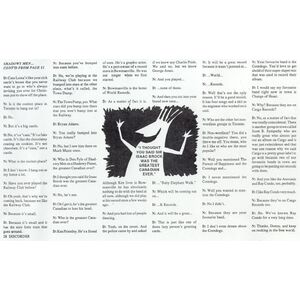
Nardwuar Shadowy 03
Nardwuar Shadowy 01
Nardwuar Shadowy 02
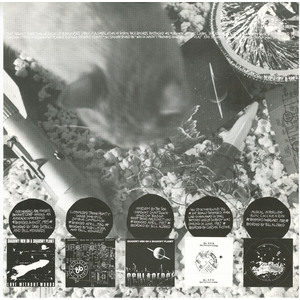
Shadowy Men on a Shadowy Planet-Savvy Show Stoppers INSERT SIDE 01
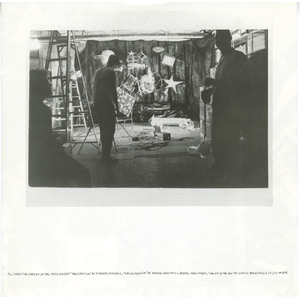
Shadowy Men on a Shadowy Planet-Savvy Show Stoppers INSERT SIDE 02
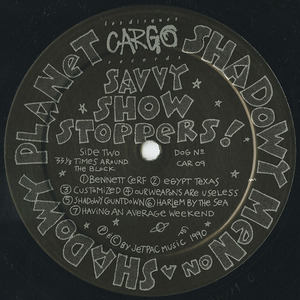
Shadowy Men on a Shadowy Planet-Savvy Show Stoppers LABEL 02
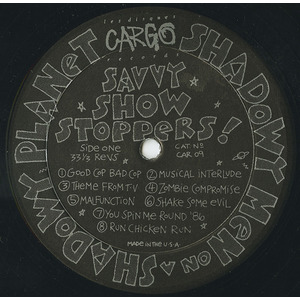
Shadowy Men on a Shadowy Planet-Savvy Show Stoppers LABEL 01
Shadowy Men on a Shadowy Planet-Savvy Show Stoppers BACK
Media
Videos
0 videos
No videos available for this title.
Credits
In Transit
No Comments