Insight
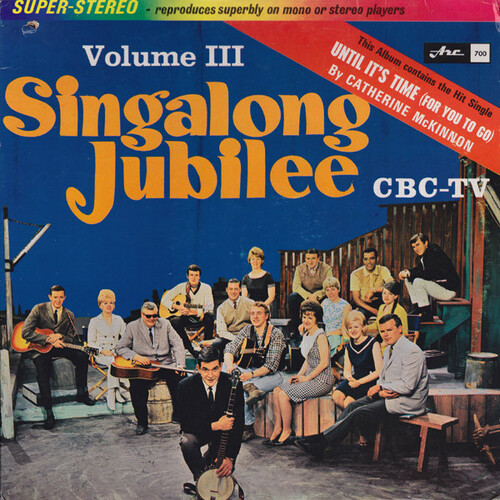
Singalong Jubilee was one of the most influential and quietly far-reaching programs in Canadian music history, serving both as a weekly national showcase for folk and roots music and as a proving ground for an extraordinary generation of Canadian performers. Produced from CBC Television’s Halifax studios, the series aired from 1961 to 1974 and helped define how Canadian folk, country, gospel, and traditional music was heard, understood, and celebrated across the country during the 1960s and early 1970s.
The show emerged as a summer replacement for Don Messer’s Jubilee, but quickly developed an identity of its own. Rather than focusing on established stars, Singalong Jubilee centered on community singing, regional repertoire, and contemporary folk material, encouraging audience participation and emphasizing musical authenticity over polish. Under producer Manny Pittson’s guidance, the series blended Maritime tradition with the wider folk revival then sweeping North America, presenting a mix of ballads, spirituals, sea songs, humour pieces, protest songs, and newly written Canadian material.
At the heart of the program were its hosts and musical anchors. Bill Langstroth, who combined his on-air role with behind-the-scenes work as producer-director at CBHT, became the show’s guiding presence, introducing songs, leading group numbers, and shaping the program’s inclusive tone. Alongside him, Jim Bennet emerged as one of the show’s most versatile voices, equally at home with traditional folk airs, country-leaning material, and original songs such as “Nova Scotia Diet.” Multi-instrumentalist Fred McKenna contributed a distinctive instrumental voice on guitar, banjo, fiddle, and steel, while also serving as a featured singer across a wide stylistic range.
One of Singalong Jubilee’s most lasting legacies was the careers it helped launch. Catherine McKinnon became an early standout, her clear soprano and theatrical poise making her one of the series’ most recognizable performers. In 1965–66, a young Anne Murray joined the cast fresh from university in New Brunswick, making her television debut on the program before going on to an international recording career. The show also introduced audiences to Ken Tobias, whose songwriting would soon attract wide attention, as well as Acadian singer Edith Butler, whose inclusion reflected the program’s expanding embrace of French-language and regional traditions.
The ensemble aspect of Singalong Jubilee was central to its sound. The Jubilee Singers—a rotating vocal group drawn largely from the Halifax area—provided rich choral backing and frequently stepped forward as soloists. Over the years, the chorus included performers such as Karen Oxley (who also served as choral director), Hal Kempster, Lorne White, Penny MacAuley, Marg Ashcroft, Jay Gallant, Linn Carroll, Michael Scott, Clary Croft, Tom Kelly, Vern Moulton, Gordon McMurtry, Hazel Walker, and others. Instrumental support evolved as well, with musicians such as Brian Ahern, Don Burke and the Don Burke Four, Vic Mullen, Garth Proude, Jack Lilly, Paul Mason, and Georges Hébert contributing to the show’s flexible, folk-rooted arrangements.
The material presented on Singalong Jubilee ranged widely. Traditional songs from the British Isles and Maritime oral tradition sat alongside African-American spirituals, Acadian folk songs, gospel numbers, and contemporary compositions by writers such as Gordon Lightfoot and Phil Ochs. The program made little distinction between sacred and secular, old and new, instead presenting Canadian music as a living continuum shaped by geography, community, and experience. This approach helped normalize Canadian-written songs on national television at a moment when domestic content was still finding its footing.
The popularity of the series naturally extended into recordings. Beginning in 1964, CBC partnered with Arc Sound to issue a run of Singalong Jubilee LPs, including Singalong Jubilee, Singalong Jubilee Volume II, Volume III, and The Singalong Jubilee Christmas Album. These releases captured many of the show’s most requested performances and preserved early recordings by artists who would soon achieve major success. In the early 1970s, material from the program was reissued on RCA Camden, and later anthologized on CD, ensuring the music remained accessible long after the television series ended.
By the time Singalong Jubilee concluded in 1974, it had quietly reshaped the landscape of Canadian folk and country music. It provided sustained national exposure for regional artists, documented a broad cross-section of Maritime and Canadian traditions, and helped bridge the gap between community music-making and the professional recording industry. Today, the show stands as one of the clearest audiovisual records of Canada’s folk revival era—a program rooted in participation, regional pride, and the belief that the country’s most compelling music was already being sung at home.
-Robert Williston
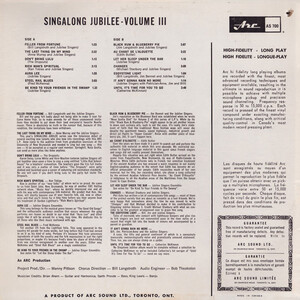
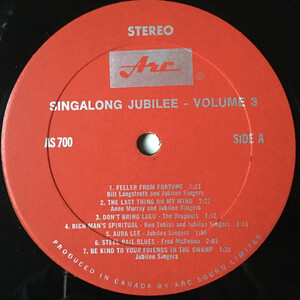
FELLER FROM FORTUNE — Bill Langstroth and the Jubilee Singers
Bill and the gang felt badly about not being able to make it over for Come Home Year, so to make amends for all those unanswerable invitations they decided to put down their favorite St. John’s roots. There is absolutely no truth in the rumour that, because of this rendition, the invitations have been withdrawn.
The last thing on my mind — Anne Murray and the Jubilee Singers
This year’s SINGALONG JUBILEE series saw the television debut of several exciting new talents who have now gone on to recording with ARC L.P. Anne came to the audition fresh from graduation exercises at the University of New Brunswick and needed to sing but one song — this one — to be accepted as a regular cast member. Springhill, Nova Scotia, can send us more artists like Anne anytime.
DON’T BRING LULU — The Dropouts
Karen Oxley, Lorne White and Vern Moulton veteran Jubilee Singers all got together one upon a time to sing a song entitled “Little Red Schoolhouse” for a teachers’ convention. The teachers gave the trio full marks and it was only a matter of time before “The Dropouts” were aptly dubbed and launched upon a career of exhuming old razzmatazz standards. No one will care if you don’t bring Lulu to the party but invite The Dropouts.
RICH MAN’S SPIRITUAL — Ken Tobias
Ken is another of our “new folks” of whom we’re so proud. He came to us from Saint John, New Brunswick, by way of another CBC Halifax network show, “Music Hop”, where he quickly impressed one and all with his way with contemporary folk material. We predict that Ken, like Anne Murray, will shortly become one of your favorite folk, old, new or otherwise and that you’ll listen for a long time before you hear anyone beat his treatment of Gordon Lightfoot’s “Rich Man’s Spiritual”.
AURA LEE — Jubilee Singers Ensemble
This song belongs to the musical genre known as “The Good Old Songs” and the enthusiastic audience reaction that occurs whenever the song performs on television is proof in our mind that “Aura Lee” and the songs like it will be around for a long, long time. We dedicate this song to those who like their music mellowed with age.
STEEL RAIL BLUES — Fred McKenna
Yet another lift from the Lightfoot folio. This song appeared in the country hit parade for many weeks, but long before that Fred had recorded it on an ARC L.P. His attack on this piece has given us perhaps the best proportion of light and shade. Fred has also shone in his treatment of Ken Tobias’ “Steel Rail Blues” — are a magic combination.
BE KIND TO YOUR FRIENDS IN THE SWAMP — Jubilee Singers Ensemble
See notes for “Let Her Sleep Under the Bar”.
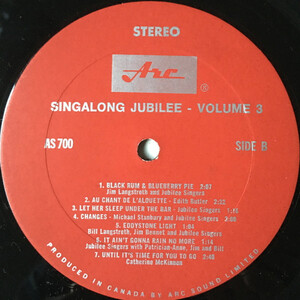
BLACK RUM & BLUEBERRY PIE — Jim Bennet and the Jubilee Singers
Jim’s reputation as the Blue Nose Bard was established when he wrote “Nova Scotia Diet” for Volume 2 of this series of L.P.’s. While by its title “Black Rum & Blueberry Pie” might appear to be yet another classic down-east culinary arts, such is not the case. It’s really Jim’s statement of faith that the traditional Nova Scotian way will never die despite the apparent reversals. Revelling in the case of rural Nova Scotia’s finest attributes on this album is one more piece of bluebery pie, Jim. It can’t happen here.
AU CHANT D’ALOETTE — Edith Butler
Over the years we have made it a point to search out and perform the authentic folk material in which this area abounds. We restricted ourselves to English language material in this quest since French singers and songs did not readily present themselves. Happily this situation was put right when Edith Butler arrived on the scene from Paquetville, New Brunswick, by way of Radio-Canada in Moncton. While Edith performs only in French, her sensitive treatment of the ancient Acadian airs has aroused a warm response in our minds. English-speaking audience members that Edith has become an unofficial ambassador of her people. Edith researches much of her own material, but for this, her recording debut, she chose a song collected by the eminent Acadian folklorist Père Anselm Chiasson. “Au Chant D’Aloette” is indigenous to all the Acadian areas of the Maritimes from the Gaspé Coast to Cape Breton.
LET HER SLEEP UNDER THE BAR — Jubilee Singers Ensemble
See notes for “Be Kind To Your Friends In The Swamp”.
CHANGES — Michael Stanbury and Jubilee Singers
Phil Ochs has written a lot of contemporary folk songs — most of them of the protest variety that are about as romantic as a lost H-Bomb. We’re very happy that somewhere along the line he was wooed to write “Changes” and that Michael decided to make it his contribution to Singalong Jubilee Volume 3. Credit Michael Stanbury with what we consider to be the greatest arrangement ever to grace this song.
THE EDYSTONE LIGHT — Bill, Jim and Jubilee Singers
Tales of mermaids who consort with lighthouse keepers and give rise to folk singers are best not commented upon in the liner notes of a record that might fall into the hands of minors not accompanied by a parent or guardian.
IT AIN’T GONNA RAIN NO MORE — Bill, Jim, Patricia-Anne and the Jubilee Singers
A song, the title and arrangement of which is a sweepingly inaccurate, meteorologically naive and grammatically unsound statement. The too, you can always stomp on a spider.
UNTIL IT’S TIME FOR YOU TO GO — Catherine McKinnon
No Singalong Jubilee album would be complete without a selection by Catherine McKinnon so we’ve included Catherine’s hit version of “Until It’s Time For You To Go” — we need say more.
Musicians
Brian Ahern: guitar, harmonica
Garth Proude: bass
King Lewis: banjo
Production
An ARC Production
Project Producer and Director: Manny Pittson
Chorus Direction: Bill Langstroth
Audio Engineer: Bob Theakston
Gallery
Images
4 images
Singalong Jubilee - Volume III (3)
Singalong Jubilee - Volume III (1)
Singalong Jubilee - Volume III (2)
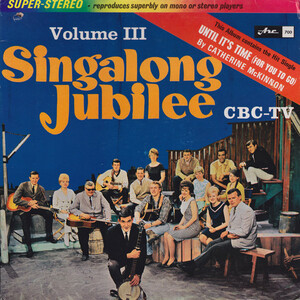
Volume III
Media
Videos
0 videos
No videos available for this title.
Credits
In Transit
No Comments