Insight
Smyle began in Burlington, Ontario around 1967 as The Smile, with Ron Demmans singing and playing guitar, Ray Durritt on guitar, Peter Rihbany on bass and a drummer known on their records only as Mel. Burlington was home base, though the band worked the Hamilton scene closely enough that RPM more than once called them a Hamilton group.
Their earliest known record is the 1969 Ruby Records single 'Be Somebody Else's Friend' b/w 'Why Couldn't You', catalogue S-202, both sides written by Demmans. The labels credit The Smile while the sleeve artwork reads simply Smile. That sleeve is also the best surviving look at the group in their first years, with photographs taken at the session itself, the players at their instruments, and separate portraits of Ron, Ray, Mel and Peter. It names David Kastle as the band's manager.
In June 1969 The Smile and The Brass Union supplied the five hours of live music CKOC brought to the start and finish area of Hamilton's Miles for Millions walk, an event that drew more than 20,000 people.
By January 1971 the spelling was Smyle, Tim Regan had taken over on drums, and the band was signed to Columbia Records of Canada. They played Columbia's Canadian product presentation at the Don Valley Holiday Inn in Toronto, performing the proposed single 'Will I Get Back Home Tomorrow' along with 'Glory Glory'. Walt Grealis reported in RPM that 'Glory Glory' drew the stronger response from the room, and that is the side Columbia put out front.
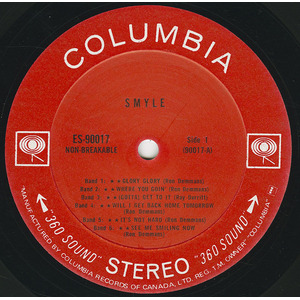
'Glory Glory' b/w 'Will I Get Back Home Tomorrow' was released early in 1971, written by Demmans and produced by John Williams. CKOC was on it first, and the band was working steadily through the Kitchener booking agency Dram. RPM's February report placed them in Sarnia, Ontario, in Olean, New York, and at Burlington's Treetop disco, with Ottawa, Welland and the Grand Hotel in Bridgeport still ahead of them and an Albany, New York date on February 21 sharing a bill with Steppenwolf.
'Glory Glory' reached No. 23 on the RPM 100 on April 3, 1971, the highest Canadian chart position the band would see. Epic picked the single up for the United States as 5-10724, and Record World made it a Pick of the Week on April 17, calling the Canadian group's American debut strong radio material. WFEC in Harrisburg, Pennsylvania added it at the beginning of May. A British release followed on CBS 7225 on May 21, and further pressings appeared in France, Spain and Brazil. Columbia A&R director Johnny Williams, who had backed the record from the start and secured the Epic deal, had it re-serviced to Canadian radio on the strength of the American release.
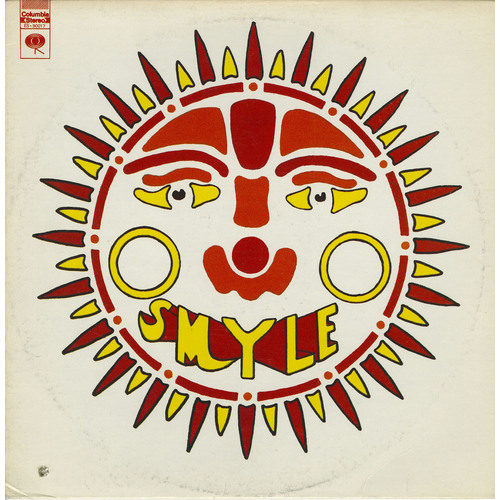
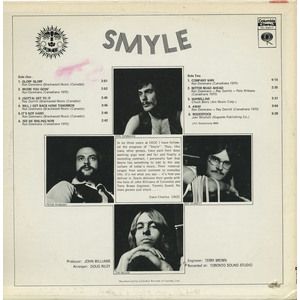
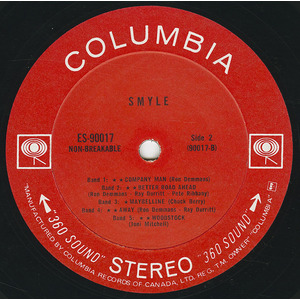
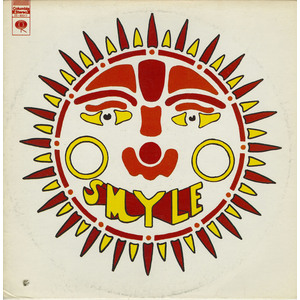
The self-titled album came in May 1971 on Columbia ES-90017, recorded at Toronto Sound Studio with Williams producing, Doug Riley arranging and Terry Brown engineering. Demmans wrote seven of the eleven songs, Durritt brought '(Gotta) Get To It', and Durritt, Demmans and Rihbany wrote 'Better Road Ahead' together. The two outside songs were Chuck Berry's 'Maybelline' and Joni Mitchell's 'Woodstock', which closes the record at five and a half minutes. Chappell Music took five of the Demmans compositions into its Canadian catalogue, and the LP reached No. 88 on the national album chart, still sitting at No. 94 at the end of June.
Columbia followed in July with '(Gotta) Get To It' b/w 'Company Man', catalogue C4-2987, both sides lifted from the album and again produced by Williams.
For 1972 the band switched producers to Bob Gallo. 'It's The World', a Gallo song backed with Durritt's 'Everybody's Singing', appeared on Columbia C4-3005 in March. 'How Many Roads (Can You Fly)' b/w 'Take It All', both written by Demmans, followed on C4-3046 in June and was reviewed by RPM that month. Those four sides were the last records issued under the Smyle name, and the group had folded by the end of the year.
Demmans, a McMaster University graduate, kept writing. His songs were published through Chappell, April/Blackwood/CBS and Acuff-Rose, and by the early 1980s he was among the writers working with Acuff-Rose in Nashville. In 1989 he was back alongside David Kastle, co-producing and singing lead on a Forty-Ninth Parallel release. RPM described him the following year as a Canadian-born, Nashville-based producer whose songs had been recorded by Lucille Starr, Susan Jacks, South Mountain, Terry Sumsion and Dan Washburn. He signed a publishing agreement with Buckhorn Music in 1993. As Ronald D. Demmans he published a novel, Eminent Domain, in 2022.
Peter Rihbany stayed in the Hamilton area, kept playing and worked as a substitute teacher. He died on December 24, 2025 at the age of 76. His obituary named Smyle as the band he was best known for and remembered both the album and the group's run on the CHUM chart.
In 2023 Return To Analog Records reissued the album as RTA-124, putting it back on vinyl for the first time since 1971.
-Robert Williston
Gallery
Images
4 images
Smyle - ST BACK
Smyle - ST LABEL 02
Smyle - ST LABEL 01
ST
Media
Videos
0 videos
No videos available for this title.
Credits
Musicians
Ron Demmans: lead vocals, guitar
Ray Durritt: lead guitar
Peter Rihbany: bass
Tim Regan: drums, percussion
Songwriting
‘Glory Glory’ written by Ron Demmans
‘Where You Goin’’ written by Ron Demmans
‘(Gotta) Get To It’ written by Ray Durritt
‘Will I Get Back Home Tomorrow’ written by Ron Demmans
‘It’s Not Hard’ written by Ron Demmans
‘See Me Smiling Now’ written by Ron Demmans
‘Company Man’ written by Ron Demmans
‘Better Road Ahead’ written by Peter Rihbany, Ray Durritt and Ron Demmans
‘Maybelline’ written by Chuck Berry
‘Away’ written by Ron Demmans
‘Woodstock’ written by Joni Mitchell
Production
Produced by John Williams
Arranged by Doug Riley
Engineered by Terry Brown
Recorded at Toronto Sound Studio, Toronto, Ontario
Publishing
‘Glory Glory’ published by Blackwood Music (Canada)
‘Where You Goin’’ published by Canadiana 1970
‘(Gotta) Get To It’ published by Blackwood Music (Canada)
‘Will I Get Back Home Tomorrow’ published by Blackwood Music (Canada)
‘It’s Not Hard’ published by Blackwood Music (Canada)
‘See Me Smiling Now’ published by Canadiana 1970
‘Company Man’ published by Canadiana 1970
‘Better Road Ahead’ published by Canadiana 1970
‘Maybelline’ published by Arc Music Corp.
‘Away’ published by Canadiana 1970
‘Woodstock’ published by Siquomb Publishing Co.
BMI
Release
Released May 1971
Manufactured by Columbia Records of Canada, Ltd.
Printed by Shorewood Packaging Corp. of Canada Ltd.
Shorepak Can. Pat. No. 758888, 1967
No Comments