Information/Write-up
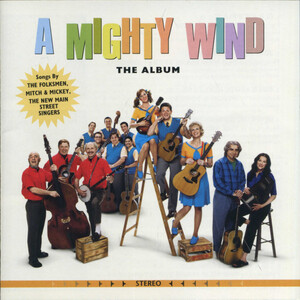
The soundtrack to A Mighty Wind is a finely calibrated parody of the Canadian folk revival, executed with uncommon musical literacy and deep familiarity with the country’s own singer-songwriter traditions. Rather than using folk music merely as comic dressing, the album inhabits the idiom so convincingly that the satire emerges from tone, earnestness, and cultural memory rather than overt joke-making.
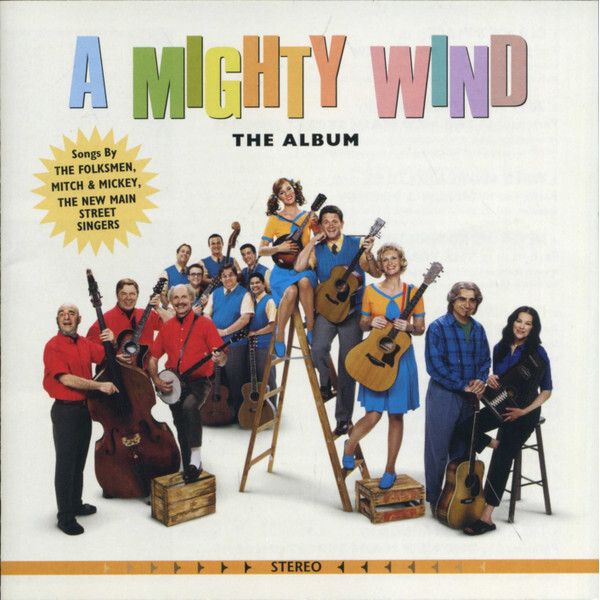
The record revolves around three invented acts — The Folksmen, The New Main Street Singers, and Mitch & Mickey — each rooted in recognizable strands of mid-century Canadian folk culture. The Folksmen suggest the urbane, lightly intellectual Toronto coffeehouse trio tradition, balancing wry observation with credible melody and tight acoustic interplay. The New Main Street Singers mirror the large, wholesome Canadian choral-folk collectives that toured schools, festivals, and television in the 1960s and ’70s, projecting optimism through massed harmonies and civic uplift.
Most pointedly, Mitch & Mickey clearly evoke Ian & Sylvia — the central Canadian duo model of intimate harmony singing, understated romanticism, and quietly confessional songwriting. Their numbers lean into the tender, bittersweet side of the folk tradition, recalling the restrained emotional economy and musical elegance that defined Ian & Sylvia’s work in Canada and beyond.
Musically, the album is scrupulously faithful to its Canadian models. The arrangements are clean, acoustic, and period-appropriate; the harmonies are disciplined; and the performances never step out of character for cheap laughs. Songs like “Old Joe’s Place,” “Blood on the Coal,” and “Skeletons of Quinto” feel like plausible — even compelling — lost pieces of Canadian folk repertoire, while “Main Street Rag” and “Potato’s in the Paddy Wagon” slyly riff on the novelty and children’s-music currents that ran through Canadian folk broadcasting.
The songwriting is the album’s sharpest achievement. Christopher Guest, Michael McKean, Harry Shearer, Eugene Levy, and Annette O’Toole construct lyrics that mirror the moral seriousness of the Canadian folk boom while gently skewering its idealism through absurd imagery, sentimental excess, and historical exaggeration. The humor is structural rather than slapstick: the jokes land because the songs sound authentic.
The ensemble finale “A Mighty Wind” functions as a parody of the grand reunion moment familiar from Canadian festival stages, but it is also genuinely stirring — a collective performance that captures both the warmth and the self-mythologizing of the folk movement it sends up.
Outside the film, the album works on two levels. It is convincing folk music in its own right — melodic, well arranged, and beautifully performed — and it is incisive comedy for listeners who know the history of Canadian folk. For comedy collectors, it is unusually musical; for folk listeners, it is unusually funny.
Within the broader Guest canon, A Mighty Wind stands as his most musically serious soundtrack, demonstrating how precise imitation of Canadian tradition can become its own form of cultural critique.
-Robert Williston
Musicians
The Folksmen
Mitch & Mickey
Eugene Levy
Catherine O’Hara
The New Main Street Singers
David Nichtern: nylon-string guitar on ‘Skeletons of Quinto’
Marston Smith: cello on ‘Skeletons of Quinto’
David Alan Blasucci: 12-string guitar on ‘The Ballad of Bobby and June’
Gregg Bissonette: percussion on ‘Potato’s in the Paddy Wagon’
Songwriting
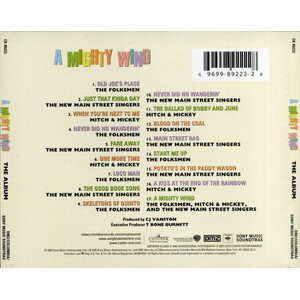
‘Old Joe’s Place’ written by Christopher Guest, Harry Shearer, and Michael McKean
‘Just That Kinda Day’ written by Christopher Guest and Michael McKean
‘When You’re Next To Me’ written by Eugene Levy
‘Never Did No Wanderin’’ written by Harry Shearer and Michael McKean
‘Fare Away’ written by Annette O’Toole, CJ Vanston, and Michael McKean
‘One More Time’ written by Catherine O’Hara and Eugene Levy
‘Loco Man’ written by Harry Shearer
‘The Good Book Song’ written by Harry Shearer and Michael McKean
‘Skeletons of Quinto’ written by Christopher Guest
‘Never Did No Wanderin’’ written by Harry Shearer and Michael McKean
‘The Ballad of Bobby and June’ written by Eugene Levy
‘Blood on the Coal’ written by Christopher Guest, Harry Shearer, and Michael McKean
‘Main Street Rag’ written by John Michael Higgins
‘Start Me Up’ written by Mick Jagger and Keith Richards
‘Potato’s in the Paddy Wagon’ written by Annette O’Toole and Michael McKean
‘A Kiss at the End of the Rainbow’ written by Annette O’Toole and Michael McKean
‘A Mighty Wind’ written by Christopher Guest, Eugene Levy, and Michael McKean
Production
Recorded at Orpheum Theatre, Los Angeles; The Treehouse; and The Village Recorder.
Mixed at The Village Recorder.
Mastered at The Mastering Lab and GZ Media (262416E).
Pressed by Memphis Record Pressing (MRP4893).
Manufactured for Real Gone Music; manufactured by Sony Music Entertainment
Publishing
Coney Island Whitefish Music
Tuxedo Time Music
Dog On The Beach Music
Hazen Music
Shmenge Music
King Brill Music
Beverly Drive Music
Publishing Designee of Catherine O’Hara
Publishing Designee of John Michael Higgins
Colgems-EMI Music Inc.
No Comments