Insight
True Myth emerged from London, Ontario in 1977 as an outgrowth of a music industry class project at Fanshawe College. What began as a classroom collaboration quickly developed into a professional recording act. Keyboardist Tom Treumuth became the central organizing force, and with support from industry figure Gary Muth, the band secured a recording contract with Warner Bros. Records.
Released in 1979, True Myth (Warner Bros. TMD 2020) stands as one of the most significant technical milestones in Canadian recording history. The album was recorded live at Soundstage Studios in Toronto using a leased Soundstream two-track digital recording system under the technical production oversight of Jack Richardson. It is widely cited as the first digitally recorded rock album made in Canada and among the earliest commercially released digital rock recordings worldwide.
Musically, the record reflects late-1970s symphonic progressive rock, built around Treumuth’s keyboard palette — acoustic piano, electric piano, synthesizers, clavinet and Mellotron — alongside Tony Cook’s acoustic and electric guitar work, Steve McKenna’s bass and slide guitar, and the lead vocals of Bruce Cumming. The sessions also featured backing vocals by Ian Thomas and Marek Norman, electric string arrangements by The Armin Electric String Quartet, second guitar by Matt McKenna, and percussion contributions from Eric Cadesky. The album’s arrangements were credited to the band, with “Space Promenade” arranged by Paul Hoffert with assistance from Treumuth.
The lineup on the 1979 debut consisted of Bruce Cumming (vocals), Tom Treumuth (keyboards), Tony Cook (guitars), Steve McKenna (bass/slide guitar), and Brian Bolliger (drums).
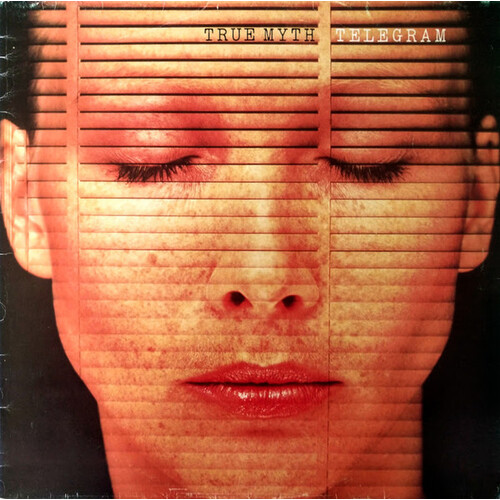
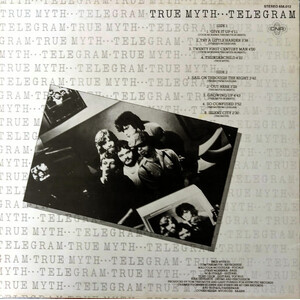
In 1981, the band released its second and final studio album, Telegram, issued in Canada on Intercan/Hypnotic (IC 1015) and also released in Europe, including a Netherlands pressing on CNR. The album marked a stylistic shift toward streamlined classic rock and pop-rock songwriting. Malcolm McGuigan assumed the lead vocal role, Bob Stirajs joined on guitar, and Kirk Devereux and Brian Bolliger handled drums on the album. Bolliger performed on three tracks: “Give It Up,” “21st Century Man,” and “Growing Up.”
Following the band’s breakup, drummer and songwriter Brian Bolliger continued writing and performing, including work with Ian Wheatley’s group The Breakers. One of his compositions, “Radio,” was later recorded by Cherie Camp. Bolliger retained his publishing rights after royalty clarification through SOCAN.
Although True Myth’s recording career was brief, the 1979 debut has enjoyed sustained recognition within progressive rock circles. In 2010, the album was reissued in Japan by Belle Antique (BELLE 101734) as a limited-edition SHM-CD in papersleeve format replicating the original gatefold artwork. Licensed from Hypnotic International and manufactured by Marquee Inc., the reissue reaffirmed the album’s standing among international prog collectors and preserved its original seven-track configuration.
Following the band’s recording period, Tom Treumuth expanded his activities into a broader production and label enterprise. He established Hypnotic Studio and later launched Hypnotic Records, releasing over 100 albums across multiple genres through distribution partnerships including A&M and Universal. Over a career spanning more than four decades, Treumuth has produced over 60 albums, with eight achieving Gold or Platinum certification. His production and label work includes projects associated with Honeymoon Suite, Helix, Big Sugar, Anvil, Voïvod, Figgy Duff, Look People, GrimSkunk, and Chris Spedding, among others.
Treumuth also worked as a talent scout for RCA in New York and was signed as a songwriter to RCA Publishing. His management career has included Honeymoon Suite, Lee Aaron, U.S. rock group Steelheart, and Hamilton-born artist Kazzer, whom he signed to Columbia Records in New York. He also managed and co-produced Gypsy Rose, signing them to RCA in New York.
As of 2004, ownership of the Hypnotic Records catalogue transferred to Linus Entertainment, placing much of the imprint’s output within a larger Canadian catalogue framework.
True Myth occupies a distinct position in Canadian music history. Their 1979 debut remains a documented milestone in Canada’s early adoption of digital recording technology, while Telegram reflects the stylistic recalibration that marked the transition from late-1970s progressive rock into the early-1980s mainstream rock era.
-Robert Williston
Musicians
Malcolm McGuigan: vocals
Tony Cook: guitar, vocals
Bob Stirajs: guitar
Tom Treumuth: keyboards
Steve McKenna: bass
Kirk Devereux: drums, percussion
Brian Bolliger: drums on 'Give it Up', '21st Century Man', and 'Growing Up'
Songwriting
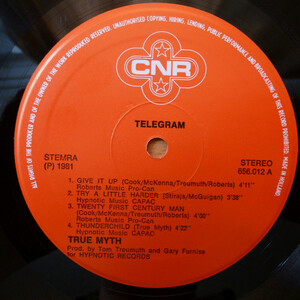
Give It Up: written by Steve McKenna, Tom Treumuth and Tony Cook; published by Roberts Music / Hypnotic Music
Try A Little Harder: written by Bob Stirajs and Malcolm McGuigan
21st Century Man: written by Steve McKenna, Tom Treumuth and Tony Cook; published by Roberts Music / Hypnotic Music
Thunderchild: written by True Myth
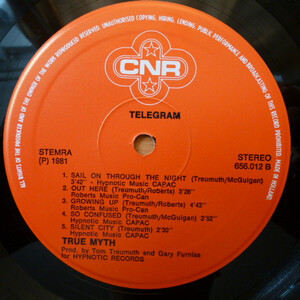
Sail On Through The Night: written by Malcolm McGuigan and Tom Treumuth
Out Here: written by Tom Treumuth; published by Roberts Music
Growing Up: written by Tom Treumuth; published by Roberts Music
So Confused: written by Malcolm McGuigan and Tom Treumuth
Silent City: written by Tom Treumuth
Production
Produced by Gary Furniss and Tom Treumuth for Hypnotic Records
Distributed in Canada by Pickwick Records of Canada Ltd.
Netherlands edition manufactured by CNR, Made in Holland
Artwork
Cover and design by Myosotis
Notes
Vinyl LP issued with an inner credits and photo sleeve.
Gallery
Images
4 images
True Myth - Telegram (Dutch) (3)
True Myth - Telegram (Dutch) (1)
True Myth - Telegram (Dutch) (2)
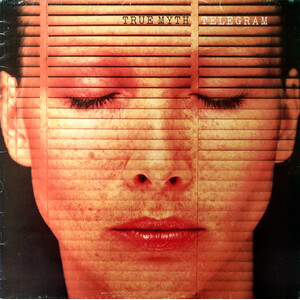
Telegram
Media
Videos
0 videos
No videos available for this title.
Credits
In Transit
No Comments