Information/Write-up
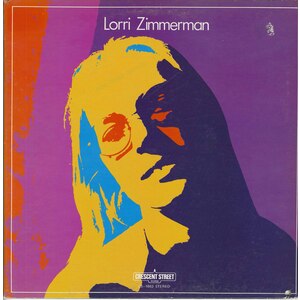
Lorri Zimmerman was a Montréal vocalist whose career moved through several distinct phases of Canadian popular music, from mid-1960s television talent showcases and Montreal garage rock to late-1960s psychedelia, early-1970s folk-rock obscurities, and finally the polished bilingual disco-pop of Toulouse. Though her name remains best known to collectors through her rare and superb self-titled 1971 LP on Crescent Street Records, her musical path reaches much deeper into the Montreal scene than that lone album might suggest.
According to the original back cover of her self-titled LP, Zimmerman first entered the music business in 1966, when she auditioned for the television talent show Like Young and, as one of its finalists, was invited to appear on an album connected to the program titled The Best of Like Young. The sleeve presents this as her formal debut, placing her among the many young Montreal performers who first gained exposure through local and syndicated television at a time when Canada’s pop infrastructure was still being built in real time.
By 1968, Zimmerman had joined the later lineup of Montreal garage favourites The Munks, performing under the billing Sweet Lorraine and The Munks. The original LP notes state that this version of the group worked successfully for about a year before disbanding. That brief but important chapter placed her squarely within one of Montreal’s best-known beat-era bands just as the city’s club circuit was evolving from garage and R&B toward a more psychedelic and studio-oriented sound.
Her next major association was with Life, the highly inventive Montreal psychedelic-rock group built around songwriter, arranger, and producer Neil Sheppard (aka Neil Ship). The back cover of Lorri Zimmerman identifies Life as her next venture and specifically cites the group’s hit ‘Hands of The Clock’, which it says “led the charts across the nation.” In reality, the single was a modest but very real Canadian success, reaching #19 on the RPM national chart in 1969 and helping establish Life as one of the more promising Montreal acts of the period.
While some later summaries have suggested that Zimmerman left before the band completed its album, the fuller story is more interesting. By the latter months of 1969, she had become part of Life’s inner circle and contributed directly to the group’s recordings. As documented in the detailed research on CitizenFreak’s Life page, Zimmerman — identified there as Lorraine Nidgelski (aka Neid) — sang the chorus on ‘Ain’t I Told You Before’ and shared joint lead vocals on the band’s striking jazz-inflected cover of ‘Strawberry Fields Forever’. By that stage she had become a fully-fledged member and toured with the band through the final months of 1969. Her presence was prominent enough that the German picture sleeve for the European release of ‘Strawberry Fields Forever’ featured her on the cover, an extraordinary visual footnote that ties her directly to one of the most fascinating and underappreciated albums in the Canadian psychedelic canon.
That context matters, because Life was no ordinary local group. Their lone 1969 Polydor LP, now widely regarded as one of the great lost records of the era, brought together players from The Scene, Bartholomew Plus Three, and Montreal’s broader club circuit, with Michael Ship (organs, vocals), J.P. Lauzon (guitar), Danny Zimmerman (bass), and Marty Simon (drums, vocals) at its core, plus contributions from Barry Albert, Frank LaRusso “Yum Yum”, Malcolm Tomlinson, and Frankie Hart. Produced and arranged by Neil Sheppard, the album fused jazz, soul, psychedelia, funk, and rock in a way that was virtually unmatched in Canada at the time. Zimmerman entered this orbit at exactly the moment the band was reaching its creative peak, and her brief participation connects her directly to one of Montreal’s most sophisticated late-1960s studio projects.
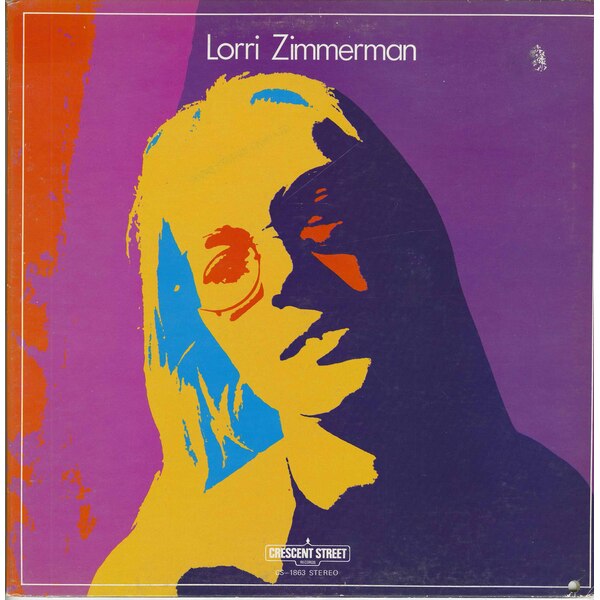
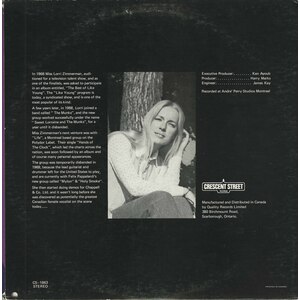
After Life began to unravel, Zimmerman shifted into demo work for Chappell & Co. Ltd., exactly as stated on the original jacket of her solo LP. Those sessions appear to have led directly to the recording of Lorri Zimmerman, released in December 1971 on Crescent Street Records. Pressed in Canada as CS-1863, the album was recorded at André Perry Studios in Montreal, with Ken Ayoub credited on the sleeve as Executive Producer, Harry Marks as Producer, and James Kay as Engineer. Issued in a striking gatefold sleeve and distributed by Quality Records Limited, the LP remains her only full-length solo statement and has since become a prized collector’s item.
Musically, Lorri Zimmerman stands as one of the great under-recognized Canadian female-fronted rock albums of the early 1970s. Sitting somewhere between late-psych, folk-rock, and bluesy hard-edged pop, it balances atmosphere and accessibility with remarkable confidence. Zimmerman was not presented as a songwriter, but the material chosen for her is exceptionally strong, drawing from Ken Briscoe, R. Swerdlow, Mylon Lefebure, Harry Marks, and Jack Bruce. Tracks such as ‘Bidin’ My Time’, ‘Paint Me A Picture’, ‘Don’t Twist My Mind’, and ‘Children Of The Universe’ reveal a singer with real range and timing — capable of warmth, grit, lift, and dramatic control without over-singing. The album’s understated power is part of what has made it endure among collectors: it has just enough fuzz, mood, and psychedelic texture to appeal to psych heads, but its real strength lies in the quality of the songs and Zimmerman’s ability to inhabit them.
That reputation has only grown with time. For years the album was largely absent from mainstream Canadian reference books and only sporadically surfaced in collector circles, despite its quality and rarity. Its eventual rediscovery by psych and private-press collectors has elevated it into the ranks of those truly special Canadian sleepers — records that seem too complete, too assured, and too emotionally convincing to have disappeared so thoroughly for so long. It is now widely regarded as a minor classic of the era and one of the strongest female-vocal Canadian underground LPs of its vintage.
Zimmerman’s post-LP discography suggests that she remained active beyond Crescent Street. In addition to singles connected to the album, she also appears on later 45s including releases credited to Lorri Zimmerman & The Vegetable Band, showing that she continued recording as the early 1970s progressed. By the middle of the decade, however, she was entering the most commercially visible phase of her career.
In the mid-1970s, Zimmerman became part of Toulouse, the Montreal vocal trio that emerged from the city’s session and backing-vocal scene and would go on to become one of Quebec’s most successful bilingual pop-disco acts. Alongside Heather Gauthier and Judi Richards, she helped define the group’s smooth, polished, crossover sound. Toulouse’s self-titled debut appeared in 1976, and the group quickly distinguished itself by moving fluidly between English and French markets at a time when that kind of crossover was still relatively rare. Their blend of sleek production, studio precision, and commercial sophistication made them one of the first bilingual Canadian disco acts to break meaningfully outside Quebec.
The group’s breakthrough came with songs such as ‘It Always Happens This Way (C’est toujours à recommencer)’, which charted nationally in Canada, and ‘A.P.B.’, which expanded their reach further in both Canada and the United States. In a telling contrast to the cult status of her solo LP, Toulouse brought Zimmerman into a far broader mainstream setting, placing her voice inside one of the most polished and radio-friendly Montreal productions of the late 1970s. As disco rose and eventually receded, Toulouse remained active into the early 1980s before splitting up, closing out a remarkable musical arc that had begun in the city’s beat-club and psych scenes more than a decade earlier.
-Robert Williston
Songwriting
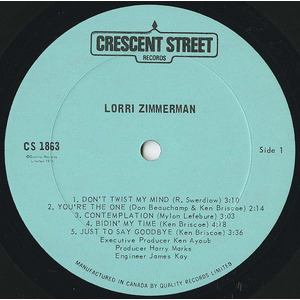
'Don't Twist My Mind' written by R. Swerdlow
'You're The One' written by Don Beauchamp and Ken Briscoe
'Contemplation' written by Mylon Lefebure
'Bidin' My Time' written by Ken Briscoe
'Just To Say Goodbye' written by Ken Briscoe
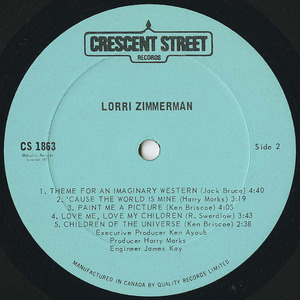
'Theme For An Imaginary Western' written by Jack Bruce
''Cause The World Is Mine' written by Harry Marks
'Paint Me A Picture' written by Ken Briscoe
'Love Me, Love My Children' written by R. Swerdlow
'Children Of The Universe' written by Ken Briscoe
Production
Produced by Harry Marks
Engineered by James Kay
Recorded at André Perry Studios, Montreal, Quebec
Executive Producer: Ken Ayoub
Notes
Manufactured and distributed in Canada by Quality Records Limited, 380 Birchmount Road, Scarborough, Ontario.
Liner notes:
In 1966 Miss Lorri Zimmerman auditioned for a television talent show, and as one of the finalists, was asked to participate in an album entitled The Best of Like Young. The Like Young program was, at the time, one of the most popular syndicated shows of its kind.
A few years later, in 1968, Lorri joined a band called The Munks, and the new group worked successfully under the name Sweet Lorraine and The Munks, for a year until it disbanded.
Miss Zimmerman’s next venture was with Life, a Montreal-based group on the Polydor label. Their single ‘Hands of the Clock’, which reportedly led the charts across the nation, was soon followed by an album and numerous personal appearances.
The group was temporarily disbanded in 1969, because the lead guitarist and drummer left for the United States to play, and were said to be working with Felix Pappalardi’s new groups Mylon and Holy Smoke.
She then started doing demos for Chappell & Co. Ltd., and it wasn’t long before she was being promoted as a potentially major Canadian female vocalist.
No Comments