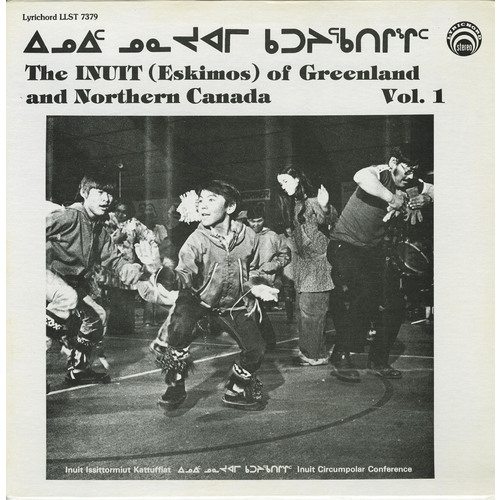
Album / Title
ᐃᓄᐃᑦ ᓄᓇᔪᐊᒥ ᑲᑐᔨᕐᑲᑎᒋᖕᒋᑦ The Inuit (Eskimos) of Greenland and Northern Canada Vol. 1
By: Compilation
Origin: Northern Canada
Insight
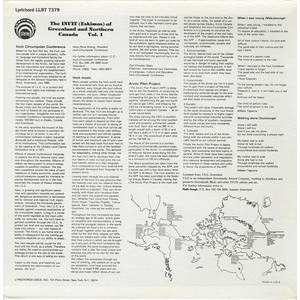
Inuit Circumpolar Conference
Based on the fact that we, the Inuit, are one people with a unique ancestry, culture, language and homeland facing the threat from the rapidly growing resource development in the Arctic, we have realized the importance and necessity of uniting ourselves through the establishment of an international organization. The Inuit and a charter unanimously adopted by all delegates at the General Assembly held in Nuuk, Greenland, July 1980.
The purpose of I.C.C. is to protect and promote Inuit rights and interests on the international level.
Forming one people, the Inuit are scattered among four nations. These include the two major powers of the world, the Soviet Union and the United States. Only the Inuit of Siberia do not participate in our organization. Altogether the Inuit Circumpolar Conference represents approximately 100,000 Inuit in Alaska, Canada and Greenland.
In the early seventies the Inupiat of Alaska faced what is known in southern terminology as an oil boom. It set off a confrontation between modern industrial demands and a traditional lifestyle, with all its implications. This confrontation led to the passing of the Alaska Land Claims Settlement Act in 1971.
Efforts of several multinational industries to explore the Arctic became more intensive throughout the seventies. Billions of dollars are being spent on energy supplies to southern markets. The Alaska experience proved the value of joint resistance to heavy economic, social and cultural pressures caused by intensive resource development and so in the mid-seventies the Inupiat of Alaska initiated the I.C.C.
Now, a growing and significant awareness and opposition towards any potentially dangerous development is demonstrated by national and regional Inuit organizations, including the Home rule government of Greenland. Thus, the I.C.C. is a bulwark against unbalanced exploitation of the circumpolar region. Living in a corner of the world regarded as the most unfriendly for centuries, the Inuit have organized ourselves through the I.C.C. to protect our land and our waters, our lifestyle and culture – our only means of survival. The Arctic is our home and our ability to safeguard it for the coming generations depends on our ability to adapt.
The next decade will be crucial for the Inuit and the Arctic as a whole. Therefore we realize the need to communicate our message across the rest of the world. This album is one way of telling our story.
Listen to the music and hopefully you comprehend the determination of our people, the Inuit.
Hans-Pavia Rosing, President
Inuit Circumpolar Conference
For further information about I.C.C.:
Inuit Circumpolar Conference
P.O. Box 204, DK-3900 Nuuk
Greenland
Phone: 23632, Telex: 053-9067
Inuit music
Many people outside the Inuit world have often wondered why Inuit are so musically talented, even though the Inuit culture as a whole originally had only one musical instrument, the drum. When introduced to other peoples’ instruments Inuit have shown the ability to master them almost instantaneously.
The explanation of this ability is easily understood. The way Inuit are brought up neither rigid nor is it narrowly bound, ethically and authoritatively. From birth Inuit were raised to depend on their ingenuity as a means of survival. A saying of considerable truth is that Inuit can be placed anywhere in the Arctic without tools and equipment and still be capable of reaching an Inuk settlement. A sense of humor and maximum use of one’s own senses are the best tools Inuit ever had to help them survive in one of the harshest environments in the world. This demand for adaptability, among other things, meant that Inuit had to develop their creative talents in order to hold onto the cultural identity which is their language.
As a consequence Inuit have retained and continually developed their language to its present forms.
Looking back through the non-material culture of the Inuit (no less precious than the material one) one can observe that Inuit are able to enjoy new cultural developments without prejudice. They can do so equally with those who introduce them and yet retain the original Inuit perspective. Whether Inuit come from Tikeraq (Point Hope), Tuyuuraq (Tigyak), Tuktuyagtuq, Nain, Labrador or Tasiilaq, Greenland, our view of the world is unique.
Throughout the last hundred years Inuit have an average age of 20 years, which gives us versatility and maneuverability in living among the youngest nations in the world.
As a people we have a lot in common and laugh together when we see each other for the first time despite our differences. We respect each other. We know that Inuit culture in which we are brought up in any part of the Inuit homeland share practically the same ecology and environment that is also the most unique and precious not only to us, but for the rest of the world.
We reflect this awareness through our way of thinking, also passed on to us by our ancestors. Inuit have survived the North for at least 4,000 years and our dance and music reflect slices of our culture that we view to be intricately linked together. The music is composed to be enjoyed, but it also represent some grievances that we have.
In the Arctic happiness go side by side with grief and it is taught to those who have experienced the joys. Raised in this land of ours we learn to open our eyes for the symphonic sights displayed before us by our land in springtime, during summer months, fall and winter seasons. This music is not composed mechanically, but comes directly from the spirit of Inuit in all its manifestations.
Carl Christian Olsen
Chairman, International Inuit Committee
on Language, Culture and Education
Inuit Circumpolar Conference
Arctic Pilot Project
The Arctic Pilot Project (APP) is designed to test the feasibility of producing natural gas from wells in the Arctic Islands, transporting the gas by a 160 km buried pipeline, transforming the gas into liquified natural gas (LNG), and shipping the LNG by ice-breaking carrier to a regasification plant in southern Canada – all on a year-round basis.
The ships carrying LNG to southern markets will be among the most sophisticated and powerful commercial vessels ever built. Each ship will be 395 m in length overall with a beam of 50 m and will have a draft of 11.5 m in open water, 18 m in ice. The power level of each ship will be 150,000 hp.
The Route of the carriers is a corridor, avoiding environmentally sensitive areas, particularly in the Arctic. In consideration of resource harvest areas along the Greenland coast, the route has been adjusted to a minimum of 100 km offshore.
The above quotations are taken from the latest pamphlet released by the APP, and it leaves you with a few facts about what the APP is all about. The Inuit position on the APP has been submitted to the National Energy Board in Canada, stating:
“The Arctic Pilot Project is the most substantial threat to the Inuit and to the Arctic as a whole today. On behalf of an Inuit people across Alaska, Arctic Canada and Greenland the Inuit Circumpolar Conference is in process to convince the developers of the project of the real nature of the APP. The disastrous effects that the APP – if approved may cause environmentally, economically, socially and culturally are immense.”
Environmentally:
The Arctic Islands hold one of the richest ecological bases of the world. Thousands of sea-mammals and Arctic sea-birds would be in danger of losing their traditional nesting and breeding ground. A fact well known by Inuit is that wildlife never return to an area from which they have been disturbed.
Economically:
The people of the Arctic are not in a position to gain from a project of this kind. Furthermore Inuit oppose any project employing any potential danger to the environment and renewable resources which are their basis of economic survival.
Socially:
This project will cause irreparable damage to the social structures of the Inuit Homeland caused by exposure to highly organized and concentrated industrial activities and by the influx of southern manpower with social values and aims completely different from the Inuit’s.
Culturally:
The land, waters and ice of the Arctic along with the animals within it are intrinsically bound to our cultural survival.
Finally the Arctic Pilot Project is deeply connected with the issues of aboriginal rights, land ownership and land claims in general. None of these have been solved and are under discussion and negotiation. Any resource development will prejudice Inuit interests in these matters and unfairly favour the proponents of the APP.
When I was young (Makusunga)
When I was young, I travelled to the Whiteman’s land
To receive an education, I travelled to the land of the white man.
All of their culture I learnt, it’s sure was difficult.
The good side of their culture and the bad I learnt.
The mind of a person rules
The mind of a person is the ruler
When I returned to the Inuit homeland
They started to forget
The good side and the bad side of our culture.
I have forgotten
To the young people I say, do not forget your culture.
Treasure it, love it, it will make you a real Inuk
And you will be happy.
The mind of person rules
The mind of person is the ruler
William Tagoona
Walking alone (Inutulunga)
Alone I will walk
Alone I will live
And if you see me alone
Do not think everything is always right
My father had to walk
Alone he had to live
Through loneliness he walked
Encountered and solved hardships
My mother had to walk
Alone she had to live
Through loneliness she walked
Encountered and solved hardships
William Tagoona
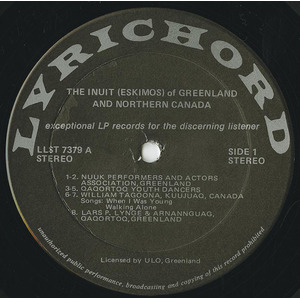
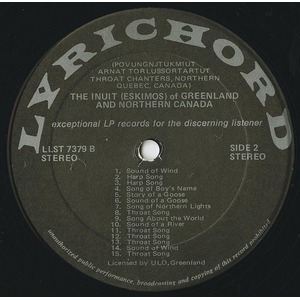
Licensed from: ULO, Greenland
ULO is an independent Greenlandic Record Company, working to distribute and preserve Greenlandic Music and other INUIT culture and art.
For further information write to:
Malik Hoegh, P.O. Box 120, DK 3950, Aasiaat, Greenland
LYRICHORD DISCS, INC.
141 Perry Street, New York, N.Y. 10014
Made in U.S.A.
Gallery
Images
4 images
VA The Inuit (Eskimos) of Greenland and Northern Canada BACK
VA The Inuit (Eskimos) of Greenland and Northern Canada LABEL 01
VA The Inuit (Eskimos) of Greenland and Northern Canada LABEL 02
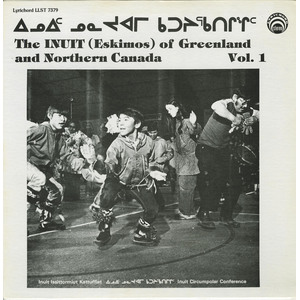
ᐃᓄᐃᑦ ᓄᓇᔪᐊᒥ ᑲᑐᔨᕐᑲᑎᒋᖕᒋᑦ The Inuit (Eskimos) of Greenland and Northern Canada Vol. 1
Media
Videos
0 videos
No videos available for this title.
Credits
In Transit
No Comments