Insight
Vital Sines was a Toronto post-punk and new wave band active through the 1980s, best known for the independently released Collage 12-inch and its strong CFNY-FM airplay in the middle of the decade. Emerging from the city’s early-1980s underground, the group evolved from a wiry punk/new wave attack into a darker, more atmospheric sound that culminated in the Big Dark Dreams sessions of 1985–1986.
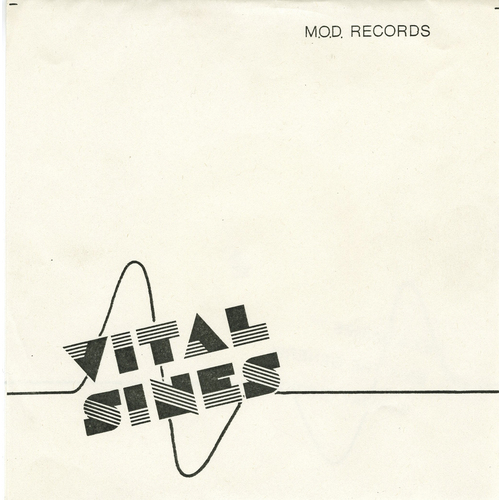
The group appears to have taken shape around 1980, initially playing Toronto’s smaller punk rooms under the name The Offenders before settling on Vital Sines. The earliest stable core was built around Rick Winkle on vocals, Terry Michaelson on bass, and Gord Wilson on guitar, with a shifting succession of drummers during the band’s formative years. Their first known release, the Subway Suicide E.P., arrived in 1981 on their own M.O.D. Records imprint. Issued as a 7-inch EP at 33 ⅓ RPM, it captured Vital Sines in their most wiry and abrasive form: a fast, nervous hybrid of punk and early new wave, with each of the three tracks credited to a different songwriter — Wilson’s ‘Subway Suicide,’ Michaelson’s ‘Sex & Babies,’ and Winkle’s ‘Erik The Generik.’ Even at this stage, the band was already operating as a collaborative unit, with multiple creative centers evident from the outset.
Like many Toronto bands of the period, Vital Sines developed as much on stage as they did on record. To land bills and stay active between headline opportunities, they sometimes played under alternate names, most notably Tryfono & The Heat Resistant Sheep, and later Burundi Plumbers, one of several alternate names the band used while continuing to work the Toronto club circuit. Those years were marked by constant refinement. The band moved through a series of drummers, and as the personnel shifted, so did the music. The hard-edged, frenetic attack of the debut gradually gave way to something more spacious and rhythm-driven: a leaner, darker sound built around stalking basslines, forceful percussion, and guitars that relied increasingly on texture and tension.
That transformation appears to have crystallized with the band’s first cassette release, Rhythms In Dark, a self-released tape from 1982 that has become more discussed than widely seen. While documentation remains thinner than for the vinyl releases, the cassette is consistently cited as the point where Vital Sines moved decisively away from their early punk shell and toward the darker, more rhythmic sound that would define their best-known work. The phrase Rhythms In Dark continued to recur in later titles, credits, and studio references, appearing again in the 1984 song ‘Rhythm Of Dark,’ the Rhythms In Dark Music copyright line on Big Dark Dreams, and references to the band’s home recording setup.
By 1984, Vital Sines had sharpened that direction into their signature statement: the four-song 12-inch Collage. Released independently as Vital Sines VS 101, the record marked their real breakthrough in Toronto and remains the release most closely associated with the band’s name. The sleeve credited Rick Winkle (lead vocals), Gordie Wilson (guitar), Terry Michaelson (bass), and Glenn Milchem (drums), confirming that by this point Milchem had become the drummer most listeners would associate with the band’s classic period. Produced by David Ross and the band, Collage captured Vital Sines at the precise moment their aesthetic clicked: the title track fused ominous atmosphere, deep theatrical vocals, and a slow-burning rhythmic pull that placed them somewhere between post-punk, dark new wave, and the more dramatic end of dancefloor alternative. It became the record most closely associated with the band’s rise in Toronto.
The title track ‘Collage’ became a genuine independent hit on CFNY-FM, the station that more than any other helped define Southern Ontario’s alternative taste in the period. The record earned steady radio and club play, sold through its local pressing, and quickly established Vital Sines as more than another promising Queen Street-era act. For many listeners, ‘Collage’ became their defining song — the track most strongly associated with the band’s CFNY and club success. The EP’s impact was strong enough that it reportedly attracted multiple reissues, including a UK edition through Midnight Records in 1985 and a later Canadian repress through Fringe Product. A promotional video for the song, associated with Gerald Packer, helped extend its reach and tied the band more firmly to the visual language of the era. CFNY recognition appears to have followed, with nominations for local U-Know awards around both the single and its video, though the exact award wording should still be treated cautiously until verified directly from contemporary press.
As Vital Sines’ profile grew, so did their ambitions. Around this same period, Winkle and Michaelson are said to have established a home setup known as Rhythms In Dark Studio, both as a creative base for the band and as a practical way to subsidize their activities by recording other Toronto acts. Like many Toronto independent bands of the period, they expanded their own recording capacity as part of sustaining the project. A later cassette commonly circulated under the collector title 9 Songs, and explicitly identified by Glenn Milchem as having been recorded and released in 1985, captures this transitional phase clearly. Six of its tracks — ‘Sorry,’ ‘Fear Of The Cold,’ ‘Climbing The Air,’ ‘Break The Chains,’ ‘New Heroes,’ and ‘Big Dark Dreams’ — would be re-recorded the following year for the band’s next major release. The cassette stands as a bridge between the leaner minimalism of Collage and the more expansive, professionally produced sound that followed.
That next phase took Vital Sines out of the home studio and into a much larger environment. Work began in 1985 and continued into 1986 at Daniel Lanois’ Grant Avenue Studio in Hamilton, with additional recording in Toronto. Recording at Grant Avenue Studio marked a significant step up from the band’s earlier independent and home-recorded work. The sessions also marked a major lineup turning point. During the recording process, Gord Wilson, whose guitar had been central to the band’s rise, appears to have left the group. His contributions remained audible in the material — and on the finished release his guitar work is still reflected in multiple arrangement notes — but the principal guitar role shifted to Kurt Swinghammer, who entered the picture during production and became the band’s credited guitarist on the final sleeve.
The result was Big Dark Dreams, a six-song 12-inch release issued in 1986 on Fringe Product as FPE 3029. If Collage was the breakthrough, Big Dark Dreams was the band’s most ambitious and fully produced release. Produced by Michael Phillip Wojewoda and the band, and recorded at Grant Avenue Studio with additional work at The Sound Kitchen, the record expanded Vital Sines’ palette without abandoning their identity. The core credited lineup was Rick Winkle (vocals), Kurt Swinghammer (guitar), Terry Michaelson (bass), and Glenn Milchem (drums, percussion), with a strong supporting cast that included Gordie Wilson on additional guitars, James Gray on keyboards, Holly Cole and Tamara Silvera on backing vocals, and The Fulton Ave. Boys Choir.
Its songs — ‘Fear Of The Cold,’ ‘Climbing The Air,’ ‘Sorry,’ ‘Break The Chains,’ ‘New Heroes,’ and ‘Big Dark Dreams’ — reveal a band pushing deeper into atmosphere and arrangement. The sleeve itself is unusually revealing, crediting specific guitar assignments and sonic details from track to track, underscoring how carefully the record was assembled. Wilson remained deeply embedded in the material despite his altered status, with key guitar parts still attributed to him across multiple songs, while Swinghammer’s presence helped shape the finished record’s sharper visual and musical identity. The cover art was by Kurt Swinghammer, linking the release not just to his playing but to his wider artistic sensibility.
Big Dark Dreams appears to have produced another CFNY-connected moment, with ‘Break The Chains’ becoming the likely focal track and generating further radio and video attention. Around this period, Vital Sines were able to step into more prominent support slots, reportedly opening for international acts such as Shriekback, Hunters & Collectors, Siouxsie and the Banshees, and Love and Rockets. By the mid-1980s, the band had moved well beyond the local club level and were operating as a serious Toronto alternative act with regional momentum.
Following the departures of Kurt Swinghammer and Glenn Milchem in May 1987, Rick Winkle and Terry Michaelson continued Vital Sines with replacement members, reportedly including Gary Alexander and Tony Klinakis, and carried the band forward into 1988 before the group dissolved.
Over the course of its run, Vital Sines underwent several lineup changes, most notably the transition from Gord Wilson to Kurt Swinghammer during the making of Big Dark Dreams. Glenn Milchem’s later work with Andrew Cash and Blue Rodeo, along with James Gray’s later association with Blue Rodeo, placed several former Vital Sines members within a broader network of Toronto musicians who remained active beyond the band’s lifespan.
-Robert Williston
Musicians
Rick Winkle: vocals, percussion
Terry Michaelson: bass, vocals
Gord Wilson: guitar, vocals
Chris Weekes: drums
Songwriting
‘Subway Suicide’ written by Gord Wilson
‘Erik The Generik’ written by Rick Winkle
‘Sex & Babies’ written by Terry Michaelson
Gallery
Images
4 images
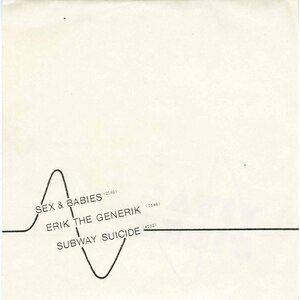
Vital Sines - Subway Suicide/ Erik the Generik b/w Sex & Babies (picture sleeve)
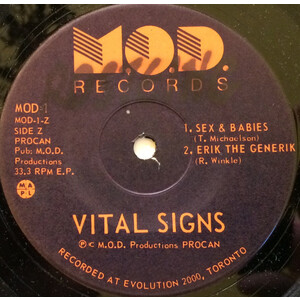
Vital Sines – Subway Suicide E.P. (1)
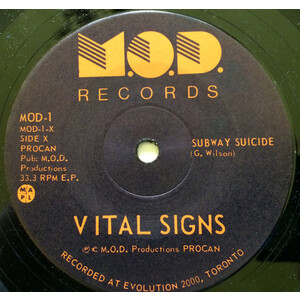
Vital Sines – Subway Suicide E.P. (2)
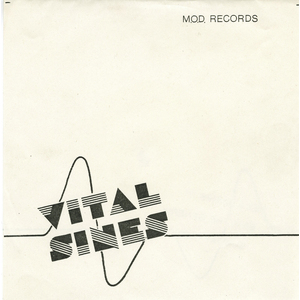
Subway Suicide E.P.
Media
Videos
0 videos
No videos available for this title.
Credits
In Transit
No Comments