Insight
Space Invaders were a Toronto art-rock band of the late 1970s and early 1980s, put together in the basement of a North York hair salon by Paul Myers and Michael Phillip Wojewoda. With Ontario College of Art student Sharon Cook on keyboards and guitar and Andrew Snell on bass, they made one record, a four-song self-titled 7-inch EP cut after hours at the Music Gallery in February 1981. It was an early proving ground for all four, and the start of a partnership between Myers and Wojewoda that ran through Dis Band to the Gravelberrys more than a decade later.
Nighthawk and the Happy PlaceMyers met Wojewoda in the back room of Advent Lutheran Church, where Myers was playing guitar in a suburban hard rock band called Nighthawk. Wojewoda was the band's 14-year-old drum tech, two years younger than Myers. When the regular drummer was late he would sit in, and the two found they shared a taste for music Nighthawk had no use for: Roxy Music, Brian Eno, XTC, and the German and Quebec bands they heard about through Trouser Press, Creem and CFNY. Nighthawk fired Myers at 17. He passed through a sci-fi prog band with a keyboardist named Raitis, a drummer named Mark and a bassist named Ray before settling into making home recordings with Wojewoda.
They worked in the basement of the Happy Place hair salon, which Wojewoda's mother Sophia ran in North York, on Sunday afternoons when the shop was closed. Wojewoda had been recording bands since 1977, and the basement became their laboratory for odd guitar sounds and improvisation. Myers was modelling his singing on Andy Partridge and David Byrne and his guitar on Andy Gill, Robert Fripp, Phil Manzanera and Eno. Practice took a back seat to joyful, homemade noise.
The band takes shapeThrough Wojewoda's sister Nicky, Myers met her friend Sharon Cook, an Ontario College of Art student in Experimental Arts who played guitar and keyboards and wrote her own songs. Myers was taken with her wordplay, and admitted he half wanted to be an art student himself, since that was where the art school bands came from. Cook joined the Sunday sessions.
The bass chair was filled for a while by Ray from the prog band. The permanent answer came from Stephen Leacock Collegiate in Scarborough, where Myers' younger brother Mike filmed the band as a trial run for his high school video class. One of Mike's schoolmates was Andrew Snell, a musically trained Mod who modelled his playing on Paul Simonon of the Clash and Bruce Foxton of the Jam. He locked in with Wojewoda right away.
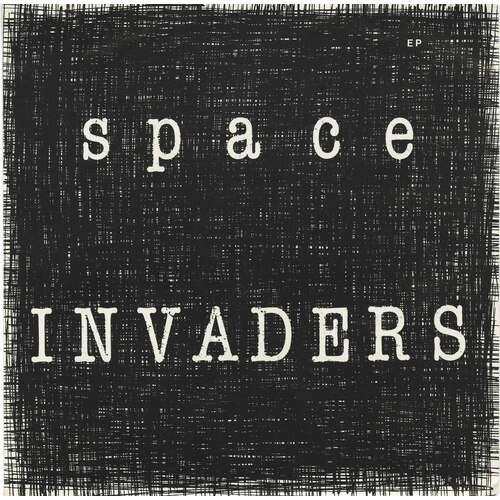
The name came from the arcade game, spotted in a donut shop on Queen Street West. They liked its hint of new technology and the idea of invading the spaces they played. Their posters set it as a lowercase 'space' and an uppercase 'INVADERS'. Nobody stopped to think how many other people might be using the same name.
The Music Gallery EPNicky also knew John Oswald, the saxophonist, improviser and tape manipulator who would later become famous for Plunderphonics. Oswald was part of the circle at the Music Gallery, the experimental music centre Peter Anson and Al Mattes had founded in 1976, and he recorded Space Invaders there after hours in February 1981 with Paul Hodge assisting. The band borrowed the money from friends and family, chiefly Myers' brother Peter and his suburban friend Chris Johnston.
The EP carries two songs by each writer. Myers' 'Cheer Up' sets atonal chords against a title it openly mocks, and his 'I Wake Up Being' is a manic, jazz-tinged piece in E minor seventh. Cook's 'But Dot Dot Dot' is a sideways look at modern love, and 'Dead Boats Don't Float' is the catchiest thing on the record. The sleeve was handmade: the band stencilled the lettering with Letraset and Cook added the marker work. World Records pressed it as WRC5-1507.
Gigs and the last showOver the next year or so Space Invaders moved downtown, most notably to The Edge, the club run by Gary Topp and Gary Cormier. Their last show was a benefit for the Funnel Experimental Film Theatre at Scadding Court Community Centre. Cook's film teacher Ross McLaren, a founder of the Funnel, asked them to play. Carl Hamfelt photographed the four of them on stage that night.
After Space InvadersMyers, Wojewoda and Snell later reunited in Dis Band, the Toronto group formed with a built-in expiry date, which played its farewell show on New Year's Eve 1982. Myers and Snell, the last men standing from Space Invaders, then formed the duo Life Times Nine. They tried hard to make it commercial and planned to move to England just as the Smiths were breaking, but never went. The duo fell apart after an argument about Crowded House, whom Myers loved and Snell did not.
Cook graduated from OCA in 1981 and moved into experimental film. Her Super 8 piece The Dot Film, polka-dot fabric blowing on a rooftop over a shortwave radio soundtrack, screened at the Funnel, and her installation Duck Blind projected Super 8 loops onto a seven-foot yellow cardboard sculpture. She made The Encyclopedia of Natural Defects (1986), a 35-minute quasi-musical built around a six-armed oracle in a sea cave, with songs she wrote during production, and Manganese! (1987), a silent-style comedy about a struggling painter in 19th-century France with guinea pigs in the leading roles and a live accordion score. She served on the Funnel's board, became its programmer during the move to Soho Street, and hosted The Funnel Broadcast, a weekly half-hour of film soundtracks, sound collages and filmmaker interviews on CKLN.
Wojewoda became one of the most important producers in Canadian alternative music, with Juno Awards for engineering in 1994 and production in 1996 and records by Rheostatics, Barenaked Ladies, Change of Heart and Spirit of the West. In 1993 he produced Bowl of Globes for Myers' band the Gravelberrys, whose 'Wonder Where You Are Tonight' became a Canadian alternative radio hit. Myers went on to write books on Barenaked Ladies, Todd Rundgren, Long John Baldry, the Kids in the Hall and John Candy. In 2026 he began writing up the Space Invaders story himself.
-Robert Williston
Gallery
Images
4 images
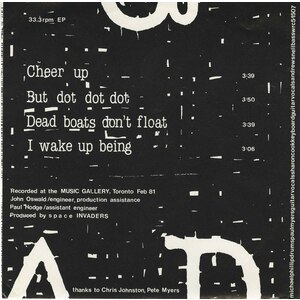
Space Invaders - ST (EP) (picture sleeve)

Space Invaders - ST (EP) (picture sleeve)
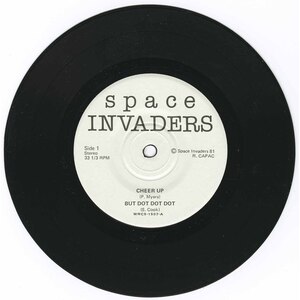
Space Invaders - ST (EP) (picture sleeve)
ST (EP)
Media
Videos
0 videos
No videos available for this title.
Credits
Musicians
Michael Phillips: drums
Paul Myers: guitar, vocals
Sharon Cook: keyboards, guitar, vocals
Andrew Snell: bass
Songwriting
‘Cheer Up’ written by Paul Myers
‘But Dot Dot Dot’ written by Sharon Cook
‘Dead Boats Don’t Float’ written by Sharon Cook
‘I Wake Up Being’ written by Paul Myers
Production
Produced by John Oswald
Produced by Space Invaders (credited on original sleeve)
Technical
Recorded at The Music Gallery, Toronto, Ontario, February 1981
Engineered by John Oswald
Assistant engineer Paul Hodge
Release
7-inch vinyl EP, 33⅓ RPM, stereo
Manufactured by World Records
Catalogue number WRC5-1507
© 1981 Space Invaders
Rights society: CAPAC
Matrix numbers
WRC5-1507-A
WRC5-1507-B
No Comments