Insight
Eric’s Trip began as a rumble beneath the quiet surface of Moncton, New Brunswick—a city with no defined indie scene, no mythology to inherit, and no roadmap for making distorted, dream-poetic pop music on homemade four-track machines. What the band lacked in infrastructure, they made up for with a fierce belief in self-creation. In the summer of 1990, Rick White and Chris Thompson—who had grown up together in the Moncton punk outfit The Forrest—joined forces with drummer Ed Vaughan and seventeen-year-old bassist-vocalist Julie Doiron, a shy presence whose soft voice would eventually become the emotional centre of the band’s sound. They named themselves after “Eric’s Trip,” a track on Sonic Youth’s Daydream Nation, a subtle declaration of both influence and intent: noisy, intimate, unguarded music that felt like a private world happening inside a basement.
Moncton, a town with a population smaller than most American university districts, proved to be both a limitation and a liberation. There were few clubs, fewer audiences, almost no expectations—and yet the band blossomed quickly. Before they even stepped onto a stage, they had already recorded and self-released two cassette EPs, Eric’s Trip and Catapillars, recorded on borrowed four-tracks in family basements, adorned with hand-drawn art, and accompanied by tender, cryptic liner notes. A third tape, Drowning, followed. Their earliest recordings—often slightly out of tune, distorted, fragile, achingly melodic—felt like diary entries pressed to magnetic tape. They were making lo-fi not as an aesthetic but out of necessity, and what resulted became the core of their identity: fuzzed-out pop songs whispered rather than shouted, with emotional worlds larger than the equipment that captured them.
Their first live show didn’t arrive until April 1991—astonishing considering their growing catalogue—but by then their music had already begun circulating through the Canadian underground. The Warm Girl EP, released in January 1992, marked a turning point. A copy landed on the desk of Halifax scene builder and Sloan co-manager Peter Rowan, who recognized something extraordinary. Eric’s Trip were not aspiring to ride the rising wave of Halifax’s so-called “Seattle North” explosion—they existed entirely apart from it. Rowan offered to manage them. murderecords released the Peter CD EP. And in a move that would reverberate across Canadian indie history, Sub Pop—then the most influential independent label on the continent—signed Eric’s Trip, making them the first Canadian band on the label.
Their Sub Pop debut Love Tara arrived in November 1993. It was unvarnished, painfully intimate, and unlike anything else circulating through the post-Nirvana landscape. “Sappy melodic pop music on top of thick distortion,” Rick White once said—an understatement. The album chronicled the breakup of White and Doiron with startling vulnerability, their gentle, wounded voices floating above guitars that sounded like collapsing amplifiers. Critics who prized studio precision were baffled. But for a generation of young listeners—especially in small towns across Canada—Love Tara was a revelation. It proved that beautiful music could be made cheaply, personally, imperfectly; that art did not require permission; that heartbreak could become a shared echo. Gord Downie immortalized it in “Put It Off,” singing: “I played Love Tara by Eric’s Trip on the day that you were born.”
The band recorded constantly—cassettes, singles, 7-inches for tiny labels like Cinnamon Toast and Sonic Unyon, EPs for Derivative and Summershine—each release handmade, collectible, and adored by a growing cult audience. Their second Sub Pop album Forever Again (1994) expanded their sonic world, featuring the minor college-radio hit “Viewmaster,” while their final album Purple Blue (1996) pushed deeper into psychedelic textures, damaged pop, and noise-folk spirituality. Throughout, they toured Canada, the U.S., and Europe, playing basements, tiny clubs, and eventually the Tragically Hip’s 1996 Another Roadside Attraction tour. Despite rising attention, the band dissolved that same year—exhausted, adored, and already legendary.
Their breakup only widened the doorway they had opened. All four members continued making music with breathtaking productivity. Rick White plunged into psychedelic exploration with Elevator to Hell (later Elevator Through and Elevator), issued numerous solo records, became a trusted producer and visual artist, and collaborated with The Sadies, Joel Plaskett, Orange Glass, and the super-group The Unintended. Julie Doiron emerged as one of Canada’s most admired singer-songwriters—first as Broken Girl, then under her own name—earning a Juno Award in 2000 for her collaboration with Wooden Stars and later working with Phil Elverum, Okkervil River, Shotgun & Jaybird, and her own Sappy Records community in Sackville, N.B. Chris Thompson deepened his long-running Moon Socket project while co-leading Orange Glass and The Memories Attack. Drummer Mark Gaudet returned to his punk roots in The Robins, releasing new material produced once again by White. Their histories remain intertwined, a constellation of projects forever orbiting the original band.
Eric’s Trip reunited several times—first for a 2001 Canadian tour (immortalized on the live album Eric’s Trip: Live in Concert, Nov. 4, 2001 via White’s Great Beyond label), and later at SappyFest and the Halifax Pop Explosion. Each reunion confirmed what had been evident all along: their music was not a relic of the ’90s, but a living language that continued to resonate with new generations of artists discovering that intimacy and distortion could coexist.
More than three decades after their first basement recordings, Eric’s Trip remains one of Canada’s most influential indie groups—not for commercial achievements, but for the world of art they made possible. Their legacy is measured in the thousands of musicians who first picked up a four-track because Love Tara showed them they could; in the countless bands inspired by their blend of noise and vulnerability; in the Maritime artists who built entire scenes from the template they defined. Eric’s Trip never tried to lead anyone. They simply recorded their lives with honesty, distortion, and a sense of wonder—and in doing so, they quietly became one of the most important bands Canada has ever produced.
-Robert Williston
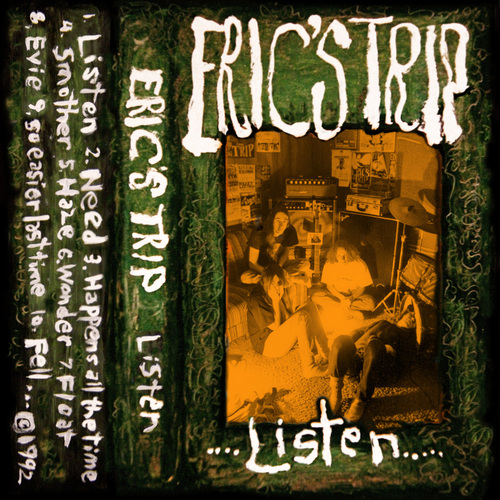
In the spring and summer of 1992 Eric's Trip had a new found excitement. We were getting really comfortable as a band, playing more shows, making new friends in Halifax, and writing lots of new songs. We recorded our first 7 inch in March, and while waiting for it's release, we were preparing another full length indie cassette album.
Chris and Julie switched instruments somewhere during the spring, but the change over went quite smoothly. We were still recording on an old cassette 4track at Chris's folks house, and by July i had these ten songs layed out. Even this cassette cover design was ready to go when the offer came to do a CD e.p. with Sloan's new Murder Records label.
With the idea of releasing our first CD now in my head, I wasn't happy with the recordings i had done here. The drums were especially not cutting through very well, the cymbal heavy one mic drum recording had very little clarity beneath the guitar and bass racket, i wanted to re-record it all again. We did more recording through the autumn, concentrating on getting a better sound, and eventually released new versions/mixes of NEED, LISTEN, HAPPENS ALL THE TIME, and HAZE along with a song from our "Warm Girl" cassette called TANGLES and an acoustic song Julie and I did called DEEPER. That release was called the "Peter e.p." named after a couple new guys in our life. Our new Moncton friend who's scratched glasses appear on the autumny cover, and Peter Rowan who was becoming our manager. People still thought it sounded "lo-fi".
One thing that's always haunted me about the released "Peter" e.p. is that it plays one semitone down in pitch. It's a little slow. I think the reason was because i sent off a stereo cassette copy of the final mix to master from and there must have been a pitch difference between the tape decks used. We tuned our guitars standard to 440, and for example "Need" starts in G when played, but it's F# on the CD. Over the years i kinda forgot about it until re-listening to this tape recently and hearing the songs in the right key again for the first time in 25 years.
So this "Listen" cassette album was left unreleased as a whole until now, though mixes of WONDER, EVIE and FELL (also with slowed pitch) were added to the "Long Days Ride..." compilation in 1996. EVIE's recording date was listed wrong in the album notes, saying Nov.92 instead of July. SMOTHER was re-recorded in early1993 for the "Never Mind the Molluscs" SubPop compilation 7inch, though this earlier version did eventually appear on our "Bootleg" 12 inch in 2007. This version of SO EASIER LAST TIME in a different mix was on the "Warm Girl" 7inch released in 1993, and FLOAT was re-recorded in Nov.93 for a Summershine/Subpop 7inch.
I always felt these 10 songs should have remained together as a group, and as noisy and rough as these recordings are, i thought some of you may enjoy hearing this.
Rick White: guitar, voice
Julie Doiron: bass, voice
Chris Thompson: guitar
Mark Gaudet: drums
released November 3, 2018
Gallery
Images
1 image
Listen (EP)
Media
Videos
0 videos
No videos available for this title.
Credits
In Transit
No Comments