Information/Write-up
Craig F. McCaw emerged from Vancouver’s late-1960s music scene as a distinctive multi-instrumentalist whose blend of guitar, sitar, and keyboard textures helped define one of the most successful Canadian groups of its era. As the lead guitarist for The Poppy Family, McCaw toured extensively with Terry Jacks, Susan Jacks, and tabla player Satwant Singh, supporting a run of hit singles and albums that made the group the top-selling Canadian act of the late sixties and early seventies. The CBC frequently featured the Poppy Family on national television, cementing their visibility across the country during the height of their chart success.
Following the breakup of the group, McCaw left Canada to study composition and theory in Delhi, India under the renowned rudra veena master Asad Ali Khan. His immersion in classical Indian music broadened his harmonic palette and deepened the modal sensibilities that would later surface in his ambient and planetarium work. Upon returning to Vancouver he became a sought-after session musician, working across a wide variety of local bands and studio projects throughout the mid-1970s.
His first major post-Poppy Family project was Sixty-Six Six, a Vancouver rock group active from 1974 to 1976 featuring Chris Raines (Python), John Mitchel, Curt Klassen, Gary Glacken, and vocalists Kendra and Roz Sprinkling. McCaw shared songwriting and production duties with Raines, and the band released a 1975 single on Honeymoon Records: Put You Out b/w Life’s On Fire. Members later moved into other regional projects, while McCaw continued on toward an increasingly solo-oriented path.
A lifelong fascination with astronomy eventually brought him to Vancouver’s H.R. MacMillan Planetarium, where his skills as a musician intersected with new creative avenues. Beginning with visual-effects work, air-brush art, and scripting, McCaw became the planetarium’s de facto resident composer, handling music composition, narration, and full audio production for dozens of planetarium shows over a span of nearly twenty years. His first soundtrack LP, Journey Through the Galaxy, sold out two vinyl pressings and evolved into a cult favourite among collectors of ambient, space-rock, and electronic music. A revised and expanded edition—incorporating material from a sequel show—was later released on CD and digital formats. Additional scores for Electric Sky, Nightwatch, and Going to Extremes further established McCaw as a major creative voice in the dome-theatre field.
As his work expanded beyond astronomy, McCaw moved into television and film scoring, contributing to a wide range of international broadcast projects. His music appeared on Celebrity Fit Club, America’s Greatest Unsolved Mysteries, and several children’s and anime series with worldwide distribution. Among his best-known credits are the animated programs Monster Rancher—which aired in over two dozen countries to an estimated weekly audience of thirty million viewers—and Hamtaro Time. Working with Sony/Turner and the Cartoon Network, he composed the theme and underscore for Powerpuff Girls Z, adding another global franchise to his résumé.
McCaw continues to work as President of Roundhouse Productions, a multimedia studio specializing in music-to-images shows for theatres, planetaria, events, and broadcast clients. The studio maintains a state-of-the-art in-house production setup, handling composition, scoring, post-production, and visual integration. McCaw has also appeared occasionally in reunion performances with former bandmates, including a memorable appearance with Susan Jacks and Satwant Singh at the Hippie Daze celebrations on Vancouver’s 4th Avenue.
Across more than five decades of music-making—from psychedelic rock and Indian classical studies to space-theatre soundtracks, animation scoring, and international broadcast work—Craig F. McCaw has built one of the most eclectic and enduring careers of any musician to emerge from Vancouver’s late-1960s creative surge. His music continues to circulate among collectors, anime fans, and planetarium historians, while projects under Roundhouse Productions keep his work active in new visual and immersive environments.
-Robert Williston
Musicians
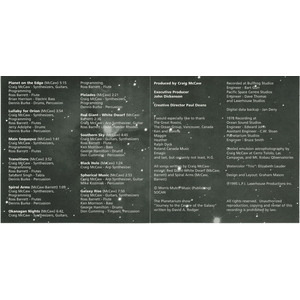
Craig McCaw: synthesizers, guitars, ARP synthesizer, Fender Rhodes, programming
Ross Barrett: flute, flutes
Brian Harrison: electric bass
Ken Morrison: bass
George Hamilton: drums
Jerry Adolphe: drums
Dennis Burke: drums, percussion
Don Cumming: percussion, timpani
Mike Koziniak: percussion
Satwant Singh: tabla
Songwriting
All songs written by Craig McCaw
except
‘Red Giant – White Dwarf’ written by Craig McCaw and Ross Barrett
‘Spiral Arms’ written by Craig McCaw and Ross Barrett
Production
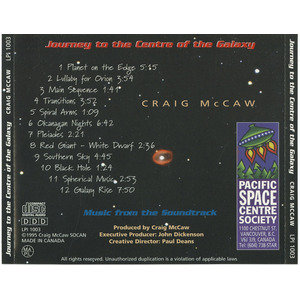
Produced by Craig McCaw
Executive Producer: John Dickenson
Creative Director: Paul Deans
Recorded at Bullfrog Studios
Engineered by Bart Gurr
Recorded at Pacific Space Centre Studios
Engineered by Dave Thomas
Recorded at Laserhouse Studios
Digital data backup by Jan Deny
1978 recording at Ocean Sound Studios
Engineered by Edward John
Assistant engineer: C.W. Sloan
1978 recording at Planetarium Studios
Engineered by Bruce Smith
Artwork
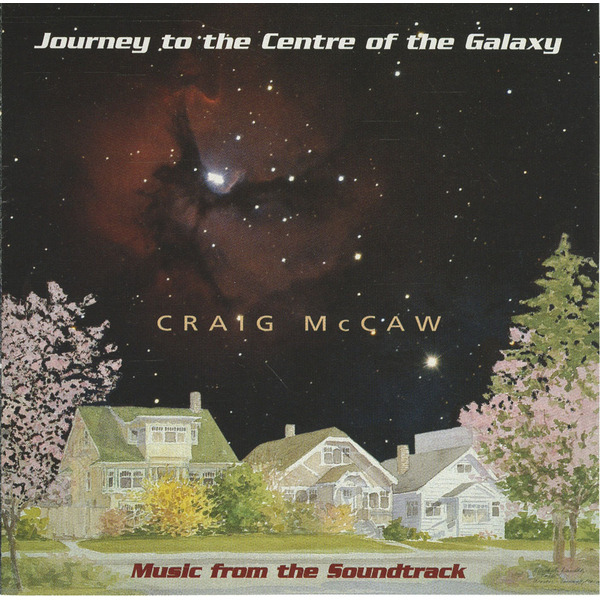
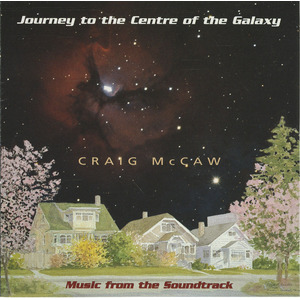
Cooled-emulsion astrophotography by Craig McCaw
Photographed at Cerro Tololo Observatory, Chile; Las Campanas Observatory, Chile; and Mount Kobau Observatory, British Columbia
Watercolor ‘Trio’ by Elizabeth Lauder
Design and layout by Graham Mason
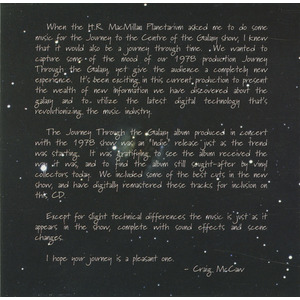
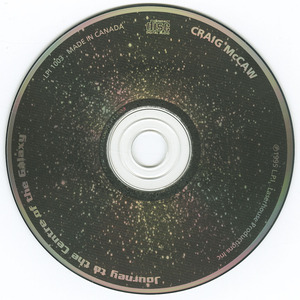
When the H.R. MacMillan Planetarium asked me to do some music for the Journey to the Centre of the Galaxy show, I knew that it would also be a journey through time. We wanted to capture some of the mood of our 1978 production Journey Through the Galaxy, yet give the audience a completely new experience. It’s been exciting in this current production to present the wealth of new information we have discovered about the galaxy and to utilize the latest digital technology that’s revolutionizing the music industry.
The Journey Through the Galaxy album produced in concert with the 1978 show was an “indie” release just as the trend was starting. It was gratifying to see the album received the way it was, and to find the album still sought after by vinyl collectors today. We included some of the best cuts in the new show, and have digitally remastered these tracks for inclusion on this CD.
Except for slight technical differences, the music is just as it appears in the show, complete with sound effects and scene changes.
I hope your journey is a pleasant one.
-Craig McCaw
Liner notes
The music on Journey to the Centre of the Galaxy was composed for the H.R. MacMillan Planetarium’s production of the same name. Craig McCaw approached the project as both a continuation and a reinterpretation of the original 1978 planetarium presentation Journey Through the Galaxy, seeking to preserve its atmosphere while presenting a completely new experience for audiences.
The production reflects advances in astronomical knowledge as well as developments in digital music technology that were reshaping the recording industry at the time. While rooted in the character of the earlier work, the updated score incorporates new material and expanded sonic detail.
The original Journey Through the Galaxy album, released independently in conjunction with the 1978 show, has remained of interest to collectors over the years. Selections from that earlier production were chosen, digitally remastered, and integrated into this release.
Apart from minor technical differences, the music appears as it does in the planetarium presentation, including sound effects and scene changes. The album mirrors the narrative flow of the live show.
The planetarium show Journey to the Centre of the Galaxy was written by David A. Rodger.
No Comments