Insight
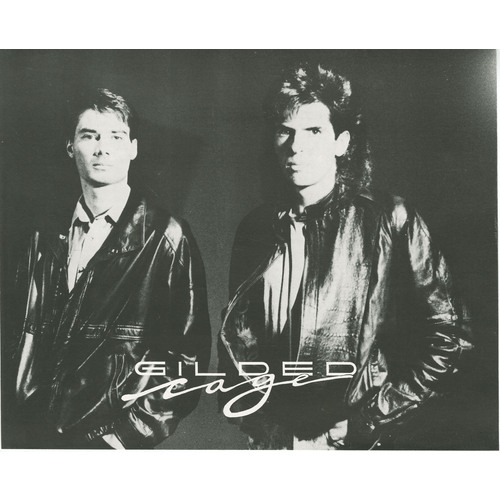
Gilded Cage were a London, Ontario–based studio rock and power-pop duo active primarily between 1987 and 1989, built around songwriter-multi-instrumentalists John Berkmortel and Bill Lamont. Distinctive for their deliberate rejection of the bar-band circuit, Gilded Cage pursued a business-minded, studio-first strategy at a time when most Canadian rock acts were still grinding through live venues in hopes of discovery.
Both members emerged from within London’s tightly knit music infrastructure and attended the same highschool in Strathroy, Ontario. Berkmortel and Lamont simultaneously began writing and recording together under the name Gilded Cage, positioning the project as a focused songwriting and recording partnership rather than a touring band. By the time Gilded Cage formally emerged, the duo had already been collaborating for nearly two years and had written several dozen original songs.
From the outset, Gilded Cage chose to bypass live performance almost entirely. Their objective was to write commercially competitive material, record it to professional standards, and secure radio airplay and industry attention without sacrificing full-time employment or personal stability. Berkmortel continued working as an engineer while Bill ran his family farm. Both members were open about their belief that the traditional “paying dues” bar circuit was not a prerequisite for success. Instead, they concentrated on songwriting, studio recording, and radio servicing, explicitly targeting a contemporary 14–30-year-old audience.
Their debut single, ‘Last Time’ b/w ‘A Feeling I Can’t Hide’ (Auto Records AUTO 003, 1987), was recorded at EMAC Studios in London and produced by Peter Brennan. The release showcased a polished, radio-ready rock sound supported by session musicians and careful production. The single received strong airplay locally and regionally, won CFPL-FM’s On Track competition, and performed well on CKSL’s Battle of the Bands, where it won multiple nights. Approximately 1,000 copies were pressed and distributed through Auto Records and local retailers including Sam the Record Man, establishing Gilded Cage as a serious studio-based act and validating their non-traditional approach.
In late 1988, the duo followed with a second single, ‘Tara’ b/w ‘Rain’ (Auto Records AUTO 005). Again recorded at EMAC Studios and produced by Brennan, the release expanded their sonic palette with added instrumentation and backing vocals. Tara proved even more successful, receiving airplay on more than 40–50 radio stations across Canada, earning documented coast-to-coast programmer support, and resulting in Gilded Cage being “retired as champions” on CKSL’s Battle of the Bands. By this point, the duo were multiple-time FM96 On Track winners and finalists, and were widely cited in London press as one of the city’s most strategically focused independent recording acts.
To extend the single’s reach and strengthen their industry profile, Gilded Cage commissioned a promotional video for Tara, produced by Ryerson Polytechnical Institute students Tim Martin and Jeff Wickstead. The video earned Second Place in the Music Video category at CBC Telefest ’89, with judges praising it as a marketable pop video supported by a strong song and excellent recording. The clip received national television exposure on YTV and CBC’s Video Hits, marking a rare level of broadcast visibility for an independent Canadian duo without a major-label deal.
Trade recognition followed soon after. Both Last Time and Tara were formally listed in Music Scene (Pro Canada) in early 1989, confirming songwriting credits, Auto Records distribution, and national industry servicing. At the same time, Tara was released in several European territories, reflecting international interest generated by its radio and video performance.
Despite growing momentum, Gilded Cage chose not to continue independently releasing singles beyond 1989. While their material was actively being shopped worldwide and album plans were discussed publicly, Berkmortel and Lamont ultimately stepped back from further releases, having already demonstrated that a carefully executed studio-first strategy could achieve radio success, national exposure, and meaningful industry attention without touring.
In retrospect, Gilded Cage stand as a clear example of a late-1980s Canadian studio project that succeeded on its own terms. Their documented arc—from songwriting partnership to radio competition victories, national airplay, broadcast-award recognition, and international release—offers a concise case study in how London, Ontario’s music ecosystem could generate polished, export-ready recordings outside the conventional live-band economy.
-Robert Williston
John Berkmortel: lead and backing vocals, bass guitar, rhythm guitar
Bill Lamont: lead guitar, keyboards, drum programming
Gallery
Images
1 image
Gotten Over You
Media
Videos
0 videos
No videos available for this title.
Credits
In Transit
No Comments