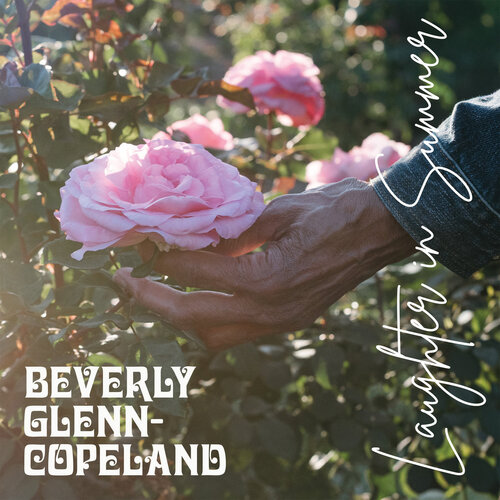
Album / Title
Laughter in Summer
Origin: Philadelphia, Pennsylvania, 🇺🇸 → Montréal, Québec → New Brunswick, 🇨🇦
About This Title
From the moment we are born, we begin the long walk home. Elizabeth and Beverly and Glenn-Copeland started down the path together nearly half a century ago, and have been trailing it since, hand in hand and song by song. Together, they’ve made a life sharing their unselfish hearts—ones too large for earthly configuration—through art and community, encouraging us all to take our own dance down the road with elemental love and grace.
Now, as Glenn lives with a version of Dementia known as LATE, their walk has taken on a different weight. Out of this season comes Laughter In Summer, an album the couple made together—realizing, before long, that it was a love letter to one another: a tender ledger of memories, shared devotion, grief and joy. We, as listeners, are privileged to enter the orbit of the Glenn-Copelands’ love. It is a generative force: a spine-builder, a river, a source of nourishment and vital life. Spending any time with Laughter In Summer can rouse us from slumber, reawakening instincts dulled by atomization and nihilism—and all that this love counters.
Laughter In Summer marks a return to the collaborative spirit that first bound Elizabeth and Glenn together all those decades ago. “I think the universe was conspiring to get us together for a long time,” Elizabeth says now. She was nineteen when she first saw him—Toronto, Jarvis Street, in a small restaurant. Onstage stood a figure with an enigmatic presence, dressed in a sweatsuit, playing piano and singing as though for no one but himself. For Elizabeth, nothing existed but the sound of that voice: plum-rich, tender, and assured.
After that night, she did not see or hear of Glenn again for a decade. She was pregnant with her daughter, Faith when a friend stopped her on the street and entreated, “Elizabeth, have you heard of Beverly Glenn-Copeland?!” She hadn’t. Into her hands the friend pressed one of Glenn’s homemade cassettes. On it were two songs: ‘Sailing On the Winds of Time’ and ‘Hold On’. Elizabeth played the latter for her unborn child, singing along as she carried Faith inside.
When Elizabeth had saved enough to record her own album in the nineties, ‘My Mother’s Eyes”, she longed to cover ‘Hold On’. She reached out to Glenn personally for his permission, and in that exchange, their friendship began. Theirs soon grew into a partnership rooted in music and spirituality. Elizabeth invited Glenn into the theater shows she produced, sometimes as collaborator, sometimes as co-producer. They shared stages, work, and vision. The seeds of Laughter In Summer—of creating music as a shared lifeline—were planted here, long before the album itself would exist.
Their love story truly began in the spring of 2007. Elizabeth, a single mother, sent a ferocious prayer to the universe: Please send me my mate. That same night she dreamt of Glenn, standing on a hill, moonlight behind him. She woke and called their mutual friend Maggie Hollis—who sang on Glenn’s ‘La Vita’—and told her of the dream. Maggie said Glenn was going through a divorce, and let her know, “Elizabeth, you would be perfect for him.”
Later that spring, Elizabeth attended Maggie’s wedding, knowing Glenn would be there. Afterward she called him. He was eating oatmeal with his oversized spoon, as he often did. Elizabeth told him about her dream: how he was reaching for her, gilded by the moonlight. On the other end of the line, she heard the spoon fall to the floor. Glenn would later say that it was his mother, who had recently passed, who brought Elizabeth to him. By the end that summer2007, they were in love
Their romance only emboldened their shared vocation: to make art in service of community, especially for children, so that the next generation might carry their message forward. In 2010, they left Toronto for the East Coast, drawn by lower costs and the call of the ocean and forests. There they founded KPH Theater Productions, a children’s theater school that flourished until 2016, when the local economy collapsed. Closing it was a difficult dream for the couple to relinquish. For years it had given them a grounded way to bring people together, to show how the arts could be a tool for belonging.
For too long, the story of Beverly Glenn-Copeland has overlooked the importance of local theater in his work, and, more fundamentally it has overlooked Elizabeth. The narrative built around Glenn has unwittingly echoed misogynistic forms of lionization, where the woman’s influence is diminished in favor of a sole male genius. But what of the woman who produced the shows that gave Glenn stages to stand on, arranged his music, raised children, built theater programs for other people’s children, paid the bills, carried him through the hardships of obscurity and the disorientation of belated fame? What of the woman who now, as Glenn lives with cognitive impairment, walks him home? “Behind every great man, a woman,” the saying goes. Glenn is keen to correct it: “In front of every great woman, a man.”
Now, Elizabeth has rightly taken her place as producer of Glenn’s work, shaping Laughter In Summer. The album’s title comes from a song born almost accidentally. Glenn, as his cognitive impairment advanced, began composing a series of instrumentals he called Songs With No Words, meant for listeners to write their own lyrics. One day he played one such piece for Elizabeth. Sitting by a lake, listening to loons and gazing at the sky, words rose up in her: laughter in summer, how I remember. “It was a very painful time,” she recalls, “because I was so aware of just how much of my sweetheart I was losing.” My life, my joy, on Earth, here, with you, she sang. The words came as a gift, as if from the loons themselves.
In 2023, before a Montreal performance, they were invited to spend a few days recording alongside producer and engineer Howard Bilerman (Godspeed You! Black Emperor, Vic Chesnutt, and Wolf Parade) at Hotel2Tango. There was no plan to make a record. They simply wanted to capture the songs they had been singing on tour, joined by a choir of Canadian voices gathered by their music director Alex Samaras. None of the singers had rehearsed with Glenn and Elizabeth. The first take of the first song, ‘Let Us Dance: Movement Two’, became the version on the album. Every other track you hear was recorded in a single take.
Other songs on the album reach further back. ‘Children’s Anthem’ dates from the couple’s early years together, written for a teachers’ workshop on bullying. Elsewhere, writing on their own ancestral lines, ‘Middle Island Lament’ recalls their years running the theater school on the Acadian coast, rooted in local history of famine, quarantine, and farewell. ‘Harbor’, written for Elizabeth’s birthday, reappears too, a song Glenn relearned by improvisation after memory loss, backstage at the Brooklyn Academy of Music, with Elizabeth’s hand in his.
As Glenn’s executive functioning diminishes, his musical being—“and I would say his heart self,” Elizabeth adds—only grows stronger. This, she believes, is the dividend of fifty years of Buddhist practice. But their love has been braided with grief. “One of the things both Glenn and I have contended with in this walk, walking him home, is the depth of our love for each other, and how it’s reflected in the depth of grief that we feel. As much as I’m losing parts of him, he’s said to me, ‘Honey, I’m also losing parts of you, because I can’t remember certain things anymore,’ and it breaks my heart.”
They refuse to look away from the sorrow. At least once a week, they sit together and name what is being lost. “Because when you deny an emotion,” Elizabeth says, “it becomes frozen within you.” The making of Laughter In Summer became another way of being present with each other—songs not just as compositions but as testaments.
“From the moment we are born, we are walking towards our deaths,” Elizabeth says. “And that’s okay. In order for there to be birth, there must be death.” Glenn tells her that when he goes, he will be able to be with her even more than now. For Elizabeth, the thought is both comfort and pain. But what sustains them both is Glenn’s refusal to stop giving. “Sometimes he’ll hold my hands and say, ‘I have so much more to give. I’ve got so much to give these young people.’”
As his wife and his caretaker, Elizabeth wants the world to show him its love for Glenn. She wants him to see how the world sees him; how it loves him, how it needs him.
And so, they keep walking. Let us join them, and dance down that road.
Musicians
Beverly Glenn-Copeland: vocals
Elizabeth Glenn-Copeland: vocals
Alex Samaras: vocals, piano
Naomi McCarroll-Butler: clarinet and whistles
Choir
Helena Deland
Camille Deléan
Eugénie Jobin
Robin Love
Naomi McCarroll-Butler
Mara Nesrallah
Frédérique Roy
Alanna Stuart
Adèle Trottier-Rivard
Publishing
Published by Third Side Music Ltd.
Gallery
Images
1 image
Laughter in Summer
Media
Videos
0 videos
No videos available for this title.
No Comments