Insight
Tony Douglas was a Toronto-based soul, reggae and R&B vocalist whose Canadian recordings bridged lover’s rock, modern soul, gospel-tinged balladry and late-1980s dance-funk. Active on record by the early 1980s, Douglas emerged from Toronto’s independent Black music scene at a time when Caribbean, soul and reggae musicians were building a parallel recording network through small labels, custom studios and community distribution.
Douglas’s album How Could I Let You Get Away, released in 1982 on Scorpio / D & K Productions, presented him as a classic soul interpreter, drawing on material associated with writers such as P. Kelly, Bobby Russell, William “Mickey” Stevenson, Ivy Jo Hunter and Z.Z. Hill. Recorded at Kensington Sound Studio and engineered by Dan Durbin, the album featured Douglas on vocals with a Toronto studio band that included Butch G. Flint, Carl Attway, Carl Harvey and Diana Louie. Its personal message placed Douglas’s music in a spiritual frame, with the singer thanking God for his voice and encouraging listeners to keep faith in difficult times.
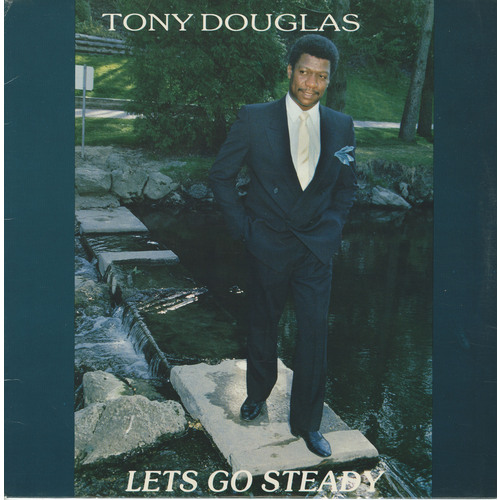
By the later 1980s, Douglas had moved into a more contemporary soul and dance sound. His album Lets Go Steady, issued on Devine Records, expanded the production around keyboards, saxophone, backing vocals and polished studio arrangements. The record included “Let Yourself Go,” “Midnight,” “Right Place Right Time,” “Leaving Me” and “How Can We Ease the Pain,” with production by Aubrey Winfield, Jim McGrath and Dan Durbin. The album connected Douglas to a wider Toronto studio network that included High Street Productions, Devine Records and musicians such as J. McGrath, T. Lewis, M. Starkman, J. Johnson, H. Koffman, E. Zeeman and Aubrey Winfield.
Although Douglas does not appear to have received major-label exposure, his known Canadian LPs document a strong independent vocalist working inside Toronto’s overlapping soul, reggae and Caribbean music communities. His recordings moved from romantic soul ballads and spiritual messages to upbeat dance grooves, preserving a little-documented corner of the city’s Black Canadian recording history.
Today, Douglas’s work survives mainly through scarce small-label vinyl releases, collector circulation and archival copies. Together, How Could I Let You Get Away and Lets Go Steady reveal a warm, earnest singer whose music reflects the ambition, faith and studio craft of Toronto’s independent soul scene.
-Robert Williston
Gallery
Images
3 images
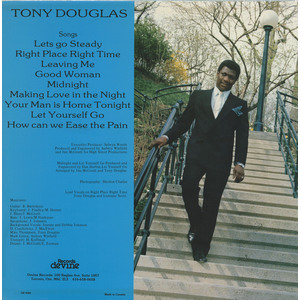
Tony Douglas - Let's Go Steady BACK
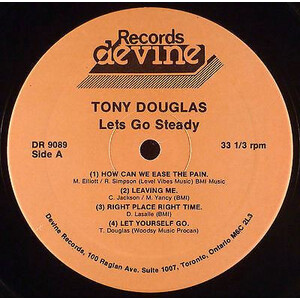
Tony Douglas (2) – Lets Go Steady
Lets Go Steady
Media
Videos
0 videos
No videos available for this title.
Credits
Musicians
Tony Douglas: lead vocals, backing vocals
Lorraine Scott: lead vocals on 'Right Place Right Time'
B. Bartolucci: guitar
J. Findley: keyboards
M. Horner: keyboards
J. Hues: keyboards
J. McGrath: keyboards, drums
T. Lewis: bass
M. Starkman: bass
J. Johnson: saxophone
Joanne Johnson: backing vocals
Debbie Johnson: backing vocals
H. Czechowicz: backing vocals
J. MacEwen: backing vocals
Mike Thompson: backing vocals
Mark Green: backing vocals
Aubrey Winfield: backing vocals
H. Koffman: trumpet
E. Zeeman: drums
Songwriting
'How Can We Ease the Pain' written by M. Elliott and R. Simpson
'Leaving Me' written by C. Jackson and M. Yancy
'Right Place Right Time' written by D. Lasalle
'Let Yourself Go' written by Tony Douglas
Production
Executive produced by Selwyn Woods
Produced and engineered by Aubrey Winfield and Jim McGrath for High Street Productions
'Midnight' and 'Let Yourself Go' produced and engineered by Dan Durbin
'Let Yourself Go' arranged by Jim McGrath and Tony Douglas
Artwork
Photography by Sherlon Charles
Companies
Devine Records, 100 Raglan Avenue, Suite 1007, Toronto, Ontario M6C 2L3
Made in Canada
No Comments